how to heat treat copper wire with dc current?

Thread Starter

dreamer44

Joined Nov 19, 2015
36
as shown above copper wire has a specific resistance per foot (and that changes based on temperature too)..
Hence I was inquiring about how long your wire was to show why the dimmer overheated..
There is a big difference in trying it with 2 inches of wire vs 3ft of wire
so you should just have asked... It was 3ft.
 

Thread Starter

dreamer44

Joined Nov 19, 2015
36
Ok, going from the chart by Dickcappels in post#13, the resistance at 500F(260C) would be Approx 160 ohms, so a 1 amp current will need 160V minimum.
OK, but we're talking about a hair-thin piece of wire here. Doesn't that play a role on determining the current?
 

alfacliff

Joined Dec 13, 2013
2,458
heat treating can be done with ac also, we do it all the time here.
I just looked up the resistance of copper wire, #45 should have a resistance of around 10,000 ohms per 1,000 feet. your 3 foot piece would be about 30 ohms. the ampacity of #32 wire, .008 inch diameret is .53 amp in free air. the ampacity of #45 wire is less, probably .3 amp max. since most copper wire is annealed anyway, why would you want to soften it again?
 

Thread Starter

dreamer44

Joined Nov 19, 2015
36
heat treating can be done with ac also, we do it all the time here.
I just looked up the resistance of copper wire, #45 should have a resistance of around 10,000 ohms per 1,000 feet. your 3 foot piece would be about 30 ohms. the ampacity of #32 wire, .008 inch diameret is .53 amp in free air. the ampacity of #45 wire is less, probably .3 amp max. since most copper wire is annealed anyway, why would you want to soften it again?
I'm sure it can be done with AC, but that creates other issues, such as safety for instance. Thanks for the information, but I'm still not clear about how to put all the things people are saying here together. The experiment is to find out how extra stages and intensities of heat treating can change certain characteristics of the wire.
 

Roderick Young

Joined Feb 22, 2015
408
OK, but we're talking about a hair-thin piece of wire here. Doesn't that play a role on determining the current?
Yes. The chart only gives the resistance, and only for that particular sensor in air. Doing a mind experiment, 1 amp at 160 volts cannot be the requirement. That's 160 watts, and a 500 °F temperature can easily be achieved by a 15-watt soldering iron, heating a much larger mass than a short length of #45 wire.

Just like heating your house in winter, I think [thermal] insulation would be the key to heating the wire without much power. Are you allowed to wrap the wire into a small coil shape (non-shorting), and put the whole works in a vacuum? That would cut down on convective losses, and oxidation, too.
 

Thread Starter

dreamer44

Joined Nov 19, 2015
36
Yes. The chart only gives the resistance, and only for that particular sensor in air. Doing a mind experiment, 1 amp at 160 volts cannot be the requirement. That's 160 watts, and a 500 °F temperature can easily be achieved by a 15-watt soldering iron, heating a much larger mass than a short length of #45 wire.

Just like heating your house in winter, I think [thermal] insulation would be the key to heating the wire without much power. Are you allowed to wrap the wire into a small coil shape (non-shorting), and put the whole works in a vacuum? That would cut down on convective losses, and oxidation, too.
no way I can't do that... I have limited resources here. What you said makes sense to me, but I'm still trying to understand how to actually do this. Dick Cappels suggestion seems the way to go so far. By the way, oxidation happens on the surface only, right? If so, it can be eliminated with a vinegar/salt bath. That's not an issue here.
 

mcgyvr

Joined Oct 15, 2009
5,394
I measured the voltage and it stays fixed at 12V.
Its a PWM dimmer.. It "dims" by turning the output voltage on and off quickly.. Your multimeter will read 12V because its not fast enough to see the waveform.
If your wire was an LED it would change the "brightness" because that LED would be turning on/off quickly and persistence of human vision will see that as a difference in brightness.
https://learn.sparkfun.com/tutorials/pulse-width-modulation

back to resistance
Set your meter to measure resistance and see what your 3ft of wire measures..
From the chart I found for 45 awg wire its 3348 ohms per thousand feet.. So 3 ft would be around 10 ohms..
With a 12V source that would be 12/10 = 1.2 Amps (at room temperature)

You need more voltage..
 

Thread Starter

dreamer44

Joined Nov 19, 2015
36
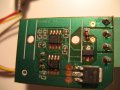
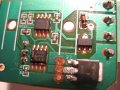
OK, but how do you explain the dimmer smoking when the knob is turned up?


Its a PWM dimmer.. It "dims" by turning the output voltage on and off quickly.. Your multimeter will read 12V because its not fast enough to see the waveform.
If your wire was an LED it would change the "brightness" because that LED would be turning on/off quickly and persistence of human vision will see that as a difference in brightness.
https://learn.sparkfun.com/tutorials/pulse-width-modulation

back to resistance
Set your meter to measure resistance and see what your 3ft of wire measures..
From the chart I found for 45 awg wire its 3348 ohms per thousand feet.. So 3 ft would be around 10 ohms..
With a 12V source that would be 12/10 = 1.2 Amps (at room temperature)

You need more voltage..
 

Dodgydave

Joined Jun 22, 2012
11,395
Its probably putting maximum voltage at its maximum current rating of the fet, and the fet cant cope with that short circuit current, at its pulsed frequency, better to use a DC psu with constant current limited to heat the wire.

Probably you will need to start with 2amps at 12V then as the wire heats up reduce the current, its trial and error, getting the right balance.
 
Last edited:

wayneh

Joined Sep 9, 2010
18,133
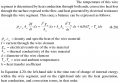
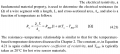
Here's an introduction to what you are dealing with. Some of the best work on hot wires was done by Langmuir in 1906, who applied his learning to the lightbulb. He invented the coiled tungsten filament and gas-filled (instead of vacuum) bulb. Take that, Edison. Later work comes from application of the Hot Wire Anemometer, an area you should study. Sorry I couldn't get these excerpts in text form, I had to take screen shots.

I still think the only way you will be able to estimate temperature of your wire in free air is to first measure the conductivity of your wire in a 500°F oven, and then assume the temperature of the wire is 500°F when it displays the same conductivity in your ohmic heating process. See 4.21 below.


Screen Shot 2015-11-20 at 10.30.10 AM.png

Screen Shot 2015-11-20 at 10.30.37 AM.png
 

DickCappels

Joined Aug 21, 2008
10,662
Just to add my 2 cents... It seems that this is the perfect time for an experiment!

I would use a constant current source and carefully creep up from a very low current. Definitely use a DC constant current source such as the ones recommended by Dodgydave or an LM317 connected similarly to the Instructables article. The reason to avoid your dimmer is that without know any particulars it is not clear whether the measured values are valid.

Unless you can get specific advice from somebody who's done this before you won't really know what to do until you start doing it (@alfacliff seems to be your go-to person for this).
 

wayneh

Joined Sep 9, 2010
18,133
The experiment is to heat treat with a DC current, not in an oven.
Says who?

Your wire will inevitably be in an "oven" - a temperature controlled chamber - no matter what you do. The only question is the temperature of the "oven". The experiment would actually be easier in empty space, where the only means of heat loss is radiation to a predictable void, and you don't have to worry about oxidation.
 

Thread Starter

dreamer44

Joined Nov 19, 2015
36
Just to add my 2 cents... It seems that this is the perfect time for an experiment!

I would use a constant current source and carefully creep up from a very low current. Definitely use a DC constant current source such as the ones recommended by Dodgydave or an LM317 connected similarly to the Instructables article. The reason to avoid your dimmer is that without know any particulars it is not clear whether the measured values are valid.

Unless you can get specific advice from somebody who's done this before you won't really know what to do until you start doing it (@alfacliff seems to be your go-to person for this).
Thanks a lot, Dick.
 
Top