hi Omri,
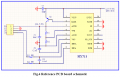
I have used a number of HX711's on different projects, I have found that just using the onboard regulator [ not an external transistor] gives accurate results.
Also, as it is ratio metric any small changes in the Vsup do not give weighing errors.
If you leave VSUP connected as your circuit, any quiescent current via the HX711 will shorten the battery life.
The DC DC quiescent current will also be in the order of 20uA for a high quality converter, I would suggest to rethink the battery capacity to suit the project.
hi Omri,
I have used a number of HX711's on different projects, I have found that just using the onboard regulator [ not an external transistor] gives accurate results.
Also, as it is ratio metric any small changes in the Vsup do not give weighing errors.
If you leave VSUP connected as your circuit, any quiescent current via the HX711 will shorten the battery life.
The DC DC quiescent current will also be in the order of 20uA for a high quality converter, I would suggest to rethink the battery capacity to suit the project.
Hi Eric,
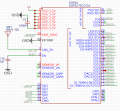
Thanks for the reply. Not sure if I got you but I don't have any regulators right now, I am the ESP32 chip only not a module.
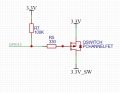
I disconnect VSUP from the circuit using QSWITCH, so no quiescent current from that side.
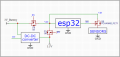
I know that DC-DC takes such current, that is why I want it to be shut down during sleep mode(see schematic below), meaning that during sleep mode the ESP32 will work on battery current and during active mode from the converter.
In active mode I am using 1 50-150mA current, I assume the diode will "ruin" my stable voltage out of the dc-dc converter.
Is there a way I can make it stable? some capacitors after the diode?
Perhaps a P-MOSFET across the diode and actively turn on the p-fet when using high current?
Remember when on mosfet conduct both ways so wire the p-fet so that it's internal diode
is the same direction / parallel to the external diode being bypassed. (Or perhaps the p-fet
could replace that diode).

 Facebook
 Google
 GitHub
 Linkedin