How to get rid of black stuff on circuit

dl324

Joined Mar 30, 2015
18,490
In Electrical Engineer with degree cannot make ICs? Dont have enough background hmmmm
Most electrical engineers don't know how to make IC's. Many/most of the people who do are physicists and chemists.

Most electrical engineers don't know how to convert a schematic to physical layout, and that's not their job.
 

Thread Starter

hhsting

Joined Apr 25, 2024
395
I'm sure you can but most likely if completely eliminated the circuit will have been destroyed as mentioned earlier.
I don't know of any chemicals to use but I suppose sanding might work.
Also lets say i have circuit on breadboard has three transistors, two diodes small one connected to function something lets say. How can I convert that circuit to one IC chip?
 

nsaspook

Joined Aug 27, 2009
16,503
Look at post #3. Yes, you can usually strip the epoxy out with careful milling until it's thin and the usage of dangerous acids and heat to clean off the remainder. If it's not destroyed, in the process you get a IC die with bonding wires connected to it.

A die that's usually completely useless as a model to build a discrete circuit using transistors and diodes from unless you have advanced IC analytical equipment to probe it layer by layer.
 

nsaspook

Joined Aug 27, 2009
16,503
Also lets say i have circuit on breadboard has three transistors, two diodes small one connected to function something lets say. How can I convert that circuit to one IC chip?
Sure, but do you at least have the equivalent, now old knowledge, of Jack Kilby and the resources of a small chemical lab with the necessary processing chemicals, gasses for doping and equipment go make the junctions and metal layers. Plus the need for bonding wiring and testing.
 

Jon Chandler

Joined Jun 12, 2008
1,654
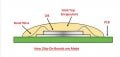
The black blob is called a COB or Chip On Board (tutorial here).

It contains the tiny silicon wafer contained inside standard IC packages, connected to the circuit board with bonded wires smaller than a human hair. To design one of these, an extremely pure silicon disk is etched with the patterns to make transistors, resistors, capacitors, etc. These are a few microns in size. After the silicon wafer is etched, it's cut to size in a clean room (imagine 1mm × 1mm or even smaller), and the bond wires are attached.

This is well beyond what can be done by a hobbiest, and even with tens of thousands of dollars of equipment is not easy.


Chip on Board

SmartSelect_20250308_182154_Edge.jpg


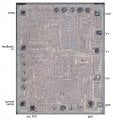
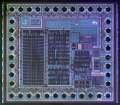
IC Die

die-labeled-pins2a.jpg
 

sghioto

Joined Dec 31, 2017
8,758
Also lets say i have circuit on breadboard has three transistors, two diodes small one connected to function something lets say. How can I convert that circuit to one IC chip?
You can't.
But it can be installed on a small as possible pc board now called a breakout board or module.:D
 

sparky 1

Joined Nov 3, 2018
1,218
To remove the glob top epoxy resin from a Chip on Board (COB) or "Blob top" IC, you can use the following methods12345:

  1. Hotplate method: Use a hotplate to heat the resin and make it easier to remove.
  2. Nitric acid method: Soak the IC in fuming nitric acid to dissolve the resin.
  3. Acetone method: Soak the IC in acetone to soften the resin.
  4. Rotary tool method: Use a rotary tool to grind away the resin.
  5. Scalpel and heat gun method: Use a scalpel and a heat gun to remove the resin without damaging the chip or bondwires.
 

WBahn

Joined Mar 31, 2012
33,315
Also lets say i have circuit on breadboard has three transistors, two diodes small one connected to function something lets say. How can I convert that circuit to one IC chip?
As a rule, you would hire someone that knows how to take your specification of what constitutes an acceptable solution to the problem that your discrete circuit solves and design a circuit that is suitable for IC fabrication that will solve the same problem to at least the same acceptable level. The schematic for the circuit on the IC may look nothing like the schematic for your breadboard circuit, because the strengths and weaknesses of discrete electronics and integrated electronics are significantly different.

This is a problem that we faced constantly when working with customers that had spent a great deal of time and effort developing a discrete circuit that did what they wanted. They often thought that all we needed to do was to replicate their circuit on an IC. Had we done that, the result would have been a chip that might not have even functioned, let along met anything close to the same performance level. Instead, we needed to start from the beginning with what the problem was they were trying to solve. Sometimes we could use a significant portion of their approach, but other times it truly was a start-from-scratch situation.

EEs that design integrated circuits design the schematics leveraging knowledge of the games you can and can't play on an IC. They then generally hand it off to the layout folks to do the artwork for the fabrication masks (similar to handing off a discrete design to a PCB layout person). For the type of projects we did, the engineer that designed the chip what the person that laid it out, because many of those same games that were reflected in the schematics required very careful attention to layout details.
 

BobaMosfet

Joined Jul 1, 2009
2,211
See attach pic. Black stuff is hard. I put solder gun on it for heat, dipped in nail posh remover and alcohol but it wont soften or get off. How do I get rid of the black round thing on circuit board to reveal the components underneath?
That's the actual IC. That is a 'BLOB' Chip. If you remove that, you can damage the delicate IC pinout if it ends up exposed. Why would you do this?
 

Tonyr1084

Joined Sep 24, 2015
9,744
I know enough to build circuits from transistors diodes etc. i know enough how they work. So why cant i make those circuits in an ics?
{taken from wikipedia https://en.wikipedia.org/wiki/Integrated_circuit}
An integrated circuit (IC), also known as a microchip or chip, is a set of electronic circuits on a small, flat piece of semiconductor material, usually silicon. It consists of various electronic components like transistors, resistors, and capacitors, interconnected. ICs are used in various electronic devices, such as computers, smartphones, and televisions, to process and store information. They’ve greatly impacted electronics by enabling miniaturization and enhanced functionality.

ICs are smaller, faster, and less expensive than discrete components, allowing for a large transistor count.

Their mass production, reliability, and building-block approach have led to the rapid adoption of standardized ICs. ICs are now used in virtually all electronic equipment, revolutionizing electronics. Computers, smartphones, and home appliances are made possible by the small size and low cost of ICs like modern processors and microcontrollers.
 

Tonyr1084

Joined Sep 24, 2015
9,744
The process of creating a "Chip" is called "Lithographics" where they literally put a chemical down then expose it to basically a schematic. It may take several layers of schematic to build a complete chip. Lithography is used because it can be greatly reduced in size. A single chip can have several thousand transistors on it, depending on size and need.

THEN that wafer or chip is cut from the disk where they made dozens of chips, possibly a hundred chips or more. That single chip (or die) has numerous points of connection. A machine takes a very very small wire and bonds it to the board and to the IC Package it is being installed into. None of this is anything a person can do because of the size of the chip and wires. This is not something a home hobbiest can do. Not without hundreds of thousands of dollars in equipment. THEN there's the need for an extreme clean room. It's just not something you or I, or anyone else here can do.

You ask about removing the black blob. You can't. Even if you can - you shouldn't. You'll ruin the chip. One reason why it's black and opaque is that light can affect how the circuit performs. A simple transistor junction can be turned on by light. Photo transistors rely on this action to make - um - photo transistors. IF you were to remove the black material without damaging the chip or its connections you will find it doesn't work. Simply because of light. Someone before me mentioned PhD's and Physicists or something like that. A simple LED works on a "Quantum" level. Not something the common home hobbiest would easily understand. Many of the members here may know how an LED works. Making one of your own - that's a totally different subject.

In short - you can't remove the blob. If you CAN - you don't want to. If you DO - you'll end up with something that doesn't work, and you won't have learned anything more than "You Can't."
 
Top