How to get 3.3V from a 5V wallwart PSU...? Please... :)

Thread Starter

Themusicman

Joined Apr 2, 2017
48
So sorry folks, I missed nearly all the replies on page 2 for some reason - didn't get the notification mail.

So, it does seem as though I can use a 5V charger!


Most (maybe even all -- I can't think of any exceptions) of my tool chargers have an integral cord and so you can't lose one with out losing the other. So I've been assuming that the TS only has the drill and has lost the cradle. I therefore also assumed that Alec_t meant that the only thing in the cradle are electrical contacts to the terminals on the screwdriver.

So I think we need two clarifications here:

@Alec_t : When you say the charger is only a mains to 4.5 Vac transformer, are you talking about everything up to and including the cradle, or just the part going from the wall to the cradle?

@Themusicman : When you say you can't locate the power supply, do you mean everything including the cradle, or just the part going from the wall to the cradle?
WBhan - I have the cradle, and approx 2M of cable coming from it, but not the wall wart - the cable seems to have been scagged and broken.
 

WBahn

Joined Mar 31, 2012
33,075
You cannot use 5VDC.
You need to use around 4.5VAC.
Or build an appropriate NiCad charger
We don't know if 5 Vdc will work or not. If the first thing inside the device is a rectifier, the 5 Vdc may well work just fine. If the first thing inside is a transformer, then it won't. I'm betting it's a rectifier.
 

Alec_t

Joined Sep 17, 2013
15,149
As the first thing inside the screwdriver is a rectifier diode (confirmed by the TS; my screwdriver has currently gone AWOL so I can't check inside mine :) ) then a 5VDC wall-wart and a suitably-sized series resistor could give the same average charge current as the B&D 4.5V transformer.
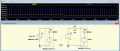
I've measured the transformer secondary resistance as 3.9Ω, and reckon a 8.2Ω series resistor should do the job.
AlternativeCharger.PNG
Of course, care would still have to be taken to avoid overcharging the battery, since this is not automatic.
 

WBahn

Joined Mar 31, 2012
33,075
It's a rectifier.
I am betting 5VDC will heat up the batteries.
But the rectifier likely has a filter cap that, unloaded, would bring the voltage up to the peak of ~6.3 V (and then less a diode drop) compared to the 5 V (and then less a diode drop).

If there's a regulator (don't know if there is or not) then that should insulate the batteries from a 10% increase in the input voltage.

Even if that weren't the case, a 10% increase in input voltage is probably allowed for in the design since power grid voltages around the world vary by at least that much from one another.
 

WBahn

Joined Mar 31, 2012
33,075
Yeabut....3 Nicads is 1.2*3= 3.6V
So? If 4.5 Vac (applied to a circuit that starts off with a rectifier) isn't going to overheat them when the screwdriver is left connected to the charger for an indeterminate length of time, then there must be some kind of circuitry in there to prevent that from happening. Why wouldn't it be reasonable to at least suspect that that same circuitry would prevent overheating when 5 Vdc is applied to that same circuit?
 

R!f@@

Joined Apr 2, 2009
10,007
I too say there must be a circuit. But according to @Alec_t there isn't but a single rectifier.
The B&D I got also had just one diode with 3 cells. The Adapter was missing, so I am not sure.
At 4.5VAC with a single diode, DCV is 2.025V. Way too low for 3 cells of 1.2V.

I went with what @Alec_t said since he had one of those..
I am saying a steady filtered 5V DC will be high.
What do you think ?
 

WBahn

Joined Mar 31, 2012
33,075
I too say there must be a circuit. But according to @Alec_t there isn't but a single rectifier.
The B&D I got also had just one diode with 3 cells. The Adapter was missing, so I am not sure.
At 4.5VAC with a single diode, DCV is 2.025V. Way too low for 3 cells of 1.2V.

I went with what @Alec_t said since he had one of those..
I am saying a steady filtered 5V DC will be high.
What do you think ?
How do you get that at 4.5 Vac that the DC voltage will be 2.025 V?

If all you have is a single diode then why wouldn't the output of the rectifier peak out at about 5.6 V? (4.5 V · √2 - 0.7 V)
 

R!f@@

Joined Apr 2, 2009
10,007
With a capacitor you are correct.
The B&D does not have a cap. Just a single diode connecting the xfmer secondary to the Nicads

In short 4.5VAC * 0.45 = 2.025VDC
 

WBahn

Joined Mar 31, 2012
33,075
With a capacitor you are correct.
The B&D does not have a cap. Just a single diode connecting the xfmer secondary to the Nicads

In short 4.5VAC * 0.45 = 2.025VDC
Why are you multiplying by 0.45?

If you hook up a 4.5 Vac signal to a 3.6 V battery through a series diode, then why wouldn't it try to charge the battery up to 5.6 V? On each cycle of the waveform the output is going to go above the battery voltage and pump some charge into it, thereby increasing the battery voltage. This will continue until either the battery charges up to a high enough voltage, namely 5.6 V, to prevent any current flowing even at the peak of the rectifier output, or leakage current (there's probably a more correct term for it) starts flowing through the battery to dissipate the energy without further charging of the battery, or something catastrophic happens.
 

Alec_t

Joined Sep 17, 2013
15,149
The sim I ran for post #49 shows that, when being charged by the B&D transformer, once the battery is fully charged (3.75V assumed) it is passing ~80mA average and is dissipating ~270mW . That is probably less than a C/10 charge rate, which should be sustainable for a lengthy period without much harm to the battery.
 

Attachments

R!f@@

Joined Apr 2, 2009
10,007
The (0.45) is for half wave rectifier without the capacitor.

Wait a sec....Does the battery acts as a capacitor after the diode ?
If so it will charge with 4.5VAC and @Alec_t is correct.

So I still believe 5VDC might over charge the battery.
 

WBahn

Joined Mar 31, 2012
33,075
The (0.45) is for half wave rectifier without the capacitor.

Wait a sec....Does the battery acts as a capacitor after the diode ?
If so it will charge with 4.5VAC and @Alec_t is correct.

So I still believe 5VDC might over charge the battery.
Why? The 5 Vdc will stop pushing current into the battery before the 4.5 Vac will.

Also, the 4.5 Vac is completely unregulated meaning that if mains voltage is higher, so will the output voltage. Is that 4.5 Vac the output at 110 Vac or 125 Vac? The 5 Vdc is regulated (though maybe not very well and there is the question of what it's output actually is when there is little to no load on it).
 
Top