How to extend bicycle horn time

Thread Starter

xox

Joined Sep 8, 2017
936
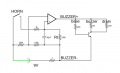
Reading over this thread got me thinking about a similar issue I have been having. Right now the horn for my bike is wired in such a way that it only beeps as long as the momentary switch is engaged. What I'd like to do is extend this so it sounds for roughly one second after the switch has been released. The factory circuit is a transistor driving an active buzzer and I want to keep all that, as is. I just want to disconnect the switch from that and feed it into a delay circuit which will then output a signal to the existing circuit.

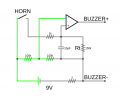
The design rather simple. When the switch is depressed, the 9V battery (which I have modeled here with an internal resistance of 2Ω) charges a capacitor through a 1K resistor. Once released, the charge is bled off by potentiometer/resistor Rt. Meanwhile a comparator goes HI and engages the horn until the voltage falls below 1/2Vcc. That's basically it.
delay.png

Now I don't have any comparators on hand. I was wondering if I can use an opamp instead? Otherwise, does everything look kosher?
 

MisterBill2

Joined Jan 23, 2018
27,159
Certainly this can be easily achieved. Simply a power mosfet transistor switch, with a capacitor to extend te on time by keeping the gate on some short RC time constant after the button is released.
I am more interested in what the need is for such a function. I have never before had anybody ask for a horn beep extender. That is certainly a new request.
 

Thread Starter

xox

Joined Sep 8, 2017
936
Certainly this can be easily achieved. Simply a power mosfet transistor switch, with a capacitor to extend te on time by keeping the gate on some short RC time constant after the button is released.
Thanks. I was hoping I wouldn't have to buy any extra parts and I already have a lot of opamps and BJT's. As I said before though, the existing circuit has a transistor that I want to leave in place.

I am more interested in what the need is for such a function. I have never before had anybody ask for a horn beep extender. That is certainly a new request.
It's just a minor annoyance really. Sometimes when I press the horn it only squawks for a split second because I've released the button too soon. This way I can just bump it with my finger to get a solid beep out of it.
 

AnalogKid

Joined Aug 1, 2013
12,043
Please post a schematic of the circuit the new delay circuit is to drive. What circuit's input requirements affect directly the design of a delay circuit.

ak
 

Thread Starter

xox

Joined Sep 8, 2017
936
Please post a schematic of the circuit the new delay circuit is to drive. What circuit's input requirements affect directly the design of a delay circuit.
IIRC it looked like just two resistors and an NPM transistor. A resistor to the base and one across the leads of the buzzer. One wire from the momentary switch goes to the positive of the battery and the other to the "top" of the transistor driver. Altogether it would amount to something like this:

circ.png

I didn't get the exact values of the resistors nor do I know the resistance of the buzzer; the values given are just estimates. (The circuit board itself is inverted and glued into the housing and I didn't want to break it apart to find out.) I'll take a look at it again tomorrow to see if I can read the stripes on the resistors as well as whether or not the buzzer has any markings on it.

From what I can tell though, since it's just expecting the full battery voltage I can simply wire it to the new circuit's output which will also be roughly 9V. No?
 

MisterBill2

Joined Jan 23, 2018
27,159
Now, a day later, I see that what you have is not the simple mechanical-buzzer bike horn that I am familiar with. So MY GUESS, and it is only a guess, is that the source of the issue is actually in the control button, and it's contact resistance. So the very first step would be to verify that the button switch makes an adequate contact with every press. Of course, I am also guessing that the installation is on a regular2-wheel bicycle and not on an electric powered mobility device. THAT would be a totally different discussion.
One additional consideration is that any circuit with an opamp or comparator is probably going to have a constant current draw that will be a drain on the battery. THAT may be an unintended problem.
One simple alternative would be one of the totally mechanical bells that are available.
 

Thread Starter

xox

Joined Sep 8, 2017
936
Okay, so I replaced the 1K resistor with a slightly smaller value to ensure that the capacitor gets fully charged for each cycle. Also ended up adding a small potentiometer inline with the discharge resistor and then superglued the tiny knob in place once I got the delay just right. To keep the circuit compact, I hard-wired all of the components together into the smallest possible form-factor, and since it doesn't need to dissipate much heat I went ahead and embedded the whole thing in hot glue!

I noticed that the beeping sound is somewhat crisper too. The entire circuit draws about 10 times less passive current (now under 1mA), a nice surprise. Overall I'm pretty happy with the way everything worked out. I took the bike for a fairly long test drive and the cold doesn't seem to effect it one bit either.
 
Top