How to determine the inductance of a coil ?

Thread Starter

q12x

Joined Sep 25, 2015
2,227
Request:
- How to determine the inductance of a coil ? Using a circuit and a formula. I have none of them, but Im thinking this must be something trivial for someone that learned this stuff in school (probably), or in life. If is not trivial, also tell me why.
Reason:
- I have a bunch of coils that I scrapped and for some of them, I have no idea what values they are. I recently build a circuit involving a coil, and I had to search and test my coils with a cheap inductance tester, that was not reading every coil I had. So that's why I need this. Is also good to have an alternative to my tool I already have. Especially for the coils this tool can not read, or that he gives me erroneous readings. Like that indecisive resistor-inductor result I get a lot from my tool, because he can see them both?, or something and then weird results perhaps. He also gives different results for the same coil. It is good to a point, is what I'm saying. So I really need a more reliable tool to check my tool results or to read what he could not read or got erroneous.
Thank you !
 
Last edited:
Thread Starter

q12x

Joined Sep 25, 2015
2,227
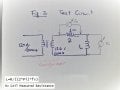
I find this link:
FYUUC19JNEVHHV9-circuit.jpg
Do tell me what you think about this method:
L=R/((2*Pi)*fv)
Steps
1) With the multi-meter set to Ohms, measure the resistance between the terminals of the inductor.
R= Coil Measured Resistance = 300.8R
2) see diagram of the circuit.
3) Connect the circuit without plugging it to the power outlet.
4) Set the potentiometer to its maximum value (this is good practice, you start by presenting the maximum
impedance to the power supply thereby minimizing the current, and move down the impedance from there)
5) Connect the circuit to the power outlet.
6) With the multi-meter set to AC voltage measure the Voltage between terminals of both the Resistor (VR) and the inductor (VL).
7) Move the potentiometer until the read of VR equals VL. See pictures (readings of 9.22V and 9.17V)
8) Turn off the power
9) Disconnect the potentiometer gently so you don't change its value.
10) With DMM set to Ohms measure the value of the potentiometer.
11) If the value read in 10 is more than 10 times bigger than the value read in 1 then add the inductor resistance
in the calculation. If it's not, you will need much more theory, mathematics and calculus to determine L.
12) Using the formula L=R/((2*Pi)*fv) you will get an approximate value for L.
In my case the potentiometer value was 4060 Ohms. L= 4060/(6.28*60Hz)= 4060/377= 10.77 H

Note 1:In my test I used a known inductor with the manufacturer label on it to show the validity of the method.
The sticker in the inductor reads: L = 9H +/- 15% with a winding resistance of R=300 Ohms.
Our measurement of internal resistance (step 1) was 300.8 and our L calculation comes very close to the upper
limit of the manufacturer specs which is 10.35 H.
 

BobTPH

Joined Jun 5, 2013
11,496
Very simplest method: Drive it with a square wave with a 1Ω resistor in series. Measure the Voltage across the resistor, which gives you the current in the inductor. The current will ramp up linearly and the slope the inductance.

dI / dt = V / L

L = V / (dI / dt)

Choose a frequency high enough to give a linear slope, i.e. where the voltage across the resistor is << voltage across the Inductor.
 

panic mode

Joined Oct 10, 2011
4,963
use correct units if you want correct results... in SI unit for time is 1 second, not 1 millisecond. you will measure time as accurately as possible (milliseconds or microseconds) but still need to scale it.
 

Thread Starter

q12x

Joined Sep 25, 2015
2,227
nope, is not working !
I tried the 1R method, reading the V across it as current, with 3 diferent DMM's, and no result.
I tried the DMM's set in Amperage mode and I can not collect the I in circuit. I tried with 2 DMMs set to mA and then to A, in alternative and in constant A mode. And nothing. No readings. The same behaviour in both DMMs.
I used my FNIRSI osc in fv generator mode. I can see the (distorted) waveform (because the coil in the path), or a clean waveform when just the probes touches. So at least this side is good.
 

MisterBill2

Joined Jan 23, 2018
27,402
Really, the method described in detail does not require measuring the current, but rather the voltage developed by the current across the variable resistor. So when the resistance equals the inductive reactance the resistance will equal the reactance plus the resistance.. With the setup shown, and 60Hz, that will work OK for inductors with fair amount of inductance. So it is a rather tedious method. And the math portion is subject to a lot of errors.
 

panic mode

Joined Oct 10, 2011
4,963
DMM? Ir is way too slow for this.
You need to take measurements on fly using suitable circuit. Or use different approach. An LC oscillator with known capacitance, followed by frequency counter to name one.
 

Art Vandelay

Joined Nov 1, 2024
140
If you have a scope, a quick way is to measure the frequency of the resonance peaks using the formula:

f = 1 / (2π √ (L * C))

For example, with a 10mH inductor and 1uF cap we get:

f = 1 / (2π √ ((1 * 10^-2) * (1 * 10^-6))) = 1591Hz

Solving for unknown inductance we get:

1591Hz = 1 / (2π √ (L * (1 * 10^-6)))

1591Hz^2 = ((2π)^2) * (L * (1 * 10^-6))

L = 1 / ((2π * 1591Hz)^2 * (1 * 10^-6)) = 0.01H = 10mH

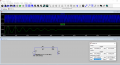
There are other formulas but this one is good for understanding how to manipulate the algebra. I like to use a lot of brackets to keep things sorted. Here's a basic simulation to demonstrate the concept:

res.png

You can also build a reasonable LC meter using an Arduino Uno and a high speed comparator. The resolution isn't very good but it can give a decent approximation. Give this guide a try: https://www.instructables.com/Inductance-Meter-Using-Arduino/
 

Art Vandelay

Joined Nov 1, 2024
140
I forgot to include 1 / in step 2. It should be:

1591Hz = 1 / (2π √ (L * (1 * 10^-6)))

1591Hz^2 = 1 / ((2π)^2) * (L * (1 * 10^-6))

L = 1 / ((2π * 1591Hz)^2 * (1 * 10^-6)) = 0.01H = 10mH
 

MrAl

Joined Jun 17, 2014
13,693
Request:
- How to determine the inductance of a coil ? Using a circuit and a formula. I have none of them, but Im thinking this must be something trivial for someone that learned this stuff in school (probably), or in life. If is not trivial, also tell me why.
Reason:
- I have a bunch of coils that I scrapped and for some of them, I have no idea what values they are. I recently build a circuit involving a coil, and I had to search and test my coils with a cheap inductance tester, that was not reading every coil I had. So that's why I need this. Is also good to have an alternative to my tool I already have. Especially for the coils this tool can not read, or that he gives me erroneous readings. Like that indecisive resistor-inductor result I get a lot from my tool, because he can see them both?, or something and then weird results perhaps. He also gives different results for the same coil. It is good to a point, is what I'm saying. So I really need a more reliable tool to check my tool results or to read what he could not read or got erroneous.
Thank you !
Hi,

What kind of coil are you talking about here? Does it have an air core or magnetic core?

Testing an air core coil is kind of straightforward, but testing one with a core is much harder.

There are formulas all over the web for calculating the inductance of an air core coil.
The derivation of one of these formulas involves considering the inductance of every turn and can get kind of geometrically complicated.
 

Thread Starter

q12x

Joined Sep 25, 2015
2,227
So, I tested my circuit and explanations in my #2 post that I find.
It still didn't worked. Because I got into very small resistors and high wattage to accommodate that balance in voltage he is speaking about. My balance was 1.6VR and 1.6VL using a 1.5R @5W. I couldn't use a pot because it started smoking, literally. I moved quickly and I didn't let it burn out but it is 'touched' now, still works but.. 'touched'. So I did it the old fashion way, manual resistor changing.
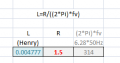
Next, after I calculated the thing, I got a 0.0047 H ,which is 4.7mH.
1730864331897.png
But I used a known value inductor with its value written on it (I have very few of these) - because all are scrapped.
And my inductor is 2.5mH ! So the measured + calculated value is practically double than the real thing. Aaah.
- The author it is giving a warning that I could not understand but must certainly it applies to what I did here -probably:
11) If the value read in 10 is more than 10 times bigger than the value read in 1 then add the inductor resistance
in the calculation. If it's not, you will need much more theory, mathematics and calculus to determine L.

Well, shit !
What kind of coil are you talking about here? Does it have an air core or magnetic core?
Good question and I forget to specify it in the OP.
Im having all sorts of coils, all scrapped and different dimensions and shapes. Many are looking like a very small transformer, but is only 2 wires linked to 2 pins only, the other 2 or 1 (so 4pins or 3 pins small looking transformer) are just for show, or most probably for soldering stability of the component.
The large majority of them are with ferrite core E+E or E+I(probably), also donuts O core, and straight full cylinder core. Quite a diversity of them. I even have with transformer steel core 2 or 3, again very small, and probably some air core but I have to look for them since they dont stand out as few as I have. Again the very large majority are ferrite core.
 
Last edited:

MrAl

Joined Jun 17, 2014
13,693
So, I tested my circuit and explanations in my #2 post that I find.
It still didn't worked. Because I got into very small resistors and high wattage to accommodate that balance in voltage he is speaking about. My balance was 1.6VR and 1.6VL using a 1.5R @5W. I couldn't use a pot because it started smoking, literally. I moved quickly and I didn't let it burn out but it is 'touched' now, still works but.. 'touched'. So I did it the old fashion way, manual resistor changing.
Next, after I calculated the thing, I got a 0.0047 H ,which is 4.7mH.
View attachment 335180
But I used a known value inductor with its value written on it (I have very few of these) - because all are scrapped.
And my inductor is 2.5mH ! So the measured + calculated value is practically double than the real thing. Aaah.
- The author it is giving a warning that I could not understand but must certainly it applies to what I did here -probably:
11) If the value read in 10 is more than 10 times bigger than the value read in 1 then add the inductor resistance
in the calculation. If it's not, you will need much more theory, mathematics and calculus to determine L.

Well, shit !

Good question and I forget to specify it in the OP.
Im having all sorts of coils, all scrapped and different dimensions and shapes. Many are looking like a very small transformer, but is only 2 wires linked to 2 pins only, the other 2 or 1 (so 4pins or 3 pins small looking transformer) are just for show, or most probably for soldering stability of the component.
The large majority of them are with ferrite core E+E or E+I(probably), also donuts O core, and straight full cylinder core. Quite a diversity of them. I even have with transformer steel core 2 or 3, again very small, and probably some air core but I have to look for them since they dont stand out as few as I have. Again the very large majority are ferrite core.
Hi,

Ok than I got some bad news for ya :)

First, the more complete formula is this:
L=(R*sqrt(E-vR)*sqrt(E+vR))/(2*pi*f*vR)
where
E is the peak applied AC voltage, and
vR is the peak voltage across the resistor.
(I say 'peak' voltage here but you can use RMS values, as long as you do both voltages with the same units).
Now if you are 'balancing' the applied voltage E and the voltage across R such that they are equal, then the formula boils down to:
L=(sqrt(3)*R)/(2*pi*f)
Note the sqrt(3) factor in there, which increases the R/(2*pi*f) part.

What this means is if your resistor is really 1.5 Ohms and the inductor really is 2.5mH, then with an applied voltage E of 1 volt peak you should see 0.886 volts peak across the resistor R when the frequency f is 50Hz.

What you should do is measure the voltages and and report them here.
The more complicated formula allows you to use a lower voltage for the voltage across the resistor. However, you should be able to do that by lowering E too.

This will obviously result in a value of around 8mH for your inductor, or so it seems, so the stamped value on the inductor may either be wrong or it requires a certain DC current to reach that lower value. That brings us to the next issue, the DC current.

When a coil has a magnetically active core, the inductance can vary depending on the DC current. As you increase the DC current the inductance usually drops. If you go up really high, the inductance may drop to almost nothing, and so for this test you would be measuring the resistance of the bare coil more than the inductance (except the formula would not be correct to get the right result for that either).

So try this again, and see if you can lower the current, and report the measurements not the conclusions and we can take another look.
 

Thread Starter

q12x

Joined Sep 25, 2015
2,227
f = 1 / (2π √ (L * C))
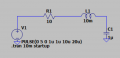
1730881854087.png
I build your circuit, And it didn't work !
I used an AC transformer with 7.8VAC output, that will give me a sinusoid AC waveform and a constant fv of 50Hz .
I used a 10R in series as you used it in your schematic - but you forgot to include it in your formula !
I used a 100nF film cap at 400V because I have a lot of them and I dont have so many 1uF nonpolarized like you drew in your cct. And this smaller value should not be a problem.
So it didnt worked because your formula needs another variable, like a voltage to be taken from somewhere, is my best guess. Because, in this current state, I can swap any inductor value and the result will be always the same. Do you see the problem? All you have here are constants. The VS, R, C, fv, all of them are constants. So you really need a variable in your function, to solve this other (inductance) variable that Im changing for reading. I hope it is clear for you.
 

meth

Joined May 21, 2016
303
From my experience, I have used RLC circuit and variable frequency source to determine the value of L. Change the frequency and see on which frequency you get the highest voltage on the inductor. That is the resonant frequency of your circuit. From there you can use the mentioned formula to determine L.
 

Art Vandelay

Joined Nov 1, 2024
140
View attachment 335191
I build your circuit, And it didn't work !
I used an AC transformer with 7.8VAC output, that will give me a sinusoid AC waveform and a constant fv of 50Hz .
I used a 10R in series as you used it in your schematic - but you forgot to include it in your formula !
I used a 100nF film cap at 400V because I have a lot of them and I dont have so many 1uF nonpolarized like you drew in your cct. And this smaller value should not be a problem.
So it didnt worked because your formula needs another variable, like a voltage to be taken from somewhere, is my best guess. Because, in this current state, I can swap any inductor value and the result will be always the same. Do you see the problem? All you have here are constants. The VS, R, C, fv, all of them are constants. So you really need a variable in your function, to solve this other (inductance) variable that Im changing for reading. I hope it is clear for you.
No other variable is needed because you are looking for the frequency at which the series resonant circuit "rings". It will be more intuitive to use a square wave because the frequency and amplitude of the square wave shouldn't matter.

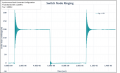
Take a look at this image, notice how the circuit rings on both the high-to-low and low-to-high transitions of the square wave. In fact, you'll always see some ringing in every circuit due to this phenomenon unless there is circuitry to compensate for it. It's most obvious in response to a square wave with sharp transitions.

In this particular case, the amplitude on the low-to-high transition is a lot greater. Even though the amplitude of the ringing attenuates, the frequency of the ringing itself remains constant, which is the frequency used in the formula I provided. Zoom into the ringing and measure the frequency between any two peaks. Put the scope probe between the capacitor and inductor.

Basically, the ringing is energy that is being reflected back and forth between the inductor and capacitor. It eventually attenuates due to resistive losses in the circuit but an ideal circuit would ring forever.


1.png
 
Last edited:

Thread Starter

q12x

Joined Sep 25, 2015
2,227
Change the frequency and see on which frequency you get the highest voltage on the inductor. That is the resonant frequency of your circuit.
- Still, didn't work.
When Im connecting the signal generator probes to the osc probes, both from FNIRSI device, the Vpp that is measured, is literally garbage. It jumps to 2mV to 130mV to 33mV and so on, very random and very frequent. Not stable or predictable at all. I turned all the knobs I could, the vertical and the horizontal, and nothing, It has some moments of stabilization but if Im changing something it goes nuts so this way is impractical !
- I connected the osc probes across inductor, and it stabilized somehow, compared with the madness before, but still way too jumpy, and is just crazy to read all that random voltage, true at a smaller range than before but still, crazy jumpy. I cant do this kind of reading. At least with the FNIRSI osciloscope and its fv generator 2in1. All this was connected on a breadboard ! not in air. If I connect osc probes to sig gen probes in air, I get a better result, but I cant use the circuit in this way.
- Next, I tried something else. I leave the signal generator hooked in the circuit and added a DMM set to V across inductor. And I changed from VAC to VCC and on both 0V was displayed. I also changed the waveform to sinusoid, then to squarewave 50% duty, and still nothing.
I do believe you are doing it like you explained but you must show me more details on how exactly you are using your tools and what settings and what result you expect to receive. Pictures and explanation of what you did. If possible, of course. It might be possible you simply have better tools than this FNIRSI I have that might not be cut to do this kind of measurments. Its a possible explanation why it didnt work in my side.
Hmmmm
 
Last edited:

meth

Joined May 21, 2016
303
- Still, didn't work.
When Im connecting the signal generator probes to the osc probes, both from FNIRSI device, the Vpp that is measured, is literally garbage. It jumps to 2mV to 130mV to 33mV and so on, very random and very frequent. Not stable or predictable at all. I turned all the knobs I could, the vertical and the horizontal, and nothing, It has some moments of stabilization but if Im changing something it goes nuts so this way is impractical !
- I connected the osc probes across inductor, and it stabilized somehow, compared with the madness before, but still way too jumpy, and is just crazy to read all that random voltage, true at a smaller range than before but still, crazy jumpy. I cant do this kind of reading. At least with the FNIRSI osciloscope and its fv generator 2in1. All this was connected on a breadboard ! not in air. If I connect osc probes to sig gen probes in air, I get a better result, but I cant use the circuit in this way.
- Next, I tried something else. I leave the signal generator hooked in the circuit and added a DMM set to V across inductor. And I changed from VAC to VCC and on both 0V was displayed. I also changed the waveform to sinusoid, then to squarewave 50% duty, and still nothing.
I do believe you are doing it like you explained but you must show me more details on how exactly you are using your tools. Pictures and explanation of what you did. If possible, of course. It might be possible you simply have better tools than this FNIRSI I have that might not be cut to do this kind of measurments. Its a possible explanation why it didnt work in my side.
Hmmmm
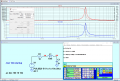
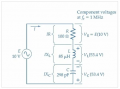
Here is an example of a circuit in resonance:
1730891988767.png
At any other frequency the voltage across L would be lower:
1730892063972.png
These measurements aren't mine, they are from an article but resonance should work like this 100%.
I don't have anything else to suggest except that you might be WAY OFF with your test frequency, or your inductor might be short circuited (if it is a single inductor you are trying to measure).
 
Top