How to control landscape lights with solar detector?

Thread Starter

hhsting

Joined Apr 25, 2024
395
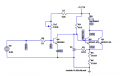
The attached circuit V2 and B1 are modeled as a solar panel. So, when it's 0.8V at v2, then B1 gives the current accordingly. The solar panel acts as a sensor to turn the LED light on/off, which is modeled as XB-DWHT. The B2 is a 9V battery model, and the V1 is a constant 12.5VDC source, which powers the LED and the rest of the circuit.

I constructed this circuit, and in real life, when my solar panels are not connected to the circuit, it gives 0.8V at a certain light level. At the same light level when the solar panel is connected, the solar panel shows a voltage drop to 0.3V, and the circuit doesn't operate as it should, and doesn't turn off the light. The LED light should go off when the solar panel is not connected, with a light level of 0.75V, but when connected to the circuit, the voltage is so it doesn't turn off the light. What can be done to operate it correctly with solar panel as sensor?
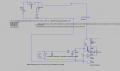
1768165976451.png
 

Attachments

AnalogKid

Joined Aug 1, 2013
12,043
Many of your resistor values are too low and are causing unnecessary loading.

The schematic shows V1 as 6.2 V, but the text says it is 12.5 V. If the latter, then Q7 always is reverse-biased, and B2 never posers anything.

Connecting Q1 and Q5 in dir3ect parallel does not work in the real world. If you need to control too much current for a single transistor, use a bigger transistor.

" it gives 0.8V at a certain light level. " - What does? Your descriptions of the desired and actual circuit operations are not clear.

What is it you are trying to achieve? If what you want to do is turn the LED off when it is light outside, your circuit is overly complex for that task.

How many solar panels are there? If more than one, why?

ak
 

Thread Starter

hhsting

Joined Apr 25, 2024
395
Many of your resistor values are too low and are causing unnecessary loading.

The schematic shows V1 as 6.2 V, but the text says it is 12.5 V. If the latter, then Q7 always is reverse-biased, and B2 never posers anything.

Connecting Q1 and Q5 in dir3ect parallel does not work in the real world. If you need to control too much current for a single transistor, use a bigger transistor.

" it gives 0.8V at a certain light level. " - What does? Your descriptions of the desired and actual circuit operations are not clear.

What is it you are trying to achieve? If what you want to do is turn the LED off when it is light outside, your circuit is overly complex for that task.

How many solar panels are there? If more than one, why?

ak
One small for landscape light. It is the one solar panel. I want solar panel to turn light on and off. When above 0.75V solar panel light off. Thats the goal. That 6.2VDc should be 12.5vdc. When V1 goes out primary source from 120V outlet then B2 takes over to power the led.
 

sghioto

Joined Dec 31, 2017
8,633
Why not use a LDR instead of a solar panel to activate the light?
Oh wait, I forgot you are modifying an existing landscape light.
Isn't this about the 4th thread on this project?
Still insisting on no ICs or micros?
 
Last edited:

Thread Starter

hhsting

Joined Apr 25, 2024
395
Hello,

Also the resistors have very strange values.
Why not stick to standard E-series values?

Bertus
Those are actual measured values of resistor I have. So for example 10 ohms resistor I have actually measures 9.9 ohms etc etc
 

Thread Starter

hhsting

Joined Apr 25, 2024
395
Why not use a LDR instead of a solar panel to activate the light?
Oh wait, I forgot you are modifying an existing landscape light.
Isn't this about the 4th thread on this project?
Still insisting on no ICs or micros?
Where can I put LDR? No room to put it in on existing landscape light. If I did not sure how to use it anyway in the post #1 circuit.
Everything is good. All items except the sensor part which is the solar panel which is the problem as mentioned in post#1
 

sghioto

Joined Dec 31, 2017
8,633
With no panel connected the voltage at no12 should be zero.
Are you sure Q4 is connected correctly?
Connect a 10K resistor from no12 to ground to provide reverse bias for Q4.
 

sghioto

Joined Dec 31, 2017
8,633
Huh? Not sure what your saying and how it resolves the problem post #1?
OK my mistake I misread the post.
With no load on the solar panel the voltage will read higher at the same light level.
Q4 and R2 are the load when the panel is connected. Try increasing R2 to 1K to start.
 

Thread Starter

hhsting

Joined Apr 25, 2024
395
OK my mistake I misread the post.
With no load on the solar panel the voltage will read higher at the same light level.
Q4 and R2 are no load when the panel is connected. Try increasing R2 to 1K to start.
Increasing resistor will decrease current and it wont drive bjt Q4 i think.

So under no load solar panel gives 0.8V but when i connect to circuit load changes to 0.3V. When I shine so much light on it when connect to circuit it shuts off the light. If i measure that light I shine under no load of the solar panel thats like 2V. So my problem is corcuit womt turn off even good amount of daylight.
 

sghioto

Joined Dec 31, 2017
8,633
It will not damage the panel talking about micro amps.
BTW I posted a circuit about this project back in Sept 2024, what happened with that?

1768177610206.png
 

Thread Starter

hhsting

Joined Apr 25, 2024
395
It will not damage the panel talking about micro amps.
BTW I posted a circuit about this project back in Sept 2024, what happened with that?

View attachment 361898
It will i tried that before.

i got TL431AB. Your circuit will have temperature affect and de stablizes voltage. I have no questions about that part of the circuit.

only in post #1 about solar panel
 

Thread Starter

hhsting

Joined Apr 25, 2024
395
If you are so sure about that then just change R2 to 1K and see if that works better.
In simulation it delays the closing of the light not sure how it works in real life though. I dont see why it would work q4 has to be driven by solar panel it needs enough current to drive other loads.
 
Top