How to check amps through a heater?

Thread Starter

rambomhtri

Joined Nov 9, 2015
606
Hi,

I have this little heater with a fan, rated 2 kW, that has 4 positions: fan only (for summer), and fan + heat (low, middle and high). Im in Europe and it gets plugged directly to the wall, 240V.

I have a MASTECH MS8229 multimeter that can read up to 10A. If I'm not wrong, the max setting should draw like 2000/240 = 8 amps. I want to use my multimeter to check how much it draws in each setting, but the problem is I need to open the circuit and put the multimeter in series with the heater. I don't know how to do this properly, and I wanted to know if any of you can give me a tip about an easy way to do this.

I can put one lead inside one of the holes of the wall, the other attached to one pin of the hater cable, then put a cable in the other hole of the wall, attached to the other pin of the heater cable. Problem is I don't find this very safe, I don't know what cable I can use that can support 8 amps, and I think you guys can suggest a better solution. I wish I had an amp clamp...

Thank you!
 

mcgyvr

Joined Oct 15, 2009
5,394
Since you do not feel that you can safely do this yourself I must ask..
What are you going to do with the current reading once you have it?
You either need the heat or you don't.. and it surely draws more with the heater on vs the fan but so what..

An amp clamp also requires you to loop around 1 single conductor also..
 

Thread Starter

rambomhtri

Joined Nov 9, 2015
606
Once I have the current reading I will create the Death Star and form my own empire.

Hahaha, it's just simply to know experimentally the real values and also I want to know how much power each setting has.
 

mcgyvr

Joined Oct 15, 2009
5,394
Well.. you will need to either buy a killawatt type device or make your own adapter cable that will allow the meter to be inserted in series with one of the heaters wires..

If you buy a male and female connector, some wire and some test points to stick your meter probes into you can make your own "safer" device..
OR use caution and cut one wire on the heater and then tie/tape the ends up to put the meter in series.. Use Caution..
 

Dodgydave

Joined Jun 22, 2012
11,395
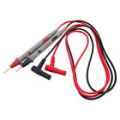
Yes to measure Amps your meter goes in Series with the load, so i would use 10Amp leads with crocodile clips on a mains plug or as you quoted.
Set your meter to A~, and use the 10A socket and Black Com.
 

Thread Starter

rambomhtri

Joined Nov 9, 2015
606
That's exactly what I was going to do yesterday, but suddenly I thought...

What if the crocodile cables can't handle 8A?

I have these crocodile little clamps with the tiny cable, that I use a lot when working on electronics, where the amps are measured in milli or even less, and voltages go from 5V up to 12V.

So I thought twice and aborted mission. Why don't cables have printed the max amps they can handle?
There should be a law...
 

DickCappels

Joined Aug 21, 2008
10,661
For this sort of thing, don't take the cheap route. Make a fixture that is basically an extension cord and insert your meter in series with the load. Be sure to insulate everything and endeavor to be sober and mindful of every action when using this contraption.
 

Thread Starter

rambomhtri

Joined Nov 9, 2015
606
Ok, thanks.

So I plan to do this... you tell me what you think

Buy a male-female wall plug that looks nice. Then open the plastic/insulator cover cable, take one of the cables, cut it and attach something where I can put my leads safely. Job done. I could use this to measure the amps of any machine, that sounds amazing.

I'd like to cut the "grounded" wire, not the hot wire. This way, if somehow I touch the attached thing that exposes the wire I'd be touching 0V instead of 240V, right?

Problem is... which one of the two holes is the hot wire?
I guess it's the left one, but I'm not sure. Also is it standardized, or you can find "bad" jobs where the incompetent electrician swapped the wires?

Also... any ideas of what can I attach to the cut wire so I can have 2 safe spots to put the leads safely but also comfortably?
A 2-way terminal block sounds good. There's a problem though, it's that I would need to use my 2 hands to make sure the contact of each lead is correct. The leads would be inestable and would need each one my constant hand help to press them against the walls of the terminal block. I'm looking for a hand free attach.

Is there a "device" or a thing to insert a multimeter lead so it makes solid contact?
Something like a terminal block which end is a tiny hole where you can insert the lead.
 
Last edited:

LesJones

Joined Jan 8, 2017
4,511
You could get a pretty good idea of the currents just by taking resistance measurments. (This would not take into account that the resistance of the elements increase with temperature.) Measure the resistance between the power leads on the plug in each of the 4 positions of the switch. Fan only, low heat medium heat and high heat. The first reading gives you the resistance of the fan. The three other readings are the resistance of the fan in parallel with the heater element. As you now know the resistance of the fan and the resistance of the element in parallel with the fan you can now calculate the resistance of the element and therfore the current through the element. (NOTE you can't calculate the current the fan takes from it's resistance as the inductive reactance of the winding that will be the main factor in controlling it's current.)
In case you can't work out resistors in parallel.
Re = (Rr x Rf)/(Rf - Rr)
Re is resistance of the element
Rf is the resistance of the fan
Rr is the resistance reading in each of the 3 heat settings.

Les.
 

Thread Starter

rambomhtri

Joined Nov 9, 2015
606
So, the fan is 1300 Ohm, the other readings are something like...
I: 62 Ohm
II: 49 Ohm
III: 26 Ohm

So, if I'm not wrong...

The fan alone draws 240/1300 = 0.18 A, which means it has 43W, makes sense.

The problem is the resistances. Your formula is wrong I think, ¿should not be that a + instead of a - ?

If I do 240/26 I get 9.2 A, that's 2.2 kW, not 2 kW. ¿Is that a valid error by the manufacturer or these quick formulas are making some simplifications that can lead up to 200W of error?

Thank you, reading the resistance was something I did not think about, what a shame. Anyway I still want to read the amps since it's something I've never done in regular machines (120-240V), and also I will have an exact value of the amps.
 

R.E.

Joined Jul 29, 2017
56
Ok, thanks.

So I plan to do this... you tell me what you think

Buy a male-female wall plug that looks nice. Then open the plastic/insulator cover cable, take one of the cables, cut it and attach something where I can put my leads safely. Job done. I could use this to measure the amps of any machine, that sounds amazing.

I'd like to cut the "grounded" wire, not the hot wire. This way, if somehow I touch the attached thing that exposes the wire I'd be touching 0V instead of 240V, right?

Problem is... which one of the two holes is the hot wire?
I guess it's the left one, but I'm not sure. Also is it standardized, or you can find "bad" jobs where the incompetent electrician swapped the wires?

Also... any ideas of what can I attach to the cut wire so I can have 2 safe spots to put the leads safely but also comfortably?
A 2-way terminal block sounds good. There's a problem though, it's that I would need to use my 2 hands to make sure the contact of each lead is correct. The leads would be inestable and would need each one my constant hand help to press them against the walls of the terminal block. I'm looking for a hand free attach.

Is there a "device" or a thing to insert a multimeter lead so it makes solid contact?
Something like a terminal block which end is a tiny hole where you can insert the lead.
Never cut the ground wire, never leave exposed 220V wires dangling about, buy this; https://www.amazon.co.uk/slp/watt-meter/8sfj9w7j6s8m73o

Here is a little ditty about wiring and colours, never switch Neutral, don't disconnect the Ground, respect the Hot wire; https://www.rospa.com/home-safety/uk/northern-ireland/electricity/plugs-fuses/wiring-plugs/
 
Last edited:

DickCappels

Joined Aug 21, 2008
10,661
Underlining for emphasis added by DickCappels. Some text removed for clarity.

I'd like to cut the "grounded" wire, not the hot wire. This way, if somehow I touch the attached thing that exposes the wire I'd be touching 0V instead of 240V, right?

Problem is... which one of the two holes is the hot wire?
I guess it's the left one, but I'm not sure. Also is it standardized, or you can find "bad" jobs where the incompetent electrician swapped the wires?

Also... any ideas of what can I attach to the cut wire so I can have 2 safe spots to put the leads safely but also comfortably?
A 2-way terminal block sounds good. There's a problem though, it's that I would need to use my 2 hands to make sure the contact of each lead is correct. The leads would be inestable and would need each one my constant hand help to press them against the walls of the terminal block. I'm looking for a hand free attach.


Is there a "device" or a thing to insert a multimeter lead so it makes solid contact?
Something like a terminal block which end is a tiny hole where you can insert the lead.
This written with the idea that you will make a current measurement dongle cable -connectors at each end so you can work on it while it is completely disconnected from the power line and the appliance. It may be much better to use two separate wires of the proper cross sectional area so you can cut one in the middle and not have to worry about opening the plug's shell.

As R.E. said in his post above, never cut the ground wire, it is there to protect you in case of a wiring error or a failure.

Going by the information to which R.E.linked in his post above, assuming you have a polarized plug, put your meter leads on the wire that is most likely Line (hot). The fact that the meter is fully insulated, as should both of the wires (in some types of connections one wire is Neutral, in others there is no neutral. Everything being insulated means that which conductor you are measuring it is not important. Avoid the terminal block and just splice wires together, that way all you have to worry about insulating is the splices.
upload_2018-2-27_15-48-34.png
For attaching the meter, I have used digital voltmeter leads that have plastic sheaths that protect the user from an exposed banana plug (yes, that is what it is called) in case the plug is accidentally pulled out while the circuit is energized. These are molded assemblies so there are no exposed conductors other than where you cut the wires. I cut off the probes and just use the wires and plugs.

When you go to use the dongle unplug it from everything then plug in your meter. After the meter is plugged in, plug in the appliance then plug the other end into the wall.

Accuracy

The measurement that corresponds to the heater element power will be accurate on a (good) current meter. The part of the load corresponding to the fan motor will have a small error because the fan is not a purely resistive load. To improve the accuracy use a meter that measures true RMS current. Most likely the heater element current will be far greater than the error in fan current measurement, so you probably don't have to worry about this. I am just including it for completeness.
 

LesJones

Joined Jan 8, 2017
4,511
62 ohm reading
(1300 x 62)/(1300-62) = 180600/1238 = 65.1 ohms
So the current will be 240/65.1 = 3.69 amps
So the power will be 240 x 3.69 = 885.6 watts

I will leave you to do the other two calculations.
Bear in mind that the actulal current will be a bit less than this as the resistnce of the element will be slightly higher whan hot. You could taking the reading quickly after it was switched off to get a more accurate value.

Les.
 

Janis59

Joined Aug 21, 2017
1,894
RE: ""Im in Europe and it gets plugged directly to the wall, 240V""
In the Europe is not a 240 Volts. Here is 220 Volts except the England what had voted that is willing not be anymore part of Europe. UK indeed has 240V.
And this partially may produce a wonderworks sometimes, as (240/220)^2=1,2 fold of power to what the appliance was created. 2 kW increase to 2,4 kW etc. Sometimes ok, sometimes not.
 

Thread Starter

rambomhtri

Joined Nov 9, 2015
606
Sorry, as English is not my main language I have hard time describing correctly the cables or specific terms.

1. By "grounded cable" I meant the cable that is shorted with ground, not ground itself. You have 3 wires in high power machines: hot/live wire, ground and the other that I call "grounded cable" (may be it's called neutral?). So I was talking about cutting the "grounded cable", the one shorted with ground, which is at 0V, like ground itself.

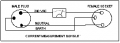
2. I'm quite positive it varies a lot in Europe between 220-240V, indeed my heater accepts 220-240V. In other words, manufacturers take into account that the voltage may vary from 220-240V even inside the same country, so it doesn't really matter if it's 220V, 230V or 240V. I don't have the UK plug (type G), I have the regular EU plug (type F):
 

DickCappels

Joined Aug 21, 2008
10,661
I think the answer is "yes":). Neutral is grounded at the distribution transformer so it probably what you call "grounded cable".
If you make a dongle that can be completely unplugged there is no advantage to cutting the neutral over cutting Line (the one with voltage on it).

Earth ground is there to be used for safety only. If you cut neutral (or "grounded cable") then any leakage current or ground fault current in the appliance will return to the distribution transformer through earth. Not safe, not allowed by electrical codes, and not nice to those earthworms in the path.
 

Thread Starter

rambomhtri

Joined Nov 9, 2015
606
Hahaha, I don't know if you understand what I say... I shall make a paint, this is what I want to do:


Sorry, neutral is not shorted with earth. The fact that both are at 0V does not mean that they are shorted, right?

So... I guess the paint is clear. Do you think it's alright to proceed?

My point was... if I cut the hot wire in the male-female cable I would leave +240V right there, opened, and although I can isolate it, it's much safer to cut the neutral cable of the male-female cable and insert there my leads, right?

Now, what I am looking for is a hand-free thing to insert the leads in the cut neutral wire. Any ideas of what can I use?
 

DickCappels

Joined Aug 21, 2008
10,661
Let me repeat -please read carefully:

Earth ground is there to be used for safety only. If you cut neutral (or "grounded cable") then any leakage current or ground fault current in the appliance will return to the distribution transformer through earth. Not safe and not allowed by electrical codes.

For safety, would it be too much trouble to make a dongle like the one in the drawing below?
upload_2018-2-27_23-9-18.png
 

Thread Starter

rambomhtri

Joined Nov 9, 2015
606
No, I think you don't understand what I mean, hahaha. Oh God... :D

I CUT the neutral cable in order to put in series the multimeter, not to leave it opened, and the multimeter is acting as a SHORT circuit. That means that the current goes THROUGH the multimeter and continues to go away through the neutral cable as it's supposed to do, just like if I didn't cut anything.

What you seem to think, or that's what I understand, is that if I put the multimeter in the neutral cable in series, the neutral cable opens and the current can only go away through earth, which is false. It's false because the current would still go through neutral since an amp reader acts as a short circuit. Even If I cut the neutral and leave it opened, the current still wouldn't go to earth or ground, the circuit would be opened and nothing would happen, earth is in no way connected to the +240V path, which is what should happen if what you seem to say was right.

Agree or am I missing something? :eek:
 

LesJones

Joined Jan 8, 2017
4,511
I find fauly plug in timers useful for this sort of thing and also for limiting the current when testing switch mode power by putting a lamp in series.Just remove the connections to the relay contacts and bring them out on a twin cable.

Les.
 
Top