Facebook
 Google
 GitHub
 Linkedin

This could be considered a homework problem, but beyond the math it's for a specific application. There are various shapes I want to make from polar curves. One of the most simple ones is a circle:
r = cos(θ) or
x = cos²(θ) and y = cos(θ)*sin(θ).
Say I want to take increments of theta by 0.0314 to pi. That would make this table:
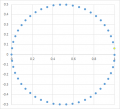
That makes this locus:
Relevant equation, I think:
[width of control surface]*sin(degrees) = linear distance
Say I want to create a 100 foot diameter circle. That means the grid needs to be about 141x141 feet.
I think I need to consider the z-axis. Any suggestions?
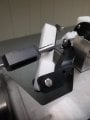
If it helps, here is the 30° X and Y constrained apparatus:
And this paper might be related, but I could be just overthinking this all: On the locus formed by the maximum heights of projectile motion with air resistance.
r = cos(θ) or
x = cos²(θ) and y = cos(θ)*sin(θ).
Say I want to take increments of theta by 0.0314 to pi. That would make this table:
| θ | X | Y |
| 0.03 | 0.9961 | 0.0626 |
| 0.06 | 0.9843 | 0.1243 |
| 0.09 | 0.9649 | 0.184 |
| 0.13 | 0.9382 | 0.2408 |
| 0.16 | 0.9046 | 0.2938 |
| 0.19 | 0.8646 | 0.3421 |
| 0.22 | 0.8189 | 0.3851 |
| 0.25 | 0.7681 | 0.422 |
| 0.28 | 0.7131 | 0.4523 |
| 0.31 | 0.6548 | 0.4754 |
| 0.35 | 0.594 | 0.4911 |
| 0.38 | 0.5318 | 0.499 |
| 0.41 | 0.469 | 0.499 |
| 0.44 | 0.4067 | 0.4912 |
| 0.47 | 0.3459 | 0.4757 |
| 0.50 | 0.2876 | 0.4526 |
| 0.53 | 0.2325 | 0.4225 |
| 0.57 | 0.1817 | 0.3856 |
| 0.60 | 0.1359 | 0.3427 |
| 0.63 | 0.0959 | 0.2944 |
| 0.66 | 0.0622 | 0.2415 |
| 0.69 | 0.0354 | 0.1847 |
| 0.72 | 0.0159 | 0.1251 |
| 0.75 | 0.004 | 0.0634 |
| 0.79 | 0 | 0.0008 |
| 0.82 | 0.0038 | -0.0618 |
| 0.85 | 0.0155 | -0.1235 |
| 0.88 | 0.0348 | -0.1832 |
| 0.91 | 0.0614 | -0.2401 |
| 0.94 | 0.0949 | -0.2931 |
| 0.97 | 0.1348 | -0.3416 |
| 1.00 | 0.1805 | -0.3846 |
| 1.04 | 0.2312 | -0.4216 |
| 1.07 | 0.2861 | -0.452 |
| 1.10 | 0.3444 | -0.4752 |
| 1.13 | 0.4052 | -0.4909 |
| 1.16 | 0.4674 | -0.4989 |
| 1.19 | 0.5302 | -0.4991 |
| 1.22 | 0.5925 | -0.4914 |
| 1.26 | 0.6533 | -0.4759 |
| 1.29 | 0.7117 | -0.453 |
| 1.32 | 0.7668 | -0.4229 |
| 1.35 | 0.8177 | -0.3861 |
| 1.38 | 0.8635 | -0.3433 |
| 1.41 | 0.9037 | -0.2951 |
| 1.44 | 0.9374 | -0.2422 |
| 1.48 | 0.9643 | -0.1855 |
| 1.51 | 0.9839 | -0.1258 |
| 1.54 | 0.9959 | -0.0642 |
| 1.57 | 1 | -0.0016 |
Relevant equation, I think:
[width of control surface]*sin(degrees) = linear distance
Say I want to create a 100 foot diameter circle. That means the grid needs to be about 141x141 feet.
I think I need to consider the z-axis. Any suggestions?
If it helps, here is the 30° X and Y constrained apparatus:
And this paper might be related, but I could be just overthinking this all: On the locus formed by the maximum heights of projectile motion with air resistance.
Last edited: