Facebook
 Google
 GitHub
 Linkedin

When you watch a YouTube video you don't have the opportunity to say, "Stop, I don't understand what you are saying or showing me."
You cannot often do this within a website.
That is the beauty with a forum such as AAC. You can get personalized one-on-one tutoring within hours or even minutes. We don't know what is your level of knowledge or experience. It is up to you to say what you know and what you don't know or don't understand. That way the answers and instructions can be tailored to you specifically. Being frustrated and making off remarks will simply discourage anyone from wanting to provide assistance.
Here is a simple exercise.
Assume we have a 1Ω resistor connected to a variable voltage DC power supply.
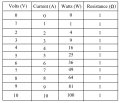
Set the power supply to fixed voltages, increasing from 0V to 10V in 1V steps. Measure the current through the resistor at each voltage setting.
Write the values of current and voltages in a table form as follows:
Voltage (V)|Current (A)|Power (watts)
0|0
1|1
2|2
3|3
4|4
5|5
6|6
7|7
8|8
9|9
10|10
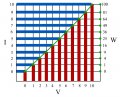
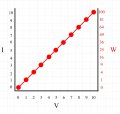
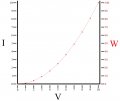
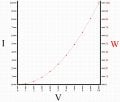
Get a sheet of graph paper (checkered paper) and draw a graph of I along the vertical axis and V along the horizontal axis.
Now calculate the power dissipated by the resistor using Power = Current x Voltage.
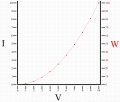
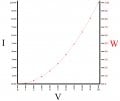
Write down the Power vs Voltage and plot the Power vs Voltage graph.
Note the difference in shape of the two graphs you have drawn.
Describe in words what you observe and the difference between the two graphs.
Ok, here it is.. Drew this up in InkScape.. used my Ohm's Law calculator I made in Visual Studio 2010 IDE.
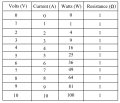
Give me a little more time to work on the 2nd assignment..
Get a sheet of graph paper (checkered paper) and draw a graph of I along the vertical axis and V along the horizontal axis.
Now calculate the power dissipated by the resistor using Power = Current x Voltage.
Write down the Power vs Voltage and plot the Power vs Voltage graph.
Note the difference in shape of the two graphs you have drawn.
Describe in words what you observe and the difference between the two graphs.