How to calculate capacitor discharge time

Thread Starter

Guest3123

Joined Oct 28, 2014
404
When you watch a YouTube video you don't have the opportunity to say, "Stop, I don't understand what you are saying or showing me."
You cannot often do this within a website.

That is the beauty with a forum such as AAC. You can get personalized one-on-one tutoring within hours or even minutes. We don't know what is your level of knowledge or experience. It is up to you to say what you know and what you don't know or don't understand. That way the answers and instructions can be tailored to you specifically. Being frustrated and making off remarks will simply discourage anyone from wanting to provide assistance.

Here is a simple exercise.

Assume we have a 1Ω resistor connected to a variable voltage DC power supply.
Set the power supply to fixed voltages, increasing from 0V to 10V in 1V steps. Measure the current through the resistor at each voltage setting.
Write the values of current and voltages in a table form as follows:

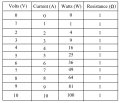
Voltage (V)|Current (A)|Power (watts)
0|0
1|1
2|2
3|3
4|4
5|5
6|6
7|7
8|8
9|9
10|10

Get a sheet of graph paper (checkered paper) and draw a graph of I along the vertical axis and V along the horizontal axis.
Now calculate the power dissipated by the resistor using Power = Current x Voltage.
Write down the Power vs Voltage and plot the Power vs Voltage graph.

Note the difference in shape of the two graphs you have drawn.
Describe in words what you observe and the difference between the two graphs.

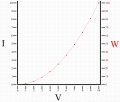
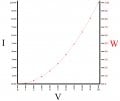
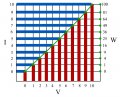
Ok, here it is.. Drew this up in InkScape.. used my Ohm's Law calculator I made in Visual Studio 2010 IDE.
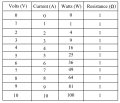
Hunted000635.jpg


Give me a little more time to work on the 2nd assignment..

Get a sheet of graph paper (checkered paper) and draw a graph of I along the vertical axis and V along the horizontal axis.
Now calculate the power dissipated by the resistor using Power = Current x Voltage.
Write down the Power vs Voltage and plot the Power vs Voltage graph.

Note the difference in shape of the two graphs you have drawn.
Describe in words what you observe and the difference between the two graphs.
 

Thread Starter

Guest3123

Joined Oct 28, 2014
404
Get a sheet of graph paper (checkered paper) and draw a graph of I along the vertical axis and V along the horizontal axis.
Now calculate the power dissipated by the resistor using Power = Current x Voltage.
Write down the Power vs Voltage and plot the Power vs Voltage graph.

Note the difference in shape of the two graphs you have drawn.
Describe in words what you observe and the difference between the two graphs.


Like this..? @MrChips

Hunted000636.jpg

Hunted000637.jpg
 
Last edited:

AnalogKid

Joined Aug 1, 2013
12,159
Half yes, half no.

Notice that the differences between adjacent values is not constant.
1 - 0 = 1
4 - 1 = 3
9 - 4 = 5
etc.
If you set the right hand scale to be linear from 0 to 100 (10, 20, 30, etc.) and then plot the wattage for each voltage, you will get a curved line. So now your chart will have two lines, the straight one you already have plus one curved.

ak
 

Thread Starter

Guest3123

Joined Oct 28, 2014
404
Half yes, half no.

Notice that the differences between adjacent values is not constant.
1 - 0 = 1
4 - 1 = 3
9 - 4 = 5
etc.
If you set the right hand scale to be linear from 0 to 100 (10, 20, 30, etc.) and then plot the wattage for each voltage, you will get a curved line. So now your chart will have two lines, the straight one you already have plus one curved.

ak

I don't see it..
Hunted000637.jpg
 

AnalogKid

Joined Aug 1, 2013
12,159
Erase the numbers on the right side scale. Those are results, and do not belong on an axis.
Replace the numbers on the right side scale with the numbers 0 through 100 (0, 10, 20, etc.).
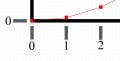
Now, plot the results dataset (0, 1, 4, 9, etc.). That is, for each voltage, place a dot at the height of the corresponding wattage. Note that except for the first two, most of the dots will be in the center of a little square.

ak
 

Thread Starter

Guest3123

Joined Oct 28, 2014
404
Erase the numbers on the right side scale. Those are results, and do not belong on an axis.
Replace the numbers on the right side scale with the numbers 0 through 100 (0, 10, 20, etc.).
Now, plot the results dataset (0, 1, 4, 9, etc.). That is, for each voltage, place a dot at the height of the corresponding wattage. Note that except for the first two, most of the dots will be in the center of a little square.

ak
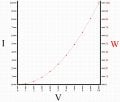
This chart Sir. Is accurate to the 0.1mm. It's dead-on. The only other way to make it more accurate, is if a robot or a computer generated the graph. It's 100% accurate. My finest work yet in InkScape.

With the graph lines.. even though it appears to be inaccurate, I assure you, it's dead-on, to the 0.01mm. Every mark is in the exact place where the watts marks needs to be.

Hunted000638.jpg


Without the graph background..
Hunted000639.jpg

YES, you are correct, my previous graphs are incorrect. These are 100% accurate.
 

Thread Starter

Guest3123

Joined Oct 28, 2014
404
When you watch a YouTube video you don't have the opportunity to say, "Stop, I don't understand what you are saying or showing me."
You cannot often do this within a website.

That is the beauty with a forum such as AAC. You can get personalized one-on-one tutoring within hours or even minutes. We don't know what is your level of knowledge or experience. It is up to you to say what you know and what you don't know or don't understand. That way the answers and instructions can be tailored to you specifically. Being frustrated and making off remarks will simply discourage anyone from wanting to provide assistance.

Here is a simple exercise.

Assume we have a 1Ω resistor connected to a variable voltage DC power supply.
Set the power supply to fixed voltages, increasing from 0V to 10V in 1V steps. Measure the current through the resistor at each voltage setting.
Write the values of current and voltages in a table form as follows:

Voltage (V)|Current (A)|Power (watts)
0|0
1|1
2|2
3|3
4|4
5|5
6|6
7|7
8|8
9|9
10|10

Get a sheet of graph paper (checkered paper) and draw a graph of I along the vertical axis and V along the horizontal axis.
Now calculate the power dissipated by the resistor using Power = Current x Voltage.
Write down the Power vs Voltage and plot the Power vs Voltage graph.

Note the difference in shape of the two graphs you have drawn.
Describe in words what you observe and the difference between the two graphs.
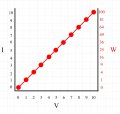
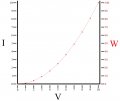
How this..?
Hunted000635.jpg
Hunted000639.jpg
Hunted000641.jpg
 

Attachments

AnalogKid

Joined Aug 1, 2013
12,159
And *that* is an exponential curve. In this case, the exponent is 2.

Most people don't get too deep into exponents, but are at least familiar with squares, cubes, etc. However, exponents do not have to be integers, and while ultimately an exponent is a number, that number could be expressed by an equation that yields a fractional result, a negative number, or both. If the equation has the value of a resistor and a capacitor in it, then the exact shape of the resulting exponential curve varies with the values of the two components.

ak
 
Last edited:

dannyf

Joined Sep 13, 2015
2,197
The situation is similar to a 7v 1100uf capacitor discharging through a 22k resistor.

LEDs are visible at 1ua. Or 22mv over the resistor.

T = -22k x 1000uf x ln(22mv/7v) or about 2 minutes.
Shorter if the led needs higher voltage to maintain brightness.
 

MrAl

Joined Jun 17, 2014
13,720
Hello again,

It looks like you want to jump right into the exponential form, so the current is:
i=i0*e^(-t/RC)

where i0 is dependent on Vcc and the LED characteristic voltage drop and the resistor value:
i0=(Vcc-vLED)/R

This leads to:
i=(e^(-t/RC)*(Vcc-vLED))/R

and solving for t we get:
t=RC*ln(Vcc/(i*R)-vLED/(i*R))

and here i is the current level we consider that makes the LED too dim.
 

dannyf

Joined Sep 13, 2015
2,197
So, to run down in 10 min, the capacitance needs to be -60min/(22k x ln(22mv/7v)) or 11mf. Still big but definitively doable.
 

dannyf

Joined Sep 13, 2015
2,197
The above analysis assumes that the voltage drop over the led stays at 2v. In reality, that voltage drops as the current through the led drops, which allows the led to stay lit longer.

My simulation shows that for red leds (1.5v Vfwd) and green leds (1.9v Vfwd), the current through them stay above 2ua well into 150 - 180 seconds after the discharge starts, consistently with the simulation shown earlier.

So the approximation I did is reasonably accurate.
 

MrChips

Joined Oct 2, 2009
34,882
@Guest3123 I'm very happy to see that you have chosen to take this learning opportunity seriously.
But don't jump ahead too quickly without completing the current exercise. I have a lot more planned for you along this path.
Treat the learning experience as a journey and not a goal. Or as someone famously said "Life is a journey, not a destination".

Your two graphs are correct.

Now describe in words what you see as being different between the two graphs.
 

dannyf

Joined Sep 13, 2015
2,197
I tried this myself. 220uf x 2 capacitors, 27Kohm resistor, red led (Vfwd=1.5v). Charged up to 12v. It took 106 seconds for the discharge current to 2ua (led Vfwd=1.4v+ at this point). The led @ 2ua is barely visible in a dimly lit room.

The formula I posted ealier would suggest T (to 2ua*27K) = -27K * 440uf * ln((2ua*27K) / (12-1.5v)) = 120sec, vs. 106 seconds.

So the assumption that the voltage across the led stays constant at 1.5v provides a reasonably good approximation.
 
Last edited:

MrChips

Joined Oct 2, 2009
34,882
I am working on the assumption that if the TS does not know the meaning of exponential then words like quadratic, derivative, integral, linear, non-linear, logarithmic, etc., are all meaningless words. We have to take one step at a time.

I am also working on the assumption that the eventual need of the TS is a time-delay circuit. The study of an LED discharge circuit is a total distraction which the TS does not yet realize and comprehend.
 
Top