How to build the old Fascination game, ideas/help?

Status
Not open for further replies.

Thread Starter

whitedragond

Joined Sep 6, 2017
4
My family played the game Fascination a few years ago, rolling balls up the ramp into a hole with sensors/lights that lit up, and I was wondering how I would go about making that game with today's tech.

I would need:
A sensor to detect a ball dropping through a particular hole.
A LED to light up corresponding to that hole (the grid would be a 5 by 5) and display.
Ability to detect when a row up/down or across or a blackout board style game (like bingo) to end the game.
How to link multiple games together so you can challenge others with one winner.

I can build the frame/structure but I don't have the knowledge of what electronic equipment I would need to make it work.

Do you have hardware suggestions or can point me in the right direction on how I would go about doing this?

thanks

D
 

Bernard

Joined Aug 7, 2008
5,784
As a start, use a IR LED & photo transistor pair for each hole. Each hole needs some memory like a IC flip-flop,
latch, or maybe a small SCR like 2N5060. And gates would detect full rows or Xs. A hole layout would be helpful. I assume that a second ball in a hit hole would have no value ?
 

Bernard

Joined Aug 7, 2008
5,784
Might consider shrinking the game from 25 holes to 16 with no free hole as 4 input ANDs are readily available, about 5 ea. 74HC20's for matrix. Maybe shrink board to use golf balls ?
 

Thread Starter

whitedragond

Joined Sep 6, 2017
4
Here is a video example of the game.

So 5 holes across and 5 down, once a sensor detects the ball dropping it would trigger the LED to light up and stay lit... then would need to have something detect when a row is lit to trigger a 'win'.
 

Bernard

Joined Aug 7, 2008
5,784
So I guess that your sticking with 24 holes ? I have used for emitter, VSLY-ND, 6 deg., 850 nm, 5 mm LED @ about US $1.31 & for receiver, VEMT X01CT, surface mount photo transistor, 15 deg., 880 nm @ about $ .85.
Another cheaper approach might be CdS cell @ $ .50 ea , 3 mm red " laser like " LEDs @ 100 for $ 5.00 & 1/6 ea of 74HC14 Schmitt trigger. I would still go for SCR memory & LED driver like MCR22-6, 400V, 1.5 A @ 20 for $6.00. A bunch of 3 input NAN or 3 input NOR gates, & more misc. ICs Rs & Cs.
Where do you buy your parts ? How to wire it all together? Being just old, would go for wire wrap on prototype
& a large plain perf board.
Sockets might be around $ 1.00 ea.
 

Bernard

Joined Aug 7, 2008
5,784
Are CdS cells fast enough to catch a falling ball ? Yes, even a fast moving finger. Alignment is not so critical
with LED & CdS cell as IR pair. Substitute a LM339, comparator X 4, for Schmitt trigger, need 6 ea.
LED & CdS cells could be mounted in small wood blocks, maybe 3 cm X 1.5 cm X 1.5 cm, with copper foil strip on each end for easy interconnection.
For power, use an AC to 5 V @ 2A adapter, about $4.00. For display I was allowing 50 mA / LED.
 

Bernard

Joined Aug 7, 2008
5,784
If you are still interested in the game, it isn't as hard as it seems because it is a lot of repetition. might start with a solderless breadboard & parts for just one hole. It would help if we knew what part of the world you were in.
Solderable circuit boards are available that match the solderless ones. Are you handy with a small ( 30W) soldering iron ?
 

Bernard

Joined Aug 7, 2008
5,784
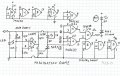
Here is the circuit for one of 24 holes. The hole board (s) would be mounted where the center hole would have been . The V ref., 2- 47K Rs would be common for all holes & would be 1K's in final. LED1's R, about 150 ohms, depends on LED & LDR, light dependent resistor, CdS cell selected. The game can be played with just
the 24 hole board circuits & the SCRs-LEDs. The gates are needed for full bars, blockout, & lockout annotation. A combination of a 2 input & a 3 input NOR gate gives inputs for 5 hole bars, & 2-2 input gates for 4 hole bars.
The SCRs are reset with a short interruption of power.FASCNINATION 00000.jpg
 

Thread Starter

whitedragond

Joined Sep 6, 2017
4
If you are still interested in the game, it isn't as hard as it seems because it is a lot of repetition. might start with a solderless breadboard & parts for just one hole. It would help if we knew what part of the world you were in.
Solderable circuit boards are available that match the solderless ones. Are you handy with a small ( 30W) soldering iron ?
Ya, it sounds simple... just using IR detector to scan when a ball drops, trigger a light to stay on, then have a 'computer board' (Arudino? Pi?) of some type that can detect when a row is complete (and I would like to be able to do a game where all the lights/holes have to be lit to win) and 'end' the game, lighting up that that users lights and possibly a winner light on top.... and maybe play a buzzer or something for excitement.

I've soldered LEDs for props, soldered a sound triggerable board for a LED light, minor things. My biggest issue is I'm not familiar with what electronic parts I would need to make it work. I figured that would be a good starting point!

I'm in Utah, would probably order parts from adafruit/amazon/wherever is cheaper.

I appreciate all your help you are giving!
 

Bernard

Joined Aug 7, 2008
5,784
Extending from one bar to full board is no problem, just add a 12 input AND or NAND A we have an output to sound a horn & or create a lockout. I still do no do micro processors so others might help after basics are done.
 

Bernard

Joined Aug 7, 2008
5,784
Do you have a LED in mind for the display ? One choice would be a 1 W, 86 L, 3.6 V @ 350 mA, SMD( surface mount), $4.00 / 10., Cat # G20821 from Electronic Goldmine. Could operate from 50 mA to full brightness- with heat sink.
Other parts also from EG.
G15177, CdS cell, $ 1.00/ 2 or 12 pks.
G 19338, red, 5 mm, LED, $ 1.25/ 10, 3 pks. OR, G21485, 3mm laser like red LEDs, $ 5.00 / 100. I've tried white, red, yellow, all work. If a 5mm bright white is ok for display then might try G20224, $8.00/ 100 for all of the LEDs.
G22029, SCR MCR22-6, 1.5A, 400V, $ 6.00 /20, 2 pks.
If using red LEDs in detector ckt. then use 2 in series with a 68 ohm resistor
A10466, LM339, $ .29, 24 ea. & spare.
G20394, power supply, 5V @ 5A, $ 14.95.
Add the resistors, EG has them, didn't check.
Resistor for display LED depends on current desired.
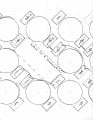
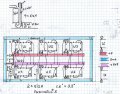
I included a sample hole layout with sensor mountings but not wired. I would shorten blocks to 2 cm to make more room for wiring.FASCNINATION 2 00000.jpg
 

Bernard

Joined Aug 7, 2008
5,784
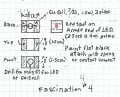
TN ( thumb nail ) # 4, a drawing of sensor mounting blocks. Copper foil, 5/32 in. might be obtained from a stained glass shop, around $ 16.00 for a lifetime supply. Will split some sections for comparator. Mount blocks firmly flush with edge of holes.
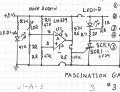
TN # 3, Added for some labels. R1-1 ( R1 thru 24-pin no. ) & R1-2, mounted on block of LED1-A. R4 & 5 disappear, replaced by connection to V reg. buss. See TN # 3.
Open for suggestions for a proper circuit board for SCRs.
Now for the duzzy, comparator mounting. I would use dead bug mounting with ICs glued upside down in open space on hole board like TN # 5 modified so that all 3 busses are in center like note on right end to make more room for Rs. Connections are made with wire wrap but only 3 to 5 turns are necessary but are soldered. Careful records are needed as IC markings are lost. Limit pins to just 2 connections if possible. Wire wrap wire & tool are available on line ? If decoding is discrete ICs then wire wrap is handy.
An interesting circuit board is Digi-Key PN: SBB8006-SS-1-ND, $ 19.95. Might be room for 24 SCRs & 20- 14 pinFASCINATION 3 00000.jpg FASCINATION 4 00000.jpg FASCINATION 5 00000.jpg ICs ?
 
Status
Not open for further replies.
Top