⚡ **How to Build a Simple OR Logic Gate Using the 555 Timer IC**

Thread Starter

rvertulo

Joined Mar 16, 2025
13
Then you don't need the 555 for that.
It just unnecessarily complicates the demo.
All you need are two switches and an LED or, at most, two switches, a transistor, and an LED.
Within the educational purpose of the circuit, it is possible to learn a lot about the RS latch and voltage comparator circuits by observing and analyzing the internal operation of the 555 to understand how it can be configured to behave as a logic OR gate.
 

nsaspook

Joined Aug 27, 2009
16,333
The "behavior" of logic gates can be achieved even with entirely mechanical systems where there are no voltage levels. In electronic circuits, the voltage levels assigned to low or high logic levels are purely conventions, which, in the case of traditional ICs using TTL and CMOS technology, have been somewhat standardized. However, this does not mean that any circuit exhibiting the behavior of a logic gate must necessarily follow these "standardized" values. It is perfectly possible to assign different values for high and low logic levels, as long as this is clearly specified in the project documentation.

True, that's wny contorting a 555 into a logic device IMO seems counterproductive to learning about logic if your target audience are beginners.

Once you have learned logic first principles then various implementations (mechanical, TTL, CMOS or even the 555) are IMO fine but using a 555 for logic is akin to the everything is a hammer meme.
 

dl324

Joined Mar 30, 2015
18,350
Within the educational purpose of the circuit, it is possible to learn a lot about the RS latch and voltage comparator circuits by observing and analyzing the internal operation of the 555 to understand how it can be configured to behave as a logic OR gate.
It would be simpler to just use the logic IC's. Or transistors, resistors, and diodes. Or a comparator.
 

Papabravo

Joined Feb 24, 2006
22,084
It would be simpler to just use the logic IC's. Or transistors, resistors, and diodes. Or a comparator.
Rube Goldberg machines were invented for the purpose of doing simple things in the most complicated and irrational fashion. I don't think anybody ever made the fatuous claim that they served an educational purpose. They may have been entertaining, but they were hardly educational.

Rube Goldberg machine - Wikipedia
 
The 555 is perhaps the most used, or abused some say, IC in history.
Although some circuits are really clever, others not so much.

The saving grace for the TS's circuit is that it implements a logic function with a significant output drive, and providing both simultaneous totem pole and open collector outputs.
 

Thread Starter

rvertulo

Joined Mar 16, 2025
13
This circuit was never designed with the goal of having a practical application, except for demonstrating that by understanding the internal workings of the 555, it is possible to expand the use of the component for many other purposes, some more useful than others.
 

nsaspook

Joined Aug 27, 2009
16,333
This circuit was never designed with the goal of having a practical application, except for demonstrating that by understanding the internal workings of the 555, it is possible to expand the use of the component for many other purposes, some more useful than others.
The 555 is the electronic version of:

1742171888362.png

Look, I think the 555 is great but I haven't seen one used in a industrial PCB circuit for the last two decades and the drawer full of them has maybe one taken for for anything (work or personal projects) during that two decades.
 
Last edited:

MrChips

Joined Oct 2, 2009
34,850
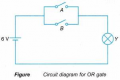
Why would anyone complicate things trying to use a 555-timer circuit when this simple circuit demonstrates an OR-gate?

1742172765048.png
 

WBahn

Joined Mar 31, 2012
32,898
This is just to show, in an educational context, that the 555 IC can be used for much more than its common monostable, bistable, or astable configurations. In fact, it's possible to simulate all logic gates using one or multiple 555s, even to the extent of assembling an entire educational computer using several (many) 555 ICs.
You are making a leap too far.

You have insisted that your logic inputs are a Logic 1 if the switch is closed and a logic 0 if the switch is closed open.

But your output is not a switch, but rather a voltage signal. So how are you planning to connect all of these 555 ICs configured as logic gates together?

If you are going to combine them to make more complex logic, then the outputs from one gate need to be able to drive the inputs of the next gate, which means that your logic needs to be based on the voltage level of the inputs and how that translates to the voltage level of the outputs. But that means that your gate is a NAND (as others have repeatedly tried to tell you). The good news is that the NAND gate is functionally complete, while the OR gate is not.

Now, for my $0.02, while it is somewhat interesting and somewhat educational to point out that something like a 555 timer IC can be forced to behave like it is only one of its constituent parts, the value in doing so is very minimal. After all, at it's core the 555 timer is nothing more than a RS Flip Flop with a couple of comparators to condition the input signals. Forcing it to behave like a simple combinatorial gate is somewhat akin to demonstrating that a cellphone can be programmed to behave like a NAND gate at a set of it's pins and then claiming that this is somehow profound because now we could build an entire educational computer just using many cellphones.

EDIT: Fixed typo.
 
Last edited:

nsaspook

Joined Aug 27, 2009
16,333
You are making a leap too far.

You have insisted that your logic inputs are a Logic 1 if the switch is closed and a logic 0 if the switch is closed.

But your output is not a switch, but rather a voltage signal. So how are you planning to connect all of these 555 ICs configured as logic gates together?

If you are going to combine them to make more complex logic, then the outputs from one gate need to be able to drive the inputs of the next gate, which means that your logic needs to be based on the voltage level of the inputs and how that translates to the voltage level of the outputs. But that means that your gate is a NAND (as others have repeatedly tried to tell you). The good news is that the NAND gate is functionally complete, while the OR gate is not.

Now, for my $0.02, while it is somewhat interesting and somewhat educational to point out that something like a 555 timer IC can be forced to behave like it is only one of its constituent parts, the value in doing so is very minimal. After all, at it's core the 555 timer is nothing more than a RS Flip Flop with a couple of comparators to condition the input signals. Forcing it to behave like a simple combinatorial gate is somewhat akin to demonstrating that a cellphone can be programmed to behave like a NAND gate at a set of it's pins and then claiming that this is somehow profound because now we could build an entire educational computer just using many cellphones.
Bravo Zulu
 

Thread Starter

rvertulo

Joined Mar 16, 2025
13
The true educational value of configuring the 555 IC as a logic gate is not just in the final result but in the learning process involved. When someone sets up this configuration, they inevitably have to understand the internal blocks of the 555—comparators, flip-flop, discharge transistor—and how each contributes to the desired logical response. This kind of exercise is not about practical efficiency but about deepening the understanding of circuit operation, which is essential for anyone who truly wants to grasp digital and analog electronics. Even though dedicated logic gates are more efficient, the knowledge gained by exploring the 555 in this way goes far beyond the simple goal of creating a logic gate.

I completely understand the opposing views, and I respect different perspectives on the matter. In the end, what really matters is that we all continue learning and growing in our understanding of electronics. Wishing all the best to everyone!
 

nsaspook

Joined Aug 27, 2009
16,333
The true educational value of configuring the 555 IC as a logic gate is not just in the final result but in the learning process involved. When someone sets up this configuration, they inevitably have to understand the internal blocks of the 555—comparators, flip-flop, discharge transistor—and how each contributes to the desired logical response. This kind of exercise is not about practical efficiency but about deepening the understanding of circuit operation, which is essential for anyone who truly wants to grasp digital and analog electronics. Even though dedicated logic gates are more efficient, the knowledge gained by exploring the 555 in this way goes far beyond the simple goal of creating a logic gate.

I completely understand the opposing views, and I respect different perspectives on the matter. In the end, what really matters is that we all continue learning and growing in our understanding of electronics. Wishing all the best to everyone!
I completely agree.

That was me 20 years ago.

The only real thing that changed is that 555 circuits are now, 20 years later, IMO obsolete as training and operational platforms for modern application requirements. You still need to train on all of the individual component modules of a 555 but not use the 555 as the practicable training, demonstration and implementation model for modern circuits.
 

WBahn

Joined Mar 31, 2012
32,898
The true educational value of configuring the 555 IC as a logic gate is not just in the final result but in the learning process involved. When someone sets up this configuration, they inevitably have to understand the internal blocks of the 555—comparators, flip-flop, discharge transistor—and how each contributes to the desired logical response. This kind of exercise is not about practical efficiency but about deepening the understanding of circuit operation, which is essential for anyone who truly wants to grasp digital and analog electronics. Even though dedicated logic gates are more efficient, the knowledge gained by exploring the 555 in this way goes far beyond the simple goal of creating a logic gate.

I completely understand the opposing views, and I respect different perspectives on the matter. In the end, what really matters is that we all continue learning and growing in our understanding of electronics. Wishing all the best to everyone!
I don't know if this applies in your case, but it makes me wonder if your exposure to the 555 came first as a black box that does timing stuff based on rote circuit configurations to implement different functionality, and that you later learned what was in it and then started exploring what other things you could do with it.

My experience was very much the other way around. When I took an electronics class (from the physics department) we started by making "logic" circuits that used switches as inputs and incandescent lamps as outputs. This made us think about logic relationships in terms of controlling power flow. We then replaced the switches with simple relays so that we could actually cascade logic blocks to make more complex logic circuits. Then we were given a bunch of resistors, diodes, and transistors and had to work our way through the basic gates in the RTL, DTL, and finally TTL (no MOS-based stuff, those transistors were too expensive and too static sensitive for use in student labs). That set the stage for use to then use the 7400 quad NAND gate as the building block to make all of the other basic gates. At that point, we got to use 7400-series parts of the gates we had build and demonstrated. We then moved up to making things like multiplexers and half-adders, full-adders, and a four-bit adder. Once we had implemented a particular gate that was in the 7400 family, we could use those ICs (provided they were in the lab's bench stock). Then we made RS flip flops, a master-slave JK flip flop, and an edge-triggered DFF. As usual, at that point we co9uld use equivalent 7400 parts in later labs. Next we made shift-registers and other sequential logic circuits, such as RAM blocks. In parallel with this, we made a really crude comparator using transistors in a long-tailed pair configuration and then brought a bunch of this together by making a timer that, unbeknownst to us, but that certainly came as no surprise, was basically a 555 timer. At each step, we had to design a circuit that met a functional specification (with some very useful hints along the way), starting with using a couple of our comparators to produce logic signals whose transitions were separated in time by a very repeatable amount -- achieved by simply using a three-resistor voltage divider to produce the comparator reference points. We then had to use these signals to create a one-shot with a manual reset. Then we modified that into an astable multivibrator.

The result is that by the time we were introduced to the 555, it had no mysteries for us and the notion that we could use the various inputs to directly control the internal latch was glaringly self-evident, since this is how we designed out timer circuit to do its job.
 
Top