How to build a Power LED ring?

LesJones

Joined Jan 8, 2017
4,511
The need for the series resistor was pointed out the the TS in post #2. The resistor also helps to deal with spikes on the power supply which will have high frequency components that the capacitor will have a low reactance to. As well as omitting the resistor the TS seems to have ignored the advice on providing heat sinking for the LEDs.

Les.
 

Thread Starter

q12x

Joined Sep 25, 2015
2,227
The need for the series resistor was pointed out the the TS in post #2. The resistor also helps to deal with spikes on the power supply which will have high frequency components that the capacitor will have a low reactance to. As well as omitting the resistor the TS seems to have ignored the advice on providing heat sinking for the LEDs.
You are right, you did mention it, now that I re-read #2 post. When I test stuff, I forget anything else and I only apply the core of what I know is essential. In a sense, I am in "automatic" mode. In this case, that protection was not part of my essentials priority to include. Unfortunately and sadly. I sincerely don't have that much experience with protection and for a lot of capacitive circuits I didnt use any kind of protection to be sincere. I know it exist but I didnt personally deal with it seriously, like now.
- Mister @LesJones what do you recommend to use as protection for spikes from switching?
And as always, thank you for your help !
 

Thread Starter

q12x

Joined Sep 25, 2015
2,227
@Sensacell I've watched ALL of his videos. The list is quite short so I consume it relatively quickly. I really like it.
Very good projects and presentation!! Thank you for showing it to me. Very inspiring. I really love how he is doing things. Very impressive the 3d printing components he did as well.
 

splud

Joined Jun 30, 2013
38
You are right, you did mention it, now that I re-read #2 post. When I test stuff, I forget anything else and I only apply the core of what I know is essential. In a sense, I am in "automatic" mode.
Break that habit. You are tinkering with mains. If there are any habits to develop here, they need to be in favour of safety. Checking for live, clearing metal from the workarea, using a benchtop isolation transformer where possible, not touching two points in the circuit, etc.
 

splud

Joined Jun 30, 2013
38
When you plug that circuit in, if the AC line happens to be at or near the peak, you have a massive inrush current for a few microseconds while the capacitors charge.
This current is sure to roast your LEDs.
Roasting the LEDs depends of course on the overall makeup of the circuit - mains L1 -> CR -> LED -> other leg of mains (L2 or N, depending) will behave differently than mains L1 -> CR -> bridge rectifier (also with other leg of mains, L2 or N, feeding the other terminal), with HV DC out into a DC Buffer cap, with the LED string in parallel to that will have much more resilience because that buffer cap needs to charge up for the DC side to have sufficient voltage for the LED, and the buffer cap will be several orders of magnitude more capacitance than the CR one.

That doesn't make a rectified output setup immune to peak phase of course. Toggling power on-off-on again can easily lead to issues (even with below NTC approach).

NTC (Negative Temperature Coefficient - resistance drops as temperature rises) Thermistors are a common way to limit inrush current, but need to be spec'd properly. These are commonly found in designs where there is substantial input buffer capacitance. They are equally at home on mains as they are DC - if you have a project where you connect power to it, and there's a spark at the connector as you make the connection, it's a good candidate for an NTC. For example, I use them on some battery charger circuits and also on the input side of capacitor banks. IMO, they are much better than a fixed resistor on the input, because the resistance is initially high (limiting the inrush), but drops off (so not wasting as much power when your load is engaged). There are designs which involve driving a transistor to bypass the NTC for even lower resistances, once the inrush current has subsided (often, because the buffer caps are past some threshold voltage).

Then you have MOVs (Metal Oxide Varistors) which are the magic sauce in your bog standard power strips. These have very high resistance when the applied voltage is below a threshold, and once it crosses that threshold, they conduct at low resistance (and revert to high resistance as soon as the voltage drops below that threshold - you could think of them as a "Zener Resistor" of sorts). Great for a brief spike, not so much for a prolonged overvoltage. They should always be paired with a suitably rated fuse or breaker on the supply side of the MOV since they can fail shorted. The more modern version of this sort of component is a TVS (Transient Voltage Suppressor) or by one branding, a TranZorb (transient absorbing diode), which has a defined breakdown voltage (not entirely unlike a zener, but then, NOT a zener). These can be found in much lower voltages than MOVs, and can be used on the output of a step-down transformer.

Each additional component drives up the BOM cost of the device. Fuse, NTC, MOV, TVs... You generally won't see them on cheap lamps using CR because CR is by definition, the cheap solution. As the cost of the device rises (such as a hi-fi stereo or a test instrument), you're more likely to see protection circuits, because they're cost effective for reducing device damage. Really cheap lamps (even with switcher circuits) often have a low value resistor as a "fuse" instead of an actual fuse.
 

Thread Starter

q12x

Joined Sep 25, 2015
2,227
Thank You mister @splud !
And I agree with everything you said. That is a Very Nice explanation !
So, to be sure I get the point right;
- the snubber (R-C-(D)) is the cheaper version of protection; where (R=resistor,C=cap,D=diode zenner or rectifier).I've seen a couple of circuits so I know now. And this is the RC that you mentioned.
- the more costly but more secure is NTC Thermistors , MOVs (Metal Oxide Varistors) , TVS (Transient Voltage Suppressor) , TranZorb (transient absorbing diode).
It appears you mentioned every form of spike/inrush protection there is.
I'll have to supply with some of what you mentioned. I actually have some very strange components that I take from power boards but never know exactly what they are, I only GUESS they may be X or Y component. I bet I have some of these special components in the same box with some random capacitors. Ill have to take a picture of them someday. Again, is what I suspect them to be.
And the mains power play I do, is not for fun. It is by necessity. I got electrocuted in my life enough times to have some very dexterous moves right now, when I deal with the mains wires. Also the precaution and safety first. I'm not an idiot, even if I learn this stuff by myself, the slow and hard way.

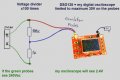
Oh... is there a way to see the switch spikes on my limited 30V over the probes from my dinky osciloscope DSO138? I didnt try anything yet, but I imagine this:
Screenshot_3.jpg
I want to be able to see what the hell is going on with my switch, because this is not the first time I burn up the output of my experiments.
 
Last edited:

splud

Joined Jun 30, 2013
38
A snubber limits the rate of the rise of voltage in a circuit, and it most frequently seen paired with a triac, so it doesn't spontaneously trigger when say, an inductive (motor) circut is switched OFF. That's different from our goal of efficiently limiting inrush current to a capacitor which we in fact WANT to charge.

NTC directly impacts inrush current on a cold circuit. They are very different from MOV and TVS - which are two different components used to deal with voltage surges above a specified threshold voltage (which a snubber does not do).

There are more protection devices out there, including Gas Discharge Tubes, which are used as lightning protection.

MOVs look like large disc capacitors. NTC are often similar, quite often matte black. There are also PTCs (whose resistance goes up with temperature rise). Other NTCs used solely for temp sensing are either SMD or small teardrops on a pair of leadwires - as you'd find in LiIon laptop battery packs, and are not suitable for inrush current limiting. If you can't identify the difference between the parts, and their ratings, please don't experiment with them using mains.


At this point, you've had your used LED driver IC PCB and your ring of LEDs functional. I'm going to call it a day.

[and you accomplished that on your own, AFAICR, so kudos]
 
Last edited:

Thread Starter

q12x

Joined Sep 25, 2015
2,227
Mister @splud , you are an angel. Thank you very much for your gracious help.
You are right, the project is finished with the power led ring. But there are more ways to skin the cat. Thats why I overstay, even if I show my way of doing it, I also wanted to see you guys coming with aditional and novelty solutions. Which you did!!! but im always hungry for more. I respect your wish to close the subject so I will close it.
Thank you again. Have a good night.
 

splud

Joined Jun 30, 2013
38
I respect your wish to close the subject so I will close it.
To be clear, I'm not telling you that you can't continue to carry on about it, just that I've contributed what I'm going to, and I need to focus more of my limited time on some of the many projects in front of me.
 
Top