How to alert to sudden temperature drop

drc_567

Joined Dec 29, 2008
1,156
A unique analog approach might use an op-amp differentiator circuit ... see images here:
https://www.electronics-tutorials.ws/opamp/opamp_7.html
An increase in temperature would yield a ramp waveform ... ideally. The differentiator output would be a step or square waveform that could be identified with a comparator, at some arbitrary threshold.
... just a suggestion at this point, not yet verified.
edit ... if the temperature sensing element is conductively fastened to an appropriately sized thermal mass, then spike or impulse temperature waveforms could hopefully be avoided as input signals to the differentiating op-amp. The exact mass size would require experimental determination. The goal is to restrict any input signal to a ramp waveform that would yield a useable square wave output.
 
Last edited:

OBW0549

Joined Mar 2, 2015
3,565
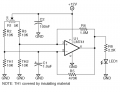
I noodled on this a bit and concocted the circuit below; it might not be precisely what you're after, but it's a place to start.

U1 can be just about any op amp; I chose a 741 just as an example. R1 adjusts for balance, to compensate any difference between R2 and R3, or between thermistors TH1 and TH2. Thermistor TH1 is wrapped in some sort of insulating material to slow down its response. TH2 is exposed to free air and is the "fast" sensor. C2 is a decoupling cap and should be located as close to the supply pins of U1 as possible. I show a power supply of +12 volts, but anything between 9V and 30V will do.

The circuit functions as a square-wave oscillator with its duty cycle, and thus the brightness of LED1, controlled by the temperature difference between the two thermistors. If TH2 is warmer than TH1, the LED will dim and eventually extinguish if the temperature difference is large enough. Conversely, if TH2 is cooler than TH1, the LED will brighten.

The circuit is off the top of my head and may require some fiddling with component values, but hopefully not much.

GhostFinder.png
 

atferrari

Joined Jan 6, 2004
5,015
Hola Andy

Do you mind telling where do you actually intend to apply the circuit? Household environment? Portable seems to be. Curious.
 

Reloadron

Joined Jan 15, 2015
7,892
Simple? How about two temperature sensors and a comparator. Have one sensor be slower than the other.

I played with something like this once using diodes (1n4148) as the sensors and a diff opamp circuit (lm324)
and moving a finger (heat source) near one of the diodes was enough to show a change...
The problem with the use of a comparator is the changing temperature of reference. I am in a room and the reference temperature is 72.0 degrees F. I walk from that room to another room where the temperature is now 70.0 degrees F and my output from sensor drops that two degrees and I get an alarm. Now my new temperature reference is 70.0 degrees F. Then I walk into yet another room where the temperature is 68.0 degrees F. My understanding is each room becomes a new reference and as I transition from room to room I want to know if the temperature in the room I enter is 2.0 degrees or greater less than where I came from. Since my reference can change constantly I discounted using a comparator type circuit which could be a simple and quick solution. If I did use a comparator design scheme I would likely go with the LM339 family just to use a comparator type chip rather than use an operational amplifier as a comparator. That being my thinking on the subject anyway. I just can't warm up to making one sensor "slower" than another. Not saying it wouldn't work merely that I likely would take another path.

Ron
 

danadak

Joined Mar 10, 2018
4,057
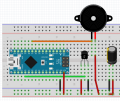
Coding looks like this in mBlock -

1572911052455.png
Basically you drag blocks out of the left window, configure values,
and mBlock converts this to Arduino code and programs the Nano
board. On web lots of training videos and examples. mBlock is a
free program.

The code above basically measures T twice, with a 1 sec (you can change
this to any value you want) delay between readings, then a test is done
to see if T has dropped by 2 degrees C. Note I have an error in the test,
number 2 should be .02 as the sensor changes 10 mV per degree C.
You can of course can change the drop value for larger, or smaller
T change.

Maybe give this a whirl at a later time, lots of fun, and you can start
looking at Arduino code, largely C, to learn C. Or just keep using the
code blocks.

There are other block languages, each with their own features, like
Snap4Arduino, Ardublock. The former has the ability if board is
tethered to a PC to speak speech, like issue a spoken warning, or
read out a voltage or current or pressure or.....

6'th graders and above are using block languages to program robots
in school. Some think this is kids only stuff. I like it and other languages
because for simple projects I can whip out a quick design w/o much
"digging" for instruction formats and variable definitions and all the
other stuff that comes with a formal language like C. I use C as well
for full blown projects. And block languages free you from having to
study internal hardware, you are sort of "shielded" from all that.

Note that you give up some HW control when using block languages
versus C or ASM. But for simple projects that are not going commercial
block language pretty good fit to learn and do projects.

Regards, Dana.
 
Last edited:

djsfantasi

Joined Apr 11, 2010
9,237
Two temperature sensors, block programming, comparators, ramp waveforms....

Personally, all too complicated for me.

Use one sensor and a microprocessor to read the temperature. Once you have two temps read over a period of time, you have the rate of temperature change.

I.e., (Temp(tn) - Temp(tn-1))/(tn-tn-1))

Normal changes in temperature will be Rate(normal); abrupt changes will be larger than a normal change. “Normal” can be determined empirically.

With an Arduino, a sketch would look like this. I use a function to read temp, which has to be customized for the particular sensor you are using.

C:
#define timeBetweenTempReadings 5000
#define temperatureSensor 10
#define alarmPin 11
#define alarmCondition = rate;

// replace rate with empirically defined value
setup () {
// define input pin for temp sensor
pinMode(temperatureSensor, INPUT);
// initialize sensor

//initialize alarm (output) pin
pinMode(alarmPin,OUTPUT);
}

loop () {

int lastTemp=0;
currentTemp = readTemp();

tempChangeRate = (currentTemp-lastTemp) / timeBetweenTempReadings;

if( tempChangeRate > alarmCondition) {
    digitalWrite(alarmPin, HIGH);
    }
else {
    digitalWrite(alarmPin, LOW);
}
}


int readTemp() {
// read temperature sensor
}
 

Thread Starter

AndyD-UK

Joined Nov 1, 2019
24
Sorry for the late replied and thank you all for this amazing input.

Hola Andy

Do you mind telling where do you actually intend to apply the circuit? Household environment? Portable seems to be. Curious.
I am a keen ghost hunter and some of the items I want to test aren't really sold, or if they are, for a lot of money, so I am trying to come up with alternatives that I can make.

So the thinking is that ghosts/spirits are often associated with cold spots and this is something I have experienced myself - what I would like to do is have a device that alarms at any sudden drop in temperature.

As I think this through as well, it would be useful to have some way to reset this device so that if I were to walk from one room to another, that I could then press a button and the new temperature is recognised and any drop in temperature will be from this new ambient room temp.

It might be that I can't make this myself and have to get someone else to help but I do like to tinker so happy to try out some of these suggestions :)
Andy
 

danadak

Joined Mar 10, 2018
4,057
The code as written in post #27 automatically resets itself after a
alarm condition has been detected and sounded.

Regards, Dana.
 

atferrari

Joined Jan 6, 2004
5,015
As I think this through as well, it would be useful to have some way to reset this device so that if I were to walk from one room to another, that I could then press a button and the new temperature is recognised and any drop in temperature will be from this new ambient room temp.

The above is what I had in mind when posting. That implies some kind of memory thus a digital implementation.

Just in case, also keep in mind that a high sensitivity temperature sensor (I surmise you would like it to be so) could be easily fooled by subtle air currents unnoticed by the user.
 
Last edited:

MrChips

Joined Oct 2, 2009
34,866
Just in case, also keep in mind that a high sensitivity temperature sensor (I surmise you would like it to be so) could be easily fooled by subtle air currents unnoticed by the user.
I believe that is the whole idea. Opening a door or window to let a cold draft through ought to be detected.

I think we can come up with a simple analog solution from one thermistor.
Two voltages with different time constants are fed into opposing inputs of an analog comparator. The output turns on an LED. The LED goes off automatically when the temperature stabilizes. No need to reset.

I will breadboard this when I have a spare moment.
 

Thread Starter

AndyD-UK

Joined Nov 1, 2019
24
I believe that is the whole idea. Opening a door or window to let a cold draft through ought to be detected.

I think we can come up with a simple analog solution from one thermistor.
Two voltages with different time constants are fed into opposing inputs of an analog comparator. The output turns on an LED. The LED goes off automatically when the temperature stabilizes. No need to reset.

I will breadboard this when I have a spare moment.
Thank you :D
 

Reloadron

Joined Jan 15, 2015
7,892
The problem here, as I see it, would be the thread starter's skill level with electrical / electronic circuits. The actual goal can be achieved any number of ways and is not a difficult goal. Most circuit solutions are relatively easy to build but the builder would need the basic skills, including ability to read a schematic and hand tools to make it happen. Now if the thread starter has a friend with the skill level(s) then we would do well to have his friend in this thread as information or suggestions passed along will likely lose something.

Ron
 

Thread Starter

AndyD-UK

Joined Nov 1, 2019
24
The problem here, as I see it, would be the thread starter's skill level with electrical / electronic circuits. The actual goal can be achieved any number of ways and is not a difficult goal. Most circuit solutions are relatively easy to build but the builder would need the basic skills, including ability to read a schematic and hand tools to make it happen. Now if the thread starter has a friend with the skill level(s) then we would do well to have his friend in this thread as information or suggestions passed along will likely lose something.

Ron
Well as a former bench engineer who used to make mass spectrometers, albeit almost 30 years ago, you could always ask me if I can solder and read schematics.
 

Reloadron

Joined Jan 15, 2015
7,892
Well as a former bench engineer who used to make mass spectrometers, albeit almost 30 years ago, you could always ask me if I can solder and read schematics.
Sorry, based on your responses I wrongly assumed you were not familiar with circuits and their applications. So as a bench engineer what was your original thinking on ways to approach this? The more anyone here knows as to your background and abilities the easier it becomes to provide ideas and help. Your response in post #6 would lead one to believe you were new to electronics. Several of your post led me to wrongly believe you did not know how to read electrical schematics or have an electrical / electronic skill sets.

It will be all wired.

And I’m nothing more than a hobbyist at this. I will be seeking someone to help make me something when I know the best way to do this :)

It would be nice if there were kits that did what I was looking for, but I think that’s a remote chance :)
Again my apologies. Yes, there are kits but any I am familiar with would require some modification or fine tuning to get where you want to be from a kit. Pretty much a matter of what you feel comfortable with.

Ron
 

Thread Starter

AndyD-UK

Joined Nov 1, 2019
24
Sorry, based on your responses I wrongly assumed you were not familiar with circuits and their applications. So as a bench engineer what was your original thinking on ways to approach this? The more anyone here knows as to your background and abilities the easier it becomes to provide ideas and help. Your response in post #6 would lead one to believe you were new to electronics. Several of your post led me to wrongly believe you did not know how to read electrical schematics or have an electrical / electronic skill sets.


Again my apologies. Yes, there are kits but any I am familiar with would require some modification or fine tuning to get where you want to be from a kit. Pretty much a matter of what you feel comfortable with.

Ron
I can read circuit diagrams but I have forgotten so much of the designing aspects and what I need to do what now. Wish I had kept at it, but my career took me down a totally different path.

If there were a kit, it just makes life easier as I don’t really like asking for help when I can give nothing back. But it doesn’t seem like there is.

So more than happy reading a circuit diagram and soldering etc. But that’s where my skills let me down :)
 

Reloadron

Joined Jan 15, 2015
7,892
I will toss out what I come up with likely tomorrow. As can be seen there is no shortage of ways to get where you want to go.

Ron
 
Top