@MrChips so more strands more flexible and better for ducts?
yes its 18 AWG, and i already calculated the required current which is 2A. I will have to have one big duct or 2x smaller ducts. not sure whats better.
A more flexible cable would be easier to pull through a duct.
You need to determine the length of the cable and calculate the resistance, voltage loss, power dissipation, and temperature rise.
what do u mean by
1) resistance
2) i did that - got around 0.5V on of cable length 7m
3) whats power dissipation?
4) by temp rise you mean? If the endpoint device is DC 5V/3A max.
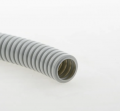
Conduit cable is available in all sizes and nearly always has 7 strands. Tri-rated cable tends to have 0.2mm 0.25mm or 0.3mm strands and many more of them. Both have the same resistance, voltage drop and temperature rise at DC, 50Hz or 60Hz. 7 strand will be flexible enough. Either will go down smooth conduit, however for flexible conduit I would recommend the 7 strand as it is not too flexible. The 24*0.2mm trirated cable will tend to get caught on the ridges as you push it down flexible conduit. If you are dragging it through, then either type is equally as good.
Tie a heavy bolt or nut to the end of a string and drop it through the full length of the conduit. Tie all the required cables to the string and pull the cables through.
that depends on application... which is why there are different options - from solid wire to one with many fine strands.
solid wire is suitable for applications with no movement. and the more movement there is, the finer strands are needed. 0.75mm2 wire with 7 or 20 strands would not last long in a robotic application.
Conduit wire is for conduits, Trirated is for anything else that needs a single wire insulated to mains voltage standard. Nothing to say that you can’t use trirated in conduit, but the 7 stranded stuff is good inside a conduit it doesn’t get flexed. https://www.drapertools.com/product/56761/electricians-draw-tape-in-plastic-case-15m/
unless you have the option of hanging it vertically and dropping a weight through it as @MrChips suggested.
I ran some CAT5 in flexible conduit under the lawn and around a flower-bed by a circuitous route to get to the microwave antenna for the internet. With the usual flexible CAT5 it was a complete pain to do, it just kept getting stuck in the grooves in the conduit. Using the stiffer outdoor CAT5 it was much easier.
flexible CAT5 it was a complete pain to do, it just kept getting stuck in the grooves in the conduit. Using the stiffer outdoor CAT5 it was much easier.
How many times has ChatGPT run wires through conduit?
it needs to be just flexible enough.Like 1/0.8mm might be a bit too stiff. Obviously, it’s better if you can pull it through rather than push, if you are going to pull it then first you need something in there to pull it with.
You might find that LSZH on 24/0.2 is better than PVC because the insulation is slightly stiffer, but from a smoke point of view LSZH is PVC conduit is a bit silly!
is the conduit going to move or flex after installation? is it part of the system that bends every few seconds due to some actuator? if so you may want to consider of suitable size and carefully consider bending diameter based on cable rating:
as far as electrical code is concerned, all conductors should be solid. but for practical reasons this is often not the case so only ends may be "solid" (by crimping etc.).
since you are placing this into the wall of a home, this is not moving at all. even solid wires are fine (just look at your existing house wiring).
LSZH is "low smoke zero halogen" and PVC is rather "smoky". Ian0 was just saying that it does combination does not make much sense.
Yes , 7 or 20 strand cable, or just about any other is fine to put in conduit
The chatter above is valid , but more for debate.
all this is said, but:
the more the number of strands of cable for a given overall size, the more flexible the cable will be,
if you took a spoon, and kept bending it , it would break, if our spoon as made of 100 strands, it would be not much use as a spoon, but it would be very hard to break by bending !
so if conduit is fixed, any cable is fine, if its just occasionally moved , say to get behind the machine occasionally, then any apart from the single / solid core is fine, if conduit is constantly moving, a more flexible say 20 strand would be if use.
The comments about power / voltage drop are to do with heating,
all none super conductor cables have a resistance, and get "warm" ,
If you tightly pack a condit with cables, and put that conduit in an insulated environment, classic is under insulation in the attic, the cables cna get very warm / burn. From the numbers you have shared this should not be a problem, as your conduit is not packed, and your only puting a limited current down the cable, well within the capabilities of the cable. Just check you have a fuse, so under fault conditions you dont draw a much higher current.
Low Smoke Zero Halogen.
You can run whatever you like through conduit. The conduit serves only to protect the wiring from damage as per section 522 of the IEE Wiring Regulations
just one more note ... ist it better to use
2x 0.75mm2 rated for 50V (they claim its speakers?/ generic <50V cable)
(but they dont state) how many Ampers can sustain.
The price of two of these is still half of the one below, maybe two of these occupy also less space as one 4 core?
instead of
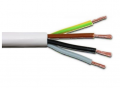
4x0.75 mm ; this is rated for 300/500V; 15A
just one more note ... ist it better to use
2x 0.75mm2 rated for 50V
(but they dont state) A.
The price of two of these is still half of the one below. View attachment 357438
just one more note ... ist it better to use
2x 0.75mm2 rated for 50V
(but they dont state) A.
The price of two of these is still half of the one below. View attachment 357438
For <50V you can use 50V rated cable. For mains, it must be double insulated. And 0.75mm is rated at 6A (not 15A). It can be uprated to 10A for an appliance cord of <2m length.

 Facebook
 Google
 GitHub
 Linkedin