I did it at the beginning of my career but have not done it since the 8080/8085/Z80 processors became a thing in about 1976 or so. Our CPU was built around a 4-bit ALU slice from TI called 74LS181. It was called internally LU-IV, the fourth generation Logic Unit, and the first to use parallel interfaces instead of serial. It ran with a clock speed of 8 MHz, with an instruction period of 10 clock cycles. The ALU was constructed from two chips, the remainder of the design was the memory and peripheral interfaces. The ROM was made from 512 byte x 8 mask ROM chips with about a 6-week lead time each. A typical system used eight of those ROM chips. The RAM was also semiconductor RAM in a 1k by 4 arrangements. One specific page in the memory map was devoted to the peripherals and IIRC each peripheral had 16 or so addresses in that page.
The peripherals included a display, a keyboard, a Centronics printer interface, magnetic cassette drive, 9-track magnetic tape drive, punch card reader, paper tape reader and punch, magnetic check reader and a few others that I've forgotten. Only the display used DMA data transfer.
In general, you'd start with an architectural specification. This is done by people who are, naturally, called computer architects. Functionality will be broken into blocks. The circuitry required for each block will then be designed by design engineers. For full custom design, resultant schematics will be given to layout designers who will convert it to its physical representation. For cell based design blocks, programs will place and route standard cells.
Full custom design generally yields more compact layout that can operate at higher frequencies. Cell based design has the advantage of realizing a design faster, generally at the cost of area and speed of operation.
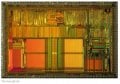
In the Intel 486 die photo below, most of the top third of the die is cell place and route. The rest is mainly full custom design. The block in the lower left is the microcode. To the right of it are the data and instruction caches.
It depends on the complexity/uniqueness of the design. For a simple CPU that is a small part of a full-custom ASIC developed by a small company, it may well be one person that does everything, from working with the customer to figure out what the real requirements are, to the schematic design and simulations, to the layout and design verification, to the eventual testing. Been there, done that. But more generally it is a team effort of people that specialize in different aspects of the design and that team could involve hundreds (thousands?) of people, with no one actually knowing every part of the chip from top to bottom -- that just becomes unrealistic when you have tens of billions of transistors involved.
Do they not have Google or YouTube where you live?
A quick search would have provided more information than you could ever digest, and enough that you could actually learn to design and fabricate your own rudimentary ICs.
First, a description of the functional requirements is created. Always the first step is a description of what is wanted. Then a logic design engineer creates a logic arrangement description to provide the desired functions. Next, an electronic engineer designs the circuit to provide those logic functions. After that IC device engineers determine the physical construction of the individual layers that become the electronic elements to become the actual logic circuit. THEN an IC design team develops an arrangement of elements to provide the required electronic circuit. THEN production engineers assist in creating the tooling to produce the patterns in the IC.
Now a question: Is this the same person or group that wanted to buy used IC production equipment and start producing ICs???

 Facebook
 Google
 GitHub
 Linkedin