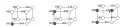
Apparently that just shows you the number of jumps you have to make according to the Hamming distance.
So you have to make 2 jumps in that case. For 001 and 110 you'd have to make 3 jumps (111).
Here is an experiment you can try next...
After you determine how many jumps you have to make, XOR your current position with the three possible positions remaining.
If it is the first jump, only jump to the next position that yields an XOR value with a '1' in the LSB of the result.
If it is the second jump, only jump to the next position that yields an XOR value with a '1' in the next LSB binary digit of the result.
If it is the third jump, only jump to the next position that yields an XOR value with a '1' in the next LSB which in this case is the MSB.
For your example, when you XOR 001 and 010 you get 011 and the Hamming distance for that is 2, so you know you have to make 2 jumps.
Next, XOR 001 with 000 and XOR 001 with 011 and XOR 001 with 101. The second and third results yield a '0' in the LSB so dont jump there. The first XOR yields a '1' in the LSB so jump there.
Now that you are there, XOR your position with the three new possible positions. When you get a '1' in the next LSB jump there only.
For example, 000 XOR 001 yields 001 so dont jump there, 000 XOR 100 yields 100 so dont jump there, 000 XOR 010 gives you 1 in that next LSB so jump there only. Since the distance was 2, you are done.
Now here is the kicker. I am just guessing here
You'll have to either prove it or find more information.

 Facebook
 Google
 GitHub
 Linkedin