It's dependent on the transistor specs and component values used.
On the breadboard the actual voltage measure is 4.02V on the emitter and 4.2V on the base.
It's dependent on the transistor specs and component values used.
On the breadboard the actual voltage measure is 4.02V on the emitter and 4.2V on the base.
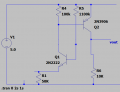
When power is first applied Q1 turns ON, which then turns Q3 ON. Vr5 is appx 4 volts and Vout is 5V.
Now C1 begins charging through R2 and D1. As the charge on C1 which is connected to the base of Q2 rises above the emitter voltage the transistor starts to conduct reducing the bias on Q1. Q1 will shut OFF turning OFF Q3 and Vout is 0V.
Once Q3 shuts OFF C1 begins discharging through R1,R2 and R3 until the voltage on the base of Q2 is too low to maintain conduction. The collector of Q2 begins to rise increasing the bias on Q1 until it begins to conduct again turning on Q3.
And the cycle repeats creating a square wave oscillator.
The use of feedback bias from Q3 to Q2 through D1 is the reason the transistors switch ON and OFF rapidly.
Creating a daisy chain effect.
When power is first applied Q1 turns ON, which then turns Q3 ON. Vr5 is appx 4 volts and Vout is 5V.
Now C1 begins charging through R2 and D1. As the charge on C1 which is connected to the base of Q2 rises above the emitter voltage the transistor starts to conduct reducing the bias on Q1. Q1 will shut OFF turning OFF Q3 and Vout is 0V.
Once Q3 shuts OFF C1 begins discharging through R1,R2 and R3 until the voltage on the base of Q2 is too low to maintain conduction. The collector of Q2 begins to rise increasing the bias on Q1 until it begins to conduct again turning on Q3.
And the cycle repeats creating a square wave oscillator.
The use of feedback bias from Q3 to Q2 through D1 is the reason the transistors switch ON and OFF rapidly.
Creating a daisy chain effect.
Its hard to understand because I think you have the transistors Q1, Q2, Q3 mixed up? One example C1 is not connected to the base of Q2. Their is alot of other mixed up so I am not sure how it still works.
Its hard to understand because I think you have the transistors Q1, Q2, Q3 mixed up? One example C1 is not connected to the base of Q2. Their is alot of other mixed up so I am not sure how it still works.
Apologize for that, below is the correct operation sequence.
When power is first applied Q1 turns ON, which then turns Q2 ON. Vr5 is appx 4 volts and Vout is 5V.
Now C1 begins charging through R2 and D1. As the charge on C1 which is connected to the base of Q3 rises above the emitter voltage the transistor starts to conduct reducing the bias on Q1. Q1 will shut OFF turning OFF Q2 and Vout is 0V.
Once Q2 shuts OFF C1 begins discharging through R1,R2 and R3 until the voltage on the base of Q3 is too low to maintain conduction. The collector of Q3 begins to rise increasing the bias on Q1 until it begins to conduct again turning on Q2.
And the cycle repeats creating a square wave oscillator.
The use of feedback bias from Q2 to Q3 through D1 is the reason the transistors switch ON and OFF rapidly.
Creating a daisy chain effect.
Apologize for that, below is the correct operation sequence.
When power is first applied Q1 turns ON, which then turns Q2 ON. Vr5 is appx 4 volts and Vout is 5V.
Now C1 begins charging through R2 and D1. As the charge on C1 which is connected to the base of Q3 rises above the emitter voltage the transistor starts to conduct reducing the bias on Q1. Q1 will shut OFF turning OFF Q2 and Vout is 0V.
Once Q2 shuts OFF C1 begins discharging through R1,R2 and R3 until the voltage on the base of Q3 is too low to maintain conduction. The collector of Q3 begins to rise increasing the bias on Q1 until it begins to conduct again turning on Q2.
And the cycle repeats creating a square wave oscillator.
The use of feedback bias from Q2 to Q3 through D1 is the reason the transistors switch ON and OFF rapidly.
Creating a daisy chain effect.
I know how they work but i cant get how you calculated q1 vbe at the start? Without vbe their is no way to know for sure state of q1. Its gets complicated you know with feedback and collector and emitter resistor

 Facebook
 Google
 GitHub
 Linkedin