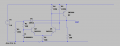
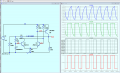
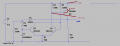
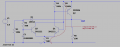
Below the circuit, I am having difficulty getting the voltages and currents at each node and how it produces a square wave at vout. Can someone please explain all this to me?
Seriously. I am trying to build oscillator square wave from transistor did research and got this link. See below link. Circuit is from the link. I posted on link but thread was closed stating open new one. I am wondering how the circuit works. My brain stops working when feedback is involved.
I can tell you how it works and what voltages are present at the nodes at different times and how it's calculated.
For starters I prefer to ask you questions about different aspects of the circuit to see if you understand the operation and calculation.
I can tell you how it works and what voltages are present at the nodes at different times and how it's calculated.
For starters I prefer to ask you questions about different aspects of the circuit to see if you understand the operation and calculation.
Unfortunately no.
It gets a little complicated because of current flow through the emitter-base and emitter-collector junctions.
Q1 is almost full saturated by current through R5. Therefore the collector voltage is slightly higher then the emitter voltage which makes the base voltage slightly higher then the emitter voltage.
Unfortunately no.
It gets a little complicated because of current flow through the emitter-base and emitter-collector junctions.
Q1 is almost full saturated by current through R5. Therefore the collector voltage is slightly higher then the emitter voltage which makes the base voltage slightly higher then the emitter voltage.

 Facebook
 Google
 GitHub
 Linkedin