Hello everyone!
I'm trying to understand how the Colpitts oscillator works.
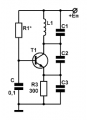
Could someone explain the roles of the capacitors labeled C and C3 in the circuit? What are they used for?
Thanks in advance!
View attachment 347760
Hello everyone!
I'm trying to understand how the Colpitts oscillator works.
Could someone explain the roles of the capacitors labeled C and C3 in the circuit? What are they used for?
Thanks in advance!
Well, I know that capacitor C is supposed to configure the transistor in a common-base setup. But I'm not completely sure about that, because many sources say that this capacitor blocks the AC signal, and that the circuit wouldn't work without it.
As for capacitor C3 — I have no idea what it's used for.
Well, I know that capacitor C is supposed to configure the transistor in a common-base setup. But I'm not completely sure about that, because many sources say that this capacitor blocks the AC signal, and that the circuit wouldn't work without it.
As for capacitor C3 — I have no idea what it's used for.
It provides a alternative path that might be equal to a short at AC but not DC. So, in a way it would block the AC by removing it from the other signal paths.
C3, ok tell us what R3 does and think about what effect a AC alternative path would have to what it does.
It provides a alternative path that might be equal to a short at AC but not DC. So, in a way it would block the AC by removing it from the other signal paths.
C3, ok tell us what R3 does and think about what effect a AC alternative path would have to what it does.
Why is it necessary to remove the AC component? What problem does it cause?
Resistor R3 sets the operation mode of transistor T1 to enable oscillation.
I think if capacitor C blocks the AC component, it will pass through resistor R3, because it has nowhere else to go. Is that correct?
To understand why and how a harmonc oscillator works, one must remember the oscillation condition as formulated by Barkhausen:
"An active element (amplifier) with positive feedback must have a lopp gain which is (slightly) larger than unity at one single frequency only."
In the example under discussion we have a common base amplification stage with positive gain (between emitter and collector).
This gain is developped across an L-C resonant circuit. The resistor R3 sets a suitable DC bias point.
In order to allow a loop gain larger than unity (but not too large with respect to heavy distortions due to overdrive effects) the feedbacl loop is closed using a capacitive signal voltage divider C2-C3.
The values of these capacitors must be carefully selected in order to fulfill the above mentioned requirements and restrictions (loop gain somewhat larger than unity).
PS (comment): I cannot see how a capacitor coudld "block" any ac component.
Why is it necessary to remove the AC component? What problem does it cause?
Resistor R3 sets the operation mode of transistor T1 to enable oscillation.
I think if capacitor C blocks the AC component, it will pass through resistor R3, because it has nowhere else to go. Is that correct?
R1 provides bias for the base along with R3, a steady DC current. Blocks is a misnomer here, bypass ( alternative path) would be better.
This is a common base configuration. Common means a reference point like circuit ground. The base needs the DC bias but but it also needs the AC signal to be at or near our common reference. C does that.
To understand why and how a harmonc oscillator works, one must remember the oscillation condition as formulated by Barkhausen:
"An active element (amplifier) with positive feedback must have a lopp gain which is (slightly) larger than unity at one single frequency only."
In the example under discussion we have a common base amplification stage with positive gain (between emitter and collector).
This gain is developped across an L-C resonant circuit. The resistor R3 sets a suitable DC bias point.
In order to allow a loop gain larger than unity (but not too large with respect to heavy distortions due to overdrive effects) the feedbacl loop is closed using a capacitive signal voltage divider C2-C3.
The values of these capacitors must be carefully selected in order to fulfill the above mentioned requirements and restrictions (loop gain somewhat larger than unity).
PS (comment): I cannot see how a capacitor coudld "block" any ac component.
R1 provides bias for the base along with R3, a steady DC current. Blocks is a misnomer here, bypass ( alternative path) would be better.
This is a common base configuration. Common means a reference point like circuit ground. The base needs the DC bias but but it also needs the AC signal to be at or near our common reference. C does that.
nsaspook, I'm still not completely clear on everything. I know that R1 and R3 set the bias point of the transistor. Now I understand that capacitor C prevents the signal from going to the transistor's base, thanks to you. Could you please explain how the feedback works with some guiding questions? Thanks!
nsaspook, I'm still not completely clear on everything. I know that R1 and R3 set the bias point of the transistor. Now I understand that capacitor C prevents the signal from going to the transistor's base, thanks to you. Could you please explain how the feedback works with some guiding questions? Thanks!
@LvW, i understand that the capacitive divider forms the feedback and causes the transistor to turn on at the right time to maintain oscillations. But why is a divider specifically used here? Is it possible to use only C2?
@LvW, i understand that the capacitive divider forms the feedback and causes the transistor to turn on at the right time to maintain oscillations. But why is a divider specifically used here? Is it possible to use only C2?
As I have tried to explain, for a "good" oscillator which
(a) is able to start oscillations (loop gain>1) and
(b) can produce pretty "good" signals (loop gain not too large)
we always should try to realize a loop gain at w=wo that is only somewhat larger than unity.
For a specific design (DC operating point, DC feedback, gain determining transconductance) it might be possible to fulfill both requirements (a) and (b) with one capacitor C2 only.
However, it is always good to have the freedom to "fine tune" the loop gain to a desired value using such a capacitive divider.
The problem to create a "good" oscillator can be summarized in the following nice sentence:
"A harmonic oscillator should be as linear as possible; and this requirement can be fulfilled only when this oscillator contains - at the same time - an element with a certain non-linearity."


 Facebook
 Google
 GitHub
 Linkedin