Facebook
 Google
 GitHub
 Linkedin

Hi folks!
I have a question about BJTs. I understand how P-N junctions work in and out now, but in modeling a PNP in my head (and on paper), something doesn't quite make sense. In a P-N Junction applying a forward bias reduces the junction (more or less), and you can overcome the junction potential and you get electron drift:

However, consider the following PNP junction:
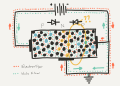
The PN junction (Collector to Base) is just a diode, so as long as you overcome the junction field, all is good. But the I don't understand how the NP junction on the right works. I recognize that it's not _quite_ reverse biased, since the N layer is hooked to ground (good), but the P is also hooked to ground. Why would that cause electron drift through the NP junction and hole flow out the Emitter?
I have a question about BJTs. I understand how P-N junctions work in and out now, but in modeling a PNP in my head (and on paper), something doesn't quite make sense. In a P-N Junction applying a forward bias reduces the junction (more or less), and you can overcome the junction potential and you get electron drift:
However, consider the following PNP junction:
The PN junction (Collector to Base) is just a diode, so as long as you overcome the junction field, all is good. But the I don't understand how the NP junction on the right works. I recognize that it's not _quite_ reverse biased, since the N layer is hooked to ground (good), but the P is also hooked to ground. Why would that cause electron drift through the NP junction and hole flow out the Emitter?