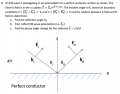
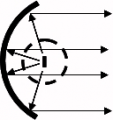
Wire 'CAN' absorb energy. That represents an energy loss in the RF transmission system so you want to keep energy out of the wire by design with reflection and transmission modes by physical shaping. The better the conductor, the more energy is reflected (the wire surface can be plated with a lower resistance conductor) and not absorbed. https://www.antenna-theory.com/antennas/reflectors/dish.php
This works for any EM signal, as high quality metallic optical mirrors are generally coated in silver to reflect light EM waves with a coefficient of reflection >90%.
The boundary conditions of the EM media as it passes from one to the other is another important design condition for EM energy transmission.
So in essence if angle of incidence is critical in absorption, then should we not be making antennas out of flat bands instead of round pegs?
- How can one get the coefficient angles for various materials say Aluminum vs Steel vs Copper for the various frequencies. Do the frequencies change the coefficients of reflection.
Just expanding on this -
"Wire 'CAN' absorb energy. That represents an energy loss in the RF transmission system so you want to keep energy out of the wire by design with reflection and transmission modes by physical shaping. The better the conductor, the more energy is reflected (the wire surface can be plated with a lower resistance conductor) and not absorbed."
So if I was to write an antenna simulator software how does the traveling wave actually look at the micron edge of a wire as it heads down to the receiver accounting for skin effect etc.
I have also noticed the effect of coupling disimular metals say coupling iron to aluminum can cause various frequencies to completely reflect back as the index of refraction is quite different - but how would the index of refraction shift due to frequency?
So in essence if angle of incidence is critical in absorption, then should we not be making antennas out of flat bands instead of round pegs?
- How can one get the coefficient angles for various materials say Aluminum vs Steel vs Copper for the various frequencies. Do the frequencies change the coefficients of reflection.
We can and do make antennas out of flat bands. It's commonly called a 'patch antenna'. https://www.allaboutcircuits.com/tools/microstrip-patch-antenna-calculator/
We usually optimize the angles by pointing the antenna in the direction of the signal.
Aluminum vs Steel vs Copper are more loss and weight factors than coefficients of reflection factors in RF antenna design due to skin effect making the boundary surface resistance much more important than bulk material electrical properties.
Just expanding on this -
"Wire 'CAN' absorb energy. That represents an energy loss in the RF transmission system so you want to keep energy out of the wire by design with reflection and transmission modes by physical shaping. The better the conductor, the more energy is reflected (the wire surface can be plated with a lower resistance conductor) and not absorbed."
So if I was to write an antenna simulator software how does the traveling wave actually look at the micron edge of a wire as it heads down to the receiver accounting for skin effect etc.
I have also noticed the effect of coupling disimular metals say coupling iron to aluminum can cause various frequencies to completely reflect back as the index of refraction is quite different - but how would the index of refraction shift due to frequency?
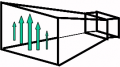
So lets take a Fresnel type antenna where the coiled wire 1/2 wavelength is much larger than the diameter of the coil. Say if we took a 200m wire and coiled it down to a size of a dinner plate, it should be resonant at the larger wavelength, but then add several fresnel antennas on the z axis would we not have something similar to a feed horn but working at much lower frequencies?
So lets take a Fresnel type antenna where the coiled wire 1/2 wavelength is much larger than the diameter of the coil. Say if we took a 200m wire and coiled it down to a size of a dinner plate, it should be resonant at the larger wavelength, but then add several fresnel antennas on the z axis would we not have something similar to a feed horn but working at much lower frequencies?
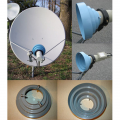
These types of antenna structures are much more practical at higher frequencies. The LNB Scalar rings are like Fresnel zone reflectors sized to the reflector.
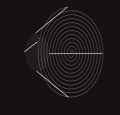
Hard to draw - the length of the wire Fresnel Spiral is significantly more than the diameter of the oval. Has anyone modeled this type of antenna, and how (or which) software would one recommend if one was to model this in it's RF pattern? Additionally the larger cone may itself be a sunken bevel forming a 'reflective' type surface but still exhibiting 1/2 - 1/4 wavelength of the total length of the coiled wire. Additionally when these are stacked would they exhibit ' energy focality' like a feed-horn at significantly longer wavelengths than normal? How long do the simulators take to simulate a transmission?
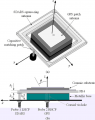
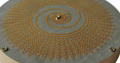
"Archimedean spiral antennas (ARSAs) are attractive for a variety of RF and microwave applications. They have been used for circularly polarized broadband communications and can be easily flush mounted in many systems. They are characterized by stable input impedance and radiation characteristics over several octaves."
Because it is flat it is also very aerodynamic and makes for very simple repeater for all kinds of usages as in:
- However I do believe that stacking these makes some kind of focality or focusing from previous basic experimentation.
Hard to draw - the length of the wire Fresnel Spiral is significantly more than the diameter of the oval. Has anyone modeled this type of antenna, and how (or which) software would one recommend if one was to model this in it's RF pattern? Additionally the larger cone may itself be a sunken bevel forming a 'reflective' type surface but still exhibiting 1/2 - 1/4 wavelength of the total length of the coiled wire. Additionally when these are stacked would they exhibit ' energy focality' like a feed-horn at significantly longer wavelengths than normal? How long do the simulators take to simulate a transmission?
"Archimedean spiral antennas (ARSAs) are attractive for a variety of RF and microwave applications. They have been used for circularly polarized broadband communications and can be easily flush mounted in many systems. They are characterized by stable input impedance and radiation characteristics over several octaves."
Because it is flat it is also very aerodynamic and makes for very simple repeater for all kinds of usages as in:
- However I do believe that stacking these makes some kind of focality or focusing from previous basic experimentation.

 Facebook
 Google
 GitHub
 Linkedin