How do they get the amperage to triple digit CC MOSFETs?

Thread Starter

ballsystemlord

Joined Nov 19, 2018
253
Hello,
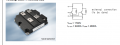
So I was thinking about how some MOSFETS, like this one in a TO-220 package, can support 100+ amps continuous current. How do they get that much amperage into such MOSFETs to test the initial design? How do they expect EEs to get that much amperage into those high current MOSFETs?

Mind, the leads on a TO-220 package are about equal in size to 14AWG wire. According to wiresize calculators, a 14AWG conductor (60C insulation), would support no more than 25A in still air. So we cannot get a big enough wire to solder to the base of the TO-220's terminals. Even if such calculators are very conservative, doubling that number would still put us well below >=100A.

Thanks

PS: This post is strictly for educational purposes. I have no need to put that much current through a MOSFET.
 

ronsimpson

Joined Oct 7, 2019
4,660
The bonding wires fuse open at 200A. (that is DC)
I have used parts like this at full current but the duty cycle is low. 200A at 10% duty cycle. I have tested parts like this at 500A for 1mS.
 
Last edited:

ElectricSpidey

Joined Dec 2, 2017
3,316
When calculating ampacity of a conductor you must also consider the length.

So, the ampacity of a 1/4" long conductor would be much greater than the numbers presented in those calculators.

Note the difference between the ampacity of chassis wiring and power cables.

Of course, interfacing a high current MOSFET with a load is still a challenge.
 

Thread Starter

ballsystemlord

Joined Nov 19, 2018
253
When calculating ampacity of a conductor you must also consider the length.

So, the ampacity of a 1/4" long conductor would be much greater than the numbers presented in those calculators.

Note the difference between the ampacity of chassis wiring and power cables.

Of course, interfacing a high current MOSFET with a load is still a challenge.
How exactly do you go about calculating the ampacity of a conductor?
Might sound stupid, but the resistance of copper is about as close as I've gotten to doing this in the books I've read so far.
My searches have only ever turned up power cable and extension cord ampacity calculators.

Thanks
 

Papabravo

Joined Feb 24, 2006
22,065
How exactly do you go about calculating the ampacity of a conductor?
Might sound stupid, but the resistance of copper is about as close as I've gotten to doing this in the books I've read so far.
My searches have only ever turned up power cable and extension cord ampacity calculators.

Thanks
From the resistivity of the material and the length you can calculate the rise in temperature for a given current. That temperature rise cannot cause the wire or any of the bonding agents along its path to even come close to melting.
 

Thread Starter

ballsystemlord

Joined Nov 19, 2018
253
I reasoned as much, but copper wire isn't pure copper. Temperature rise depends on if you're talking about wire in air, PCB outer or inner layer, etc.
 

ronsimpson

Joined Oct 7, 2019
4,660
Current rating is based on temperature. For example, wire your house running through walls with wall insulation are rated at a very low current because there is no whare for the heat to go. Wire without insulation exposed to air flow has a much higher rating.
Many data sheets show a bonding wire current rating. Then a package rating and a silicon rating.
Life is not simple. lol
 

ronsimpson

Joined Oct 7, 2019
4,660
How do they get that much amperage into such MOSFETs to test the initial design?
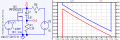
I have some 2000 volt power supplies. For testing high voltage IGBTs and FETs. I do not pull 2000A directly from the power supplies. (2kA not a type-o) The power supplies charge up a capacitor bank the size of a lunch box. (big lunch box) The current comes from the capacitors. I turn on the FET for 10uS off for 10uS then back on for 10uS and off. During the middle off time the current is stored on an air core inductor.
1723562550272.png
 

Danko

Joined Nov 22, 2017
2,153
Mind, the leads on a TO-220 package are about equal in size to 14AWG wire.
According to wiresize calculators, a 14AWG conductor (60C insulation), would support no more than 25A in still air.
So we cannot get a big enough wire to solder to the base of the TO-220's terminals.
Even if such calculators are very conservative, doubling that number would still put us well below >=100A
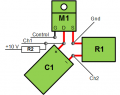
No wires, only shortened leads:
1723562294007.png1723631207972.png
 
Last edited:

Thread Starter

ballsystemlord

Joined Nov 19, 2018
253
@ronsimpson , I was thinking about smaller packages, such as TO-220, TO-247. I do know you can get much more power through a big wire and a screw lug.

@Danko , Yes, you can shorten the leads, but for any "realistic" project, I don't think running really short wires is all that is done. Maybe for the last inch or so to get the power into the MOSFET.
 

WBahn

Joined Mar 31, 2012
32,747
I reasoned as much, but copper wire isn't pure copper. Temperature rise depends on if you're talking about wire in air, PCB outer or inner layer, etc.
Which is why the ampacity of conductors isn't based solely on the cross-sectional area or the total resistance. You have to look at the environment that the conductor is in, and you have to model that environment adequately (or simply collect appropriate data). You can often find tables for common situations, such as the rules for current limitations for PCB traces recommended by the PCB house.
 

Danko

Joined Nov 22, 2017
2,153
@Danko , Yes, you can shorten the leads, but for any "realistic" project, I don't think running really short wires is all that is done. Maybe for the last inch or so to get the power into the MOSFET.
Big test current goes in loop C1, R1, M1 through red marked conductors (leads) only.
Power for setup arrives through resistor R2 (I=10 mA).
So, here is no reason to use thick wires, at all.
See picture in post #9.
ADDED:
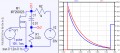
At V2=30 V and R1=0.01 Ω, test current is more than 900 A:
1723904129491.png
 
Last edited:

du00000001

Joined Nov 10, 2020
189
Hello,
So I was thinking about how some MOSFETS, like this one in a TO-220 package, can support 100+ amps continuous current. How do they get that much amperage into such MOSFETs to test the initial design? How do they expect EEs to get that much amperage into those high current MOSFETs?

Mind, the leads on a TO-220 package are about equal in size to 14AWG wire. According to wiresize calculators, a 14AWG conductor (60C insulation), would support no more than 25A in still air. So we cannot get a big enough wire to solder to the base of the TO-220's terminals. Even if such calculators are very conservative, doubling that number would still put us well below >=100A.

Thanks

PS: This post is strictly for educational purposes. I have no need to put that much current through a MOSFET.
"Playing" with the settings in wiresize, you would have found that 90 °C insulation rises the current allowed to 35 A.
The "ampacity" of a wire depends beyond the cross-section on maximum ambient temperature, temperature rise acceptable, power dissipation in the proximity of the conductor (incl. heat sinking) and much more.
Avvery long time ago I've researched on a similar topic - just to find out that no standard (aka "norm") exists that would give current values for a given cross-section. (The standard just gave away "design considerations".) BTW: the wire insulation doubles as a thermal insulation, thus reducing the allowable current. (Check the values for "cable" in wiresize! ("cable" to be interpreted as a number of individual insulated wires enclosed in a common outer insulation.)

In the end it's all about the maximum temperature acceptable. So a non-insulated trace with a given cross-section on a 125 °C PCB (or a "naked" wire) is able to carry significantly more current than an insulated wire of the same cross-section.
In the past I found that a 255 mil trace with 30 um thickness (about 0.2 mm²) on a PCB could easily carry 10 A (our then goal). Now think about "thick copper" (most likely 140 um) and even wider traces, maybe on both outer surfaces: difficult to solder, but quite capable in terms of ampacity.
 
Top