How do power supplies operate?

Thread Starter

birckcmi

Joined Jan 1, 2018
216
I know that title sounds suspiciously dumb, but here's my reason: I needed a decent lab power supply, so I bought a used HP 10-amp PS, fixed some obvious problems that needed solving before I could use it, hooked up my multimeter and switched the PS on. The voltage reading I got was bang on, but I got no action at all from the ammeter(even after I had set the multimeter correctly for reading amps). It occurred to me that I may not be able to get an amp reading until I have the PS connected to a load that demands current at some level. And that is my question. Do I need to have the load in the circuit before I will get an amp reading?
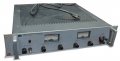
HP PS photo.jpg
 

OBW0549

Joined Mar 2, 2015
3,566
It occurred to me that I may not be able to get an amp reading until I have the PS connected to a load that demands current at some level. And that is my question. Do I need to have the load in the circuit before I will get an amp reading?
Yes. With no load, the PS isn't supplying any current.

A power supply's current rating simply tells you how much current the supply is capable of outputting (before it overheats, shuts down, trips off, blows up, catches fire, beeps, goes into current limit mode, etc. etc.); it is the load which determines how much current will flow.
 

Thread Starter

birckcmi

Joined Jan 1, 2018
216
Thanks, OBW0549. So until further notice I will assume that everything is working. Everything looks good- no scorch marks, no suspicious sparks or buzzing sounds. The voltmeter is accurate, so I know the unit is putting out something.
 

Lo_volt

Joined Apr 3, 2014
370
A quick method to set the current limit of a power supply like that is to set the voltage to a low setting (~1 volt is fine) and short the output. This allows you to adjust the current limit to your desired setting. Keep in mind that the wire that you use to short the output must be capable of handling the current you will drive through it. 30 AWG wire will melt before you turn the current up very far. For a 10 amp supply, 18 AWG will work for a short while. You may notice it getting warm if you leave it set at 10 amps for more than a few seconds. Once the current limit is set, remove the shorting wire and set the voltage to your desired setting.

To determine the accuracy of the current setting would require buying high wattage low value resistors to use as loads and measuring the current at different voltage settings. With analog meters like that, the precision of the measurement is pretty coarse. To test your supply, I'd just make sure that it can supply 10 amps and that it's not varying while supplying that current.
 

SamR

Joined Mar 19, 2019
5,478
I would advise using a resistor. A dead short even at LO V is infinite A and could either trip something or hit the current limiter and drawdown V to compensate. Even a kΩ will do. Do the math! You could probably get away with a momentary short but do it with a load.
 

OBW0549

Joined Mar 2, 2015
3,566
I would advise using a resistor. A dead short even at LO V is infinite A and could either trip something or hit the current limiter and drawdown V to compensate. Even a kΩ will do. Do the math! You could probably get away with a momentary short but do it with a load.
Good advice. Nothing wrong with shorting the power supply's output if it has a current limit function and IF its current limit function is known to operate properly; if that's the case, no harm will be done. But if the supply doesn't have current limiting, or its current limiting is not functioning, POOF!

Incandescent lamps make good loads for this purpose; a 120V 100W lamp will draw about 130 mA with 12V across it, enough to give the ammeter a rough test. High-wattage resistors are a bit pricey; light bulbs are cheap.
 

AlbertHall

Joined Jun 4, 2014
12,624
Good advice. Nothing wrong with shorting the power supply's output if it has a current limit function and IF its current limit function is known to operate properly; if that's the case, no harm will be done. But if the supply doesn't have current limiting, or its current limiting is not functioning, POOF!

Incandescent lamps make good loads for this purpose; a 120V 100W lamp will draw about 130 mA with 12V across it, enough to give the ammeter a rough test. High-wattage resistors are a bit pricey; light bulbs are cheap.
Or a car headlight bulb for higher current.
 

Thread Starter

birckcmi

Joined Jan 1, 2018
216
Good advice. Nothing wrong with shorting the power supply's output if it has a current limit function and IF its current limit function is known to operate properly; if that's the case, no harm will be done. But if the supply doesn't have current limiting, or its current limiting is not functioning, POOF!

Incandescent lamps make good loads for this purpose; a 120V 100W lamp will draw about 130 mA with 12V across it, enough to give the ammeter a rough test. High-wattage resistors are a bit pricey; light bulbs are cheap.
Great idea. I actually have an electrician's bulb+socket on long wires for checking wiring.
 

Lo_volt

Joined Apr 3, 2014
370
I would advise using a resistor. A dead short even at LO V is infinite A and could either trip something or hit the current limiter and drawdown V to compensate. Even a kΩ will do. Do the math! You could probably get away with a momentary short but do it with a load.
The TS has a power supply with current limit adjustment. A power supply like that will of course draw down the voltage when the output is shorted. With the output shorted, it will change to current limiting mode, the limit of which will be determined by the current adjustment knob.

A dead short is never really a dead short; it always has some resistance. If he's trying to set the current limit, he'll need to use a pretty low value resistor to be able to draw the current he needs to make the current setting adjustment. If he sets the output to 12 volts he'll need a 1.2 ohm resistor to adjust it up to 10 amps. Do the math.

I've used similar power supplies to drive LED's in current mode and used the above procedure to adjust the supply. Once the current limit is set, in my case the LED drew 1 amp of current, I turned the voltage setting just above the LED operating voltage. With the LED connected, the power supply voltage dropped to the LED forward voltage but the current was regulated to the setting that I determined when adjusting the supply, i.e. 1 amp.
 

AlbertHall

Joined Jun 4, 2014
12,624
A dead short is never really a dead short; it always has some resistance. If he's trying to set the current limit, he'll need to use a pretty low value resistor to be able to draw the current he needs to make the current setting adjustment. If he sets the output to 12 volts he'll need a 1.2 ohm resistor to adjust it up to 10 amps. Do the math.
At the moment we don't know that the current limit works so a short is not a good idea if the current isn't limited. You need a load which will draw some current within the range of the supply, not necessarily near the maximum then you can see whether turning down the limit does indeed reduce the output.
 

Thread Starter

birckcmi

Joined Jan 1, 2018
216
At this point, I just want to determine that the power supply is doing what it's supposed to. So attaching a 100-watt or greater bulb across the output will give me enough resistance, at a medium amperage (100 W divided by 12 volts= 8.3 amps) to at least register on the power supply's ammeter and the multimeter, no? The specs tell me that constant voltage is <36VDC and constant current is <10 amps, so if I go up to 24 VDC, I can limit the amps to 4.2. Does that sound right, or have I screwed up Ohm's law again?
 
Last edited:

AlbertHall

Joined Jun 4, 2014
12,624
If the 100W bulb is a mains voltage bulb that would be about 576Ω (240V bulb) or 121Ω (110V bulb). Now that resistance is when the bulb is hot so at <36V it won't be hot so the resistance will be lower than that but the current will still be low but may be enough to determine if the current limit works.

Incidentally, even with no load, if you turn the current limit right down do you still get output voltage?
If the current limit is adjustable down to zero then it should collapse the output voltage when turned right down. If it doesn't this does not mean it is not working. Usually there is an internal adjustment to set the minimum limit and that only needs to be a tiny bit out to fail this simple test.
 

crutschow

Joined Mar 14, 2008
38,430
So attaching a 100-watt or greater bulb across the output will give me enough resistance, at a medium amperage (100 W divided by 12 volts= 8.3 amps)
That's only true of the bulb is rated for 12V, 100W.
A 100W, 120V bulb will have a hot resistance (at 120V) of 120²/100W =144Ω and a much lower cold resistance.

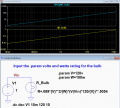
Below is the simulation of an incandescent bulb using an empirical Spice model.
It shows that a 100W, 120V bulb will draw about 270mA @ 12V.

1580934992474.png
 

Thread Starter

birckcmi

Joined Jan 1, 2018
216
If the 100W bulb is a mains voltage bulb that would be about 576Ω (240V bulb) or 121Ω (110V bulb). Now that resistance is when the bulb is hot so at <36V it won't be hot so the resistance will be lower than that but the current will still be low but may be enough to determine if the current limit works.

Incidentally, even with no load, if you turn the current limit right down do you still get output voltage?
If the current limit is adjustable down to zero then it should collapse the output voltage when turned right down. If it doesn't this does not mean it is not working. Usually there is an internal adjustment to set the minimum limit and that only needs to be a tiny bit out to fail this simple test.
Yes, I still get voltage.
 

OBW0549

Joined Mar 2, 2015
3,566
Incandescent lamps make good loads for this purpose; a 120V 100W lamp will draw about 130 mA with 12V across it, enough to give the ammeter a rough test.
Oops. @crutschow's post #15 made me scratch my head:

Below is the simulation of an incandescent bulb using an empirical Spice model. It shows that a 100W, 120V bulb will draw about 270mA @ 12V.
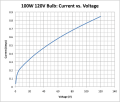
Oops. It turns out the number I cited, taken from actual measurements, was for a 40W bulb, not a 100W. Looking at the measurement data for a 100W bulb, I get the same value for current that @crutschow gave. Here's the chart:

100W120V.png
 
That power supply may have straps for local/remote sense and/or master/slave operation.

Get a copy of the "HP DC power supply handbook" It should be online for free. HP was Agilent and now Keysight
 
Top