How come I can touch the neutral bus?

MrChips

Joined Oct 2, 2009
34,882
When TS said “hot” he was not referring to ”hot” as in temperature. He meant “line” or “live”.

The neutral wire is not “live” because it is at earth potential under normal circumstances. In a fault condition, if the neutral wire got disconnected from the electrical utility, it can become “live” and you could be executed by touching it.
 

metermannd

Joined Oct 25, 2020
472
The neutral is basically the center tap on the distribution transformer secondary.

In my previous apartment, I began having issues with the lights changing in intensity as various things were turned on or off, and I finally took matters into my own hands - turned off everything, turned off the main breaker at my panel, then took the panel cover off to double-check the mains connections. The neutral had either worked loose or was never snugged properly. I carefully tightened it and checked the others (all work with the panel cover off was one-handed, as the other was needed to hold the flashlight!) I then put everything back together and brought everything back up. That proved to me that a poor neutral connection can be just as dangerous as a bare live wire. :)
 

B-JoJo-S

Joined Jan 3, 2026
349
I love to draw.
Screenshot 2026-02-17 at 10.14.15 AM.png
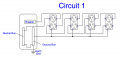
In Circuit 1 there are no faults. Touching neutral anywhere along the path will result in no shocks. Neither should you get a shock when touching ground.
Screenshot 2026-02-17 at 10.14.40 AM.png
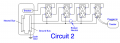
In Circuit 2 there is a fault. The neutral wire is broken. If nothing is plugged in you can touch neutral anywhere along the path and you won't get shocked. There should be no voltage anywhere on the path. HOWEVER, if something is plugged in, a clock, a lamp a toaster etc. if you touch the neutral wire on either of the two right outlets you WILL get a shock IF you are touching ground at the same time. If you touch neutral and ground and you get a shock then you have a broken wire somewhere along the return path. I chose to draw the break between the four outlets but it could be anywhere between the last outlet and the Neutral Bus. But you don't have to touch these wires to know if there's a fault. Use a volt meter to measure the presence of line voltage between Neutral and Ground. Any voltage tells you there's an issue.

Not only is there an issue in circuit 2 the toaster will not work either.

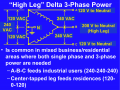
In North America electrical wiring is from a split phase transformer. L1 to L2 = 240 volts. L1 to Neutral or L2 to Neutral will be 120 volts. Neutral at the transformer is connected to grounding rods deep into the ground. That's why you can get a shock if you touch L1 or L2 while standing bare foot in wet grass. Oh - and concrete CAN conduct electricity too.

Hope this helps.
 
Last edited:

Futurist

Joined Apr 8, 2025
789
The hot is in quotes because it's not really hot hot but electrons are flowing to (toward) hot instead of from it during reversal.
Imagine a car battery, connect two wires to the -ve terminal.

Now measure the voltage between the two wires.

Now replace the battery with a small AC dynamo, again measure the voltage between the two wires.

Now replace the dynamo with a gasoline powered AC generator, again measure the voltage between the two wires.

What is the measured voltage in each of the three cases?
 

nsaspook

Joined Aug 27, 2009
16,344
1771689020904.jpeg
1771689044097.jpeg

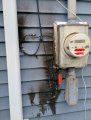
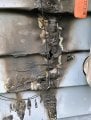
What can happen when you have a bad neutral connection. The coax shield becomes a current carrying wire for the home utility wiring.
 
Top