Homemade Multi-Drill

Thread Starter

Cosmosus_

Joined Jul 7, 2018
15
Hi,
I'm thinking of making a multi drill for wood drilling, that uses anywhere from 6 to 9 9V or 12V DC motors. These motors would be wired in parallel, with one battery source. I'd mount a drill chuck on each of the motors shafts for a drill bit. Now, I need a little bit of help from you. Do any of you have an experience in doing such a project?
My main concerns are drilling torque so that I could drill holes effortlessly in about 5 centimeter thick wood frames. Also, Another concern is battery life and how many volt batteries should I get? With same voltage as the motors? Are DC motors prone to overheating by working close to their full potential? My goal is to have reliable and long-lasting contraption for drilling.

Thank you very much, I wish you all a good day!
 

Thread Starter

Cosmosus_

Joined Jul 7, 2018
15
I was thinking anywhere from 6-8 drills, spaced about 5 centimeters apart. I would like to be able to use smaller aswell as bigger drill bits, like 10 mm.
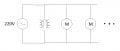
Maybe batteries are more of a hassle than I thought. After more thinking about this project, the best option would be 220V power supply rather than battery, since this machine would only be needed in garage. In this case, a transformator should be wired before the circuit (motors). Would I need anything else, like voltage regulator? My main goal with this project is being as straightforward and simple as possible, with enough DC motor torque to drill thicker pieces of wood and without motors overheating.

Here's a circuit of what I'm trying to achieve:
 

Attachments

MaxHeadRoom

Joined Jul 18, 2013
30,658
The motors in the pic appear to be small DC maybe not capable of using 10mm bits.
You would need a large bridge rectifier also.
Max.
 

-live wire-

Joined Dec 22, 2017
959
I recommend getting a very powerful stepper motor like this and incorporating a microcontroller into the design. Get a good driver for it. Maybe something like this. It is 4A and .9 ohms. But, it need more than 5V (V = I*R). There is inductive reactance which will significantly reduce the current at a given voltage. The driver ensures constant current, but it can only do that with a high enough voltage. So a reasonable voltage to supply is at least 12V.

You can then make a 4s 1p pack of these 18650s. That means 2.6AH, 14.4V nominal (12v min and 16.8 max), and 32WH. That would be just $12. It would just need a BMS and holder, which can be bought cheaply off of ebay. It would give you an approximate battery life of half an hour or more. If you need more capacity just get more cells.

The microcontroller can be an arduino nano. You can easily program it with a computer and the cable. You can have pushbuttons and stuff to chose higher torque or higher speed, or to switch between them. You can even program it to start out with higher torque and increase the speed. You can add indication LEDs to show the mode.

If this seems expensive, you can always look for cheaper motors, drivers, etc. But they will not be as powerful.
 

Thread Starter

Cosmosus_

Joined Jul 7, 2018
15
I recommend getting a very powerful stepper motor like this and incorporating a microcontroller into the design. Get a good driver for it. Maybe something like this. It is 4A and .9 ohms. But, it need more than 5V (V = I*R). There is inductive reactance which will significantly reduce the current at a given voltage. The driver ensures constant current, but it can only do that with a high enough voltage. So a reasonable voltage to supply is at least 12V.

You can then make a 4s 1p pack of these 18650s. That means 2.6AH, 14.4V nominal (12v min and 16.8 max), and 32WH. That would be just $12. It would just need a BMS and holder, which can be bought cheaply off of ebay. It would give you an approximate battery life of half an hour or more. If you need more capacity just get more cells.

The microcontroller can be an arduino nano. You can easily program it with a computer and the cable. You can have pushbuttons and stuff to chose higher torque or higher speed, or to switch between them. You can even program it to start out with higher torque and increase the speed. You can add indication LEDs to show the mode.

If this seems expensive, you can always look for cheaper motors, drivers, etc. But they will not be as powerful.
Thank you! What a detailed response! but wow, is this expensive! I'm looking for the cheapest option I can get away with, but still provided with good drilling power and not worrying about motors overheating.This "machine" is used for drilling multiple holes at the same time, evenly spaced.It is used for making holes in hive frames. Don't know exactly why, but there is a demand in my area, so I thought I could begin with this project. Maybe I exaggerated with drill bit thicknes, I have to ask a friend to tell me which diameter is maximum he would use.
All the mechanical parts I can get for free, laser cut, even stainless steel.
I concluded that power from outlet is better option, since it doesn't require batteries and people use this machine in a garage anyways. So if I use 220V i would need transformer and some kind of bridge rectifier?
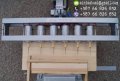
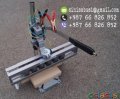
Here are pictures of what I'm trying to accomplish:
 

-live wire-

Joined Dec 22, 2017
959
Thank you! What a detailed response! but wow, is this expensive! I'm looking for the cheapest option I can get away with, but still provided with good drilling power and not worrying about motors overheating.This "machine" is used for drilling multiple holes at the same time, evenly spaced.It is used for making holes in hive frames. Don't know exactly why, but there is a demand in my area, so I thought I could begin with this project. Maybe I exaggerated with drill bit thicknes, I have to ask a friend to tell me which diameter is maximum he would use.
All the mechanical parts I can get for free, laser cut, even stainless steel.
I concluded that power from outlet is better option, since it doesn't require batteries and people use this machine in a garage anyways. So if I use 220V i would need transformer and some kind of bridge rectifier?
Here are pictures of what I'm trying to accomplish:
There are certainly much more economical solutions out there. It just sounded like your main priority was customization, even if it is more costly. Power from an adapter is definitely a better option, but it sounded like you needed it to be portable. Sorry if I misread something.

So have you considered some sort of gear mechanism to drive multiple bits at the same time? This would mean you don't need to buy many motors (which will be expensive). If you need independent control of the drills, try getting motors with a large gear reduction ratio. As the saying goes, even the tiniest of motors can move a mountain with a large enough reduction ratio. The one thing is more torque mean less RPM with the gear ratio. So just make sure it will have the minimum acceptable RPM.

A brushed DC motor might actually be better here. It is much simpler to control and is cheaper in total. The issue is if you want to increase the speed, you have to increase the power, and torque. It does not allow for as much control as a stepper. And you cannot hold a position without complicated feedback (like in a servo). Also, the brushes will wear out over time.
 

Thread Starter

Cosmosus_

Joined Jul 7, 2018
15
There are certainly much more economical solutions out there. It just sounded like your main priority was customization, even if it is more costly. Power from an adapter is definitely a better option, but it sounded like you needed it to be portable. Sorry if I misread something.

So have you considered some sort of gear mechanism to drive multiple bits at the same time? This would mean you don't need to buy many motors (which will be expensive). If you need independent control of the drills, try getting motors with a large gear reduction ratio. As the saying goes, even the tiniest of motors can move a mountain with a large enough reduction ratio. The one thing is more torque mean less RPM with the gear ratio. So just make sure it will have the minimum acceptable RPM.

A brushed DC motor might actually be better here. It is much simpler to control and is cheaper in total. The issue is if you want to increase the speed, you have to increase the power, and torque. It does not allow for as much control as a stepper. And you cannot hold a position without complicated feedback (like in a servo). Also, the brushes will wear out over time.
I don't need independent motor control, nor any kind of speed and torque control for any of the motors.
Yes, I concluded that power from adapted is a better option. Therefore I would need some kind of transformer and bridge rectifier? The simpler the better; no microcontrollers etc. What specs should I look for in a motor? (torque, speed, voltage, gearbox..) If I would buy multiple motors, I'm looking for ones strong enough to drill with 4-5mm drill bits, but still cheap, like 10 bucks a piece from China.
But in case of gears instead of motors, I would need one more powerful one right? Don't know if this mechanical solution is the best thing for minimizing the complexity of the project.
 
Last edited:

Thread Starter

Cosmosus_

Joined Jul 7, 2018
15
For drilling wood with a 3mm bit you should be turning about 3000RPM
Something like this is 3300RPM with a 6mm chuck.

https://www.banggood.com/DC-12-36V-...ket-p-1144675.html?rmmds=buy&cur_warehouse=CN

And like someone said on another forum, use 3 drills at 100mm spacing and make a fixture to drill 3 holes, slide you board 50mm. and drill the other 3 holes.

Ken
So voltage can go up to 36V? Looks great, especially for the price, chucks I would order separately. One guy at another forum suggested these two: https://www.ebay.co.uk/itm/Electric...5?clk_rvr_id=1590899362551&afsrc=1&rmvSB=true

https://www.ebay.co.uk/itm/10-1-Gea...PM-Encoder-Gear-Motor-37Dx49L-mm/183147703801

First one's got only 470RPM but has 10:1 gearbox, what do you think? Can something for even cheaper like 10bucks get me enough speed and torque to use 4mm drill bits?
 

Dodgydave

Joined Jun 22, 2012
11,395
So voltage can go up to 36V? Looks great, especially for the price, chucks I would order separately. One guy at another forum suggested these two: https://www.ebay.co.uk/itm/Electric...5?clk_rvr_id=1590899362551&afsrc=1&rmvSB=true

https://www.ebay.co.uk/itm/10-1-Gea...PM-Encoder-Gear-Motor-37Dx49L-mm/183147703801

First one's got only 470RPM but has 10:1 gearbox, what do you think? Can something for even cheaper like 10bucks get me enough speed and torque to use 4mm drill bits?
Whichever motors you buy, i would use a switchmode psu to drive them, if your motors are 12V then use an old Atx psu, if you need 24V then go for one of these types rated at 10amps.

https://m.ebay.co.uk/itm/DC-3-3V-5V...itching-Power-Supply-LED-3D-PSU-/151886747221
 

Thread Starter

Cosmosus_

Joined Jul 7, 2018
15
Yes, this one is very affordable!
How do I know that 10Amps output is enough -> therefore 10A motors? Would I need anything else?
What about another option, using one motor and toothed belt for other drill chucks?
 

Thread Starter

Cosmosus_

Joined Jul 7, 2018
15
Whichever motors you buy, i would use a switchmode psu to drive them, if your motors are 12V then use an old Atx psu, if you need 24V then go for one of these types rated at 10amps.

https://m.ebay.co.uk/itm/DC-3-3V-5V...itching-Power-Supply-LED-3D-PSU-/151886747221
why are these so cheap?

https://www.alibaba.com/product-det...pm=a2700.7724838.2017115.1.b3c83ab4qLUWpu&s=p

https://www.alibaba.com/product-det...l?spm=a2700.7724838.2017115.84.b3c83ab4qLUWpu

If you're looking at specs, it says 5~48V output voltage, 2.3~16A output current, 100W power
 

Dodgydave

Joined Jun 22, 2012
11,395
Jji
Yes, this one is very affordable!
How do I know that 10Amps output is enough -> therefore 10A motors? Would I need anything else?
What about another option, using one motor and toothed belt for other drill chucks?
Because they're from China and it looks like they can supply upto 3000 units. If you can buy one then go for it, i use these as bench psus made variable easily.
 

-live wire-

Joined Dec 22, 2017
959
I really don't think it makes the most sense to make your own power supply! There is so much complicated stuff involved if you want any kind of regulation. And maxheadroom, there isn't even a filter capacitor in there! And please make sure the motor has some kind of snubber. At least a simple flyback diode. Otherwise you could seriously damage stuff.

You could actually get a 5-pack of these stepper motors. They are $13 per motor. There may be even cheaper ones with the same torque. You can have them start out at low speed high torque and then gradually increase the speed. You can probably get up to 800 rpm if you sacrifice some torque. You just need some drivers (maybe like these) and an arduino nano. There is even a vin pin that would allow you to power the arduino off of 12V (but not too much higher). The code may be a little complicated, but you don't necessarily have to code it yourself.

You will want to get a power supply that can supply the current without difficulty. I recommend something like this. You may even be able to find something cheaper. You could also try using a car battery if you really don't want to spend more money. Just get a volt meter to make sure you don't drain it too much.
 

MaxHeadRoom

Joined Jul 18, 2013
30,658
I really don't think it makes the most sense to make your own power supply! There is so much complicated stuff involved if you want any kind of regulation. And maxheadroom, there isn't even a filter capacitor in there! .
You don't need it for strictly inductive control devices, switching, motors etc.;)
I would never use SMPS for motors etc.
Max.
 

-live wire-

Joined Dec 22, 2017
959
If you want to use steppers to get a good torque/speed balance then you need a decent power supply. And would the transformer really be so much more economical? Don't they get expensive?
 

MaxHeadRoom

Joined Jul 18, 2013
30,658
If you want to use steppers to get a good torque/speed balance then you need a decent power supply. And would the transformer really be so much more economical? Don't they get expensive?
The US manuf. for DIY Gecko steppers even state you do not need a fancy regulated P.S..
It cost's more in the long run for Txfr/bridge but works out more economical in the long run when you have to start replacing SMPS every time they fail, they are not so rugged.
Max.
 
Top