Homemade Armature Questions

Thread Starter

Rokket2001

Joined Mar 19, 2023
18
I'm making a tabletop, handcrank DC generator.

(I've been accidentally sent back in time to 1882, can I charge my cell phone using 1882 materials?)

I THINK I can make a simple, DC generator that makes 5V (I have very limited electrical knowledge but enough to be dangerous.) Because I don't have a huge budget, rather than buy copper rod for the armature, I happen to have some 1/4" or 6mm copper tubing.

Can I wind winding wire* on the tubing instead of solid rod? (Not sure if the hollow core is a problem.)

Instead of 6 months+ (and the expense) of trial and error, I'm seeking wisdom. I figure there are books and smart people in 1882.

*They didn't have enameled wire until about 1907-ish, but I'm going to test painted wire and I have backup ideas.

Thanks!
 

Thread Starter

Rokket2001

Joined Mar 19, 2023
18
True, but the bicycle generator wouldn't be available to me in 1882. I can't get much info on what dynamos would be available, but I imagine they would be closer to what I could build.
 

Thread Starter

Rokket2001

Joined Mar 19, 2023
18
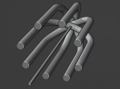
Commutator - Yes. I'm going to use 4 U shaped rods wrapped in winding wire, and the end will be connected with split rings (commutator). Plain (non Neodymium) mags either side. But to save time and money, I'd like to use tubing instead of rod. I just wonder if being hollow will be bad, do I have to get solid rod?

I also wonder if two layers of wrapping will be enough, but two layers is within the budget, so I'll try that before I source more winding wire. My brushes will be very simple copper strips.
 

KeithWalker

Joined Jul 10, 2017
3,603
I don't understand why you would want to wind the armature on copper rod or tube. Armatures are usually wound on laminated ferrous cores. Can you give us some idea of the physical layout of the generator. A hand drawn sketch would probably be enough for us to give you useable advice.
 

Thread Starter

Rokket2001

Joined Mar 19, 2023
18
Ah, because I depend on the kindness of Electrical People. I figured if the winding is copper, make the support copper. I could use steel. I was figuring on 4 U shapes around an axle (with crank). Originally copper, but I could use small steel rods.

armature-1.png

Thank you!
 

panic mode

Joined Oct 10, 2011
4,864
no... it is not "could" use iron ...
it is must use iron (or other ferrous material).

each material is used for its properties...
1. purpose of iron is to concentrate magnetic flux.
2. copper is used for high conductivity.
3. the wire also need to be insulated or windings would touch each other and cause short. so thin coat of enamel is painted on the wire.

solid chunk of iron could be used but this would result in heavy loses due to eddy currents. this is why iron is split into thin sheets. those are also painted to increase electrical resistance and lower losses.
 

KeithWalker

Joined Jul 10, 2017
3,603
Ah, because I depend on the kindness of Electrical People. I figured if the winding is copper, make the support copper. I could use steel. I was figuring on 4 U shapes around an axle (with crank). Originally copper, but I could use small steel rods.
Thank you!
Steel is not a very good choice for efficiency either. It has high magnetic hysteresis. You need something that is easy to magnetize, but doesn't remain magnetized when the electrical field surrounding it is changed. Soft iron or mu-metal which is a nickel-iron alloy would be a better choice.
 

KeithWalker

Joined Jul 10, 2017
3,603
Soft iron wire is available at most hardware stores. It can be made even softer by heating is red-hot and allowing it to cool slowly. Bundles of it is what is recommended for motor and solenoid armatures in a book called "The Boy Electrician", first published in 1914. You will probably find it fascinating reading so here is where you can find it. It was the start to my electronics career back in 1949.
The Boy Electrician (gutenberg.org)
 

Thread Starter

Rokket2001

Joined Mar 19, 2023
18
it is must use iron (or other ferrous material).

each material is used for its properties...
1. purpose of iron is to concentrate magnetic flux.
2. copper is used for high conductivity.
3. the wire also need to be insulated or windings would touch each other and cause short. so thin coat of enamel is painted on the wire.
I was thinking of conductivity. I had thought just interrupting the mag field did the trick, but that makes sense, the mag flux. Whatever makes electrons jump. Thanks for that!
 

Thread Starter

Rokket2001

Joined Mar 19, 2023
18
Soft iron wire is available at most hardware stores. It can be made even softer by heating is red-hot and allowing it to cool slowly. Bundles of it is what is recommended for motor and solenoid armatures in a book called "The Boy Electrician", first published in 1914. You will probably find it fascinating reading so here is where you can find it. It was the start to my electronics career back in 1949.
The Boy Electrician (gutenberg.org)
I will search for soft iron. Also, great book, downloaded a PDF. Clear and simple! Thank you!
 

Thread Starter

Rokket2001

Joined Mar 19, 2023
18
You might be able to charge it, but finding a cell tower to connect might be a problem.
Yes, from what I read, radio was about 1897, and the first cell network was Japan in the 1970s. But a phone is great for photos, and there might be useful apps. Plus, I'm told the likelihood of me going back in time to (any time, really) is small. But just in case...
 

Thread Starter

Rokket2001

Joined Mar 19, 2023
18
True! :D
It all started when my wife and I watched a show where a woman accidentally goes back to 1882. She looks at pictures of her daughter on her phone, and she's very sad when the battery dies. I thought, I MIGHT be able to charge that!

If I'd used a totally copper armature, no. But there's that Dunning-Kruger effect. I THOUGHT I could do it.

But in 1882, I've been allowed to ask smart people and look at books, so it's still a go. I've learned two things already! 1 - I'm not as smart as I think I am, which, really didn't need a lesson, actually (my wife reminds me all the time), and 2 - IRON!

One of the very early dynamo guys had a great name. Frenchman named Hippolyte Pixii! THAT's a name and a half. But history remembers Michael Faraday. Faraday Schmaraday. Pixii! Pixii!
 
Top