Home Audio Amplifier Repair

Thread Starter

MilkyTech

Joined Oct 28, 2016
22

JoeJester

Joined Apr 26, 2005
4,390
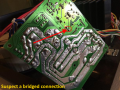
The only thing I saw that might be a bridge is at the point of the arrow below:board1-1.png

Can you take another picture of the board lying flat and fills your phone or camera a little better?
 

Thread Starter

MilkyTech

Joined Oct 28, 2016
22
I know it looks buggered up there in the photo but its good. I replaced those caps twice and my soldering iron may have rubbed the board a bit but its a clean connection.
I failed to get a spark yesterday after being powered down and unplugged all night. All I did between yesterday and the night before is move the board around taking photos and then pushed the smaller bridge rectifier (gw rs202m) over a little bit because it was touching the resistor next to it. All of this movement must have "fixed" a poor solder joint.
I left it unplugged again last night and put it completely back together this morning and still no spark. Hooked up a speaker and everything is functioning normally without spark. I guess I will take it apart again and resolder that smaller bridge and maybe some other components to be sure.
Thanks to all for your help. Now I wish I hadn't gotten rid of 2 great powered subs I used to have whose amps went bad. I feel like I now have the knowledge and resources (AAC!) to fix them. Oh well. :cool:
 

JoeJester

Joined Apr 26, 2005
4,390
I should have seen an unobstructed space between the two runs. Any solder blob could make a bridge. Since you wiggled the smaller bridge and it corrected itself, you might get out your magnifier glass, or, shoot a close-up picture and zoom in. It's best if your camera is looking straight down on the board.
 

Thread Starter

MilkyTech

Joined Oct 28, 2016
22
I know it looks like a solder blob in the picture, but its not. Also, if that cap was shorted chances are it would heat up and blow. It would not cause that large spark on the other side of the board. thank you for your input though.
 

AlbertHall

Joined Jun 4, 2014
12,630
If the cap was shorted there would be no voltage across it or current through it so it would be just fine. The short may cause some magic smoke to be released elsewhere, but the cap would be fine and dandy.
 

Thread Starter

MilkyTech

Joined Oct 28, 2016
22
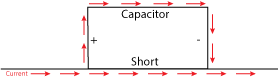
Why would no current run through it? Wouldn't the current continue along both paths - across the short and through the capacitor?

Check out the answer from this thread: http://electronics.stackexchange.co...nt-electrolytic-capacitors-be-short-circuited
Electrolytic capacitors may become permanently damaged by excessive peak currents, which will definitely occur during short-circuit events. The reason is that (a) the internal resistance will cause a momentary, but large power dissipation (heat!) and (b) the distribution of the current spike inside the capacitor will not be formed evenly across the large area of the aluminum foil and hot spots may occur. The electrolyte may vaporize along these small zones and damage to the insulating aluminum oxide layer may occur as well.

If you're lucky, the capacitance will decrease just a bit or the top of the can may change its shape into something like a dome. If you're very unlucky, the cap may fail and heat up quite a bit (and eventually blow).

With very large currents, e.g. during inrush events into the primary caps of switching power supplies, you can actually feel how the caps heat up in an unhealthy way (don't touch live circuits or charged caps!!!). Such inrush events may be viewed as the opposite of a short circuit condition, just that the current flows in the opposite direction ("into the cap").

BTW: Also true for other capacitors like ceramics. I've seen ceramics explode, too, when they were subjected to rapid discharge events. The ceramic dielectric material changes its shape just a tiny bit when the electric field varies. If this happens fast, enough force may be created for the capacitor to blow. Disc capacitors will withstand some abuse, ceramic multilayer capacitors (MLCCs) are quite sensitive.
 

AlbertHall

Joined Jun 4, 2014
12,630
Definition of a short-circuit - zero ohms.
So when a current flows through a short it generates zero volts. Thus there is no voltage across the capacitor and therefore there can be no current flowing into the capacitor.

Current doesn't flow through a capacitor. A current flowing into a capacitor charges the capacitor, that is the voltage across the capacitor rises but there can be no voltage across a short-circuit so the capacitor cannot charge.
 

Thread Starter

MilkyTech

Joined Oct 28, 2016
22
I think your thinking is flawed, or doesn't apply to this scenario. if the current charges the capacitor before the short, why wouldn't it after the short? according to what you are saying, if I short a resistor in the same manner (by soldering its leads together on the back of the board), I would get zero voltage reading with my meter on either lead of the resistor? Isn't a speaker a resistor of sorts? if I split off a speaker wire and hook up another speaker (essentially shorting the first speaker in this same manner), don't both speakers still produce sound?
 

wayneh

Joined Sep 9, 2010
18,124
Shorted leads across a capacitor will cause no current to flow in, out, or through the capacitor. It's not possible to develop a voltage across shorted pins. No voltage = no charge separation = no current.

Now, shorting a charged capacitor will cause a very large discharge current. Once.
 

AlbertHall

Joined Jun 4, 2014
12,630
if I short a resistor in the same manner (by soldering its leads together on the back of the board), I would get zero voltage reading with my meter on either lead of the resistor?
You would measure zero voltage between the leads of the resistor.

if I split off a speaker wire and hook up another speaker (essentially shorting the first speaker in this same manner), don't both speakers still produce sound?
If you do this then both speakers will produce sound. They will share the current according to their resistances (strictly, their impedances). A loudspeaker is not a short circuit - it has a resistance of 4/8/16 ohms.
 

Thread Starter

MilkyTech

Joined Oct 28, 2016
22
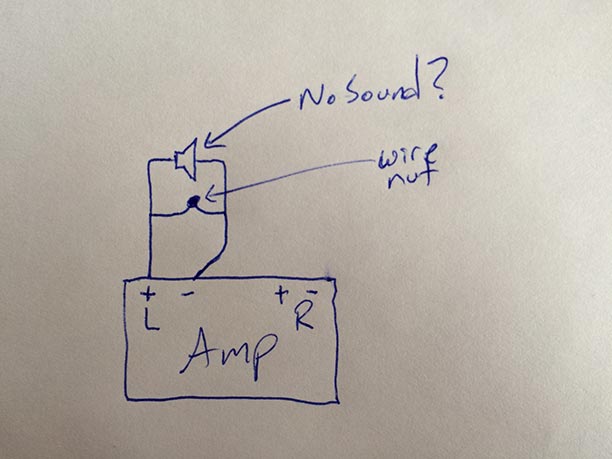
So if I remove one of the speakers from the circuit and tied its wires together keeping the circuit closed, the other speaker wouldn't produce some sound before the amp blows up? 100% of the current would flow through the wire with no resistance and 0% of the current would go through the wire with a speaker still attached?

I need to set up an experiment so I can see this with my own eyes, although not sure how to set it up without blowing up an amp. with no resistance, I would imagine the amp will heat up very very quickly
 

wayneh

Joined Sep 9, 2010
18,124
And the channels should be independent. A short on one might cause the amp to shut itself off (protection mode), but if it isn't a smart amp, the other channel should play normally.
 

Thread Starter

MilkyTech

Joined Oct 28, 2016
22
And the channels should be independent. A short on one might cause the amp to shut itself off (protection mode), but if it isn't a smart amp, the other channel should play normally.
I was planning on setting up the experiment on one channel with nothing hooked up to the other channel with this crappy amp I just fixed, not sure if it's smart or not. I did test the amp with a speaker on only 1 channel and it worked fine.
This is my plan:
 

Thread Starter

MilkyTech

Joined Oct 28, 2016
22
I do believe you, it just doesn't make logical sense in my mind yet. If i think about current like the flow of water, obviously it will take the path of least resistance, but I would think some would still take the other path. Doesn't the wire itself provide a tiny bit of resistance? You cannot send an unlimited amount of current through a particular size wire, right?
 

wayneh

Joined Sep 9, 2010
18,124
Current will flow like water from a higher elevation (voltage) to a lower one by all paths available. More will flow through the path of least resistance, but current will flow in ALL paths. You are correct that there can be a tiny voltage drop across any conductor and that means a tiny voltage can drive current through some other path.

But in your experiment, you'll see the difference between maybe 0.1Ω in the wires (probably even less) versus 8Ω or more in the speaker. The current will distribute proportionally so you'll have less than 1/80 the current to move the speaker coil.

If you use a 1Ω ohm resistor instead of a wire, you should indeed be able to hear the speaker faintly. Using an 8Ω resistor will cause the current to share roughly equally and the volume will be cut in half, which is barely detectable.
 
Top