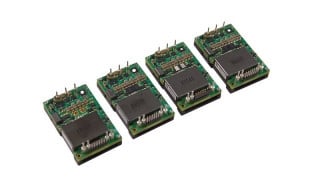
High-Power LED Flasher

SgtWookie

Joined Jul 17, 2007
22,230
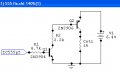
Well, here's what I was thinking in the way of an easy fix:


Actually, all he'd really need would be the R2/Q2 part. The flashing order would be reversed - but who cares, really; they're about 50/50 anyway, right?

The resistor labeled Ctrl is representative of the impedance of that input to ground. It simulates just fine.
 

Attachments

Thread Starter

turnertj

Joined Nov 4, 2009
78
Transistor! Wow...I'm an electronics idiot. Still not sure where this goes. If the IC555p5 is the 5th pin, which leads to one of my buck puck control lines, do I need to do this circuit on the other control line as well? Is the V1 the input voltage to the buck puck?

The flashing order really doesn't matter.

But I tested it out today, the circuit with how it is now...and it's damn bright. So it might be good enough! Have to build a box and try it out...

After you guys get a PCB and get everything hooked up, do you do anything with the board other than secure it into a project box or something?
 

SgtWookie

Joined Jul 17, 2007
22,230
I'm confused (which is easy to do!)...
That's OK - we're all kinda struggling through this thing ;)

Wookie, does this fit somewhere into the circuit that Bill drew me?
Yes - actually, some of it is existing already, like the battery represented by V1.

If so...do i have to supply the V1 somehow--I was going to use 3 CR123s, so would that be 9.6 instead?
The V1 represents your batteries - but I just showed it as a single battery because I'm lazy like that ;)

Also...really dumb question here...what's the Q thing?
Yep, Q1 and Q2 are transistors. But I think it's going to be a bit more simple than what I showed.
OK, that link had a more updated datasheet than I had.

The datasheet shows a chart for Vdd vs output voltage vs source current, but it jumps right from 5v to 18.5v. It's mighty difficult to extrapolate just what the 555 output voltage might be when Vcc=9v and the timer is trying to source 9mA, but my gut tells me that it's going to fall a bit short. I'm guessing about 5mA and Vcc-2v is about the best it's going to do, which would leave that Ctrl line a bit lower than it needs to be.

I guess the thing you need now is an updated schematic with the transistors in there, right?
 

SgtWookie

Joined Jul 17, 2007
22,230
Transistor! Wow...I'm an electronics idiot. Still not sure where this goes. If the IC555p5 is the 5th pin, which leads to one of my buck puck control lines, do I need to do this circuit on the other control line as well?
Yes.
Is the V1 the input voltage to the buck puck?
V1 represents your batteries.

The flashing order really doesn't matter.
It's really binary LOL

But I tested it out today, the circuit with how it is now...and it's damn bright. So it might be good enough! Have to build a box and try it out...
Well, I'm afraid that if the output is really straining to drive that much current, it may cause reliability problems.

After you guys get a PCB and get everything hooked up, do you do anything with the board other than secure it into a project box or something?
I usually put it in a box or some sort of enclosure. I've even used the lid to an instant iced tea bottle as a quick 'n' dirty enclosure, just so that the parts had some protection.

Guess I'll give Bill's PaintCad a shot ;)
 

Thread Starter

turnertj

Joined Nov 4, 2009
78
Cool...I tried a few measurements if that helps.

1. Setup #1: Red LED hooked up to BuckPuck #1 and Green LED to BuckPuck #2 - Red LED: 2V drop across LED, drawing 700mA, and 3V drop across Control line
- Green LED: 2.8V drop across the LED, drawing 450mA, and 4.5V drop across Control

2. Setup #2: Switched the LEDs...
- Green LED: 3.13V drop across LED, drawing 700mA, 3V drop across control
- Red LED: 1.86V drop across LED, drawing 450mA, 4.5V drop across Control

So is the control line supposed to be lower to get more current? It's listed as 0-5V. There's also a reference line at 5V...what's that for?
 

SgtWookie

Joined Jul 17, 2007
22,230
I guess I'd better read that datasheet a couple more times... what is the exact part number that you are using now?
[eta]
Never mind, found it!

http://ledsupply.com/03023-d-e-1000p.php

3021-D-E-1000
DC in - 5-32v
AC in - no
On-board trim - no
Control/dimming - yes
7-pin SIP

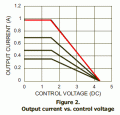
OK, here's the control voltage input chart with your model highlighted in red:
 

Attachments

Last edited:

Thread Starter

turnertj

Joined Nov 4, 2009
78
Okay...another wrinkle.

I have a wiring harness for the buckpuck driver with a pot between the CNTL and the REF line. When the voltage is lower on the CNTL line, the LED is brighter!
 

SgtWookie

Joined Jul 17, 2007
22,230
OK, I'm just trying to get all this straight at the moment. I've been juggling lots of people's projects and things can get fouled up - especially with as many twists and turns as this project has taken!

3021-D-I-1000
DC in - 5-32v
AC in - no
On-board trim - yes
Control/dimming - yes
7-pin SIP

[edit]
Yes, your Cntl line going lower in voltage agrees with the chart I posted; the lower the voltage on Ctrl, the higher the output current.

[eta]
OK, it was a mistake to not use the REF line. I'd just made an edit to the schematic and was going to post it, but now I really see what's going on, and I'll have to make another change.
 
Last edited:

SgtWookie

Joined Jul 17, 2007
22,230
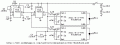
OK, this is basically according to figure 14 in the datasheet, adapted to Bill's circuit:


It's using REF as the +5v voltage source, and when Cntl isn't getting voltage from REF, it should be nearly ground.

Q1 and Q1 can be just about any small PNP transistor, like 2N3906, 2N4403, 2N2907; they're all available at a Radio Shack.

[eta]
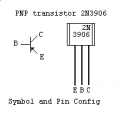
Don't let the transistor symbol throw you. Here's what the PNP symbol looks like (E=emitter, B=base, C=collector) and how they correspond to the physical part. Hold the transistor with the lettering on the flat face towards you so you can read it. Some transistors have EBC markings just above the pins, but if they don't, don't worry about it.
 

Attachments

Last edited:

Thread Starter

turnertj

Joined Nov 4, 2009
78
I put in the additional "stuff" for the first buckpuck...and it flashes! When I measure the current through the LED though, it's still just pulling 500mA, not 1A. Also, I measured the voltage on the control line, and it's still at 3V. Any ideas?

ALso...sent out those 700mA drivers today...sorry about the delay.

Tj
 

SgtWookie

Joined Jul 17, 2007
22,230
I put in the additional "stuff" for the first buckpuck...and it flashes!
OK, was it NOT flashing before, and it IS flashing now?
Or is the behavior any different?
Please provide any detail you can.

When I measure the current through the LED though, it's still just pulling 500mA, not 1A. Also, I measured the voltage on the control line, and it's still at 3V. Any ideas?
OK, if you measure 3v, that is consistent with a 500mA output according to the chart:

Where the red line intersects with 3v on the X-axis, you'll see roughly 500mA to the left.
However, when you're measuring 3v on CONTROL, what are you measuring on REF? If they're different by more than about 200mV, then there's still a problem.

In that case, I will want to know the voltage on both sides of the 2.2k resistor I had you connect to the base of the new transistor(s).

For troubleshooting purposes, you can connect the junction of C1 and U1a pins 2/6 to either ground or +V (battery pack - or +) to turn the LED on or off. Jumper leads with alligator clips on each end are quite helpful for such things. Radio Shack sells them in sets of 4:
http://www.radioshack.com/product/index.jsp?productId=2062622

ALso...sent out those 700mA drivers today...sorry about the delay.
 

Wendy

Joined Mar 24, 2008
23,798
Interesting. I'm still around, just not much to say (except I was wrong?).

I wouldn't have used the 4.7KΩ since the 7555 goes to ground, but that is a matter of preference.
 

SgtWookie

Joined Jul 17, 2007
22,230
Interesting. I'm still around, just not much to say (except I was wrong?).
Hi Bill - glad you're still "in here".
I'm not sure what exactly is wrong either. I don't know why it's not going up to 5v until we get feedback from Tj.

I wouldn't have used the 4.7KΩ since the 7555 goes to ground, but that is a matter of preference.
Yeah, I know. However, since Tj is experiencing difficulties, I figured it was better to follow the datasheet. I admittedly fudged on the base resistors for reasons that you well know, but for Tj's benefit, I wanted to try to ensure good transistor saturation so that the Vce would be quite low when the LED was supposed to be off.

I really don't know at this point, but it could be that the buckpucks were "broken" by their CONTROL inputs being pulled up too high.

If you have some ideas, lay 'em on...
 

Wendy

Joined Mar 24, 2008
23,798
I have a couple of Logic Level MOSFETs, could that help? I'm thinking of using them to turn on / off the puck buck.

Something else, with the parts I have I could try one of the early concepts (carefully of course), where one puck buck is shared and switched between LEDs.
 

SgtWookie

Joined Jul 17, 2007
22,230
I have a couple of Logic Level MOSFETs, could that help? I'm thinking of using them to turn on / off the puck buck.
Hmmm. I don't know how long it takes for the BuckPucks to start up and shut down, if that's what you're considering. From another thread, it seems that the supply return lead and LED return lead are connected internally. I suppose an N-ch logic level MOSFET could be used to connect/disconnect the LED's return lead. An IRLD014 would probably be adequate; rated for 1.7A, and is packaged in a 4-pin DIP.

However, I'm really wondering why the adaptation of the datasheet recommendation (fig.14) does not seem to be working properly.

Something else, with the parts I have I could try one of the early concepts (carefully of course), where one puck buck is shared and switched between LEDs.
Yes - thinking back, I was concerned about the BuckPucks' output voltage under no-load conditions, but that turned out to be a non-issue. I don't see why that wouldn't work just fine. Use 1 N-ch logic level MOSFET per LED, and just alternate which gate is high/low.
 
Top