High Impedance on RX output for FPV

Thread Starter

Marcus2012

Joined Feb 22, 2015
425
Hey all :)

I'm setting up a FPV system for my Quadrotor and just a bit confused regarding the audio feed. The receiver unit has an audio output of 1Vp-p Typ/10KOhm. I'm not very familiar with audio amplifiers but would I be right in assuming this is too high an impedance to simply apply directly to an 8Ohm speaker or earphones? If so can anyone please suggest any piece of kit (preferably small) or circuit that would match the impedance from source to load? I have tried researching impedance matching in this situation but unfortunately I seem to find conflicting information as to whether or not you need to match the impedance.

Thanks for any help guys :)
 

MikeML

Joined Oct 2, 2009
5,444
You need power gain and a little bit of voltage gain; dont worry about impedance matching.

Say your amplifier has a gain of 3. 1Vp-p input is 0.35Vrms; so is an input power of 0.35^2/10K = 0.125uW
3Vpp at the output is 1.06Vrms; so is an output power of 1.06^2/8 = 0.141W, so the power gain is > one million.

LM386 would work...
 

Thread Starter

Marcus2012

Joined Feb 22, 2015
425
You need power gain and a little bit of voltage gain; dont worry about impedance matching.

Say your amplifier has a gain of 3. 1Vp-p input is 0.35Vrms; so is an input power of 0.35^2/10K = 0.125uW
3Vpp at the output is 1.06Vrms; so is an output power of 1.06^2/8 = 0.141W, so the power gain is > one million.

LM386 would work...
Thank you so much! :) Good to know I can disregard impedance and the receiver won't try overpowering the speaker. As for the gain the LM386 datasheet states I can set it from 20-200. I am still a bit fuzzy on this application as gain is a logarithmic scale right? or wrong? If it's linear is it just a ratio or input to output voltage.

e.g.

gain = 20
20Vpp at the output is 7.07Vrms; so is an output power of 7.07^2/8 = 6.248W

If that's correct would that be suitable for a speaker/earphones?

Thanks again :)

EDIT: I was also thinking of wiring 2 speakers in series so is that 7.07^2/16 = 3.124W?
 
Last edited:

Thread Starter

Marcus2012

Joined Feb 22, 2015
425
Set the gain to 20, and put a pot on the input
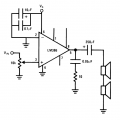
Thanks again :) I've adapted the example circuit from the datasheet which I've attached below does that all seem ok? I've added the decoupling capacitors and it already had the 10K trimpot on the input. So what is the trimpot for? Input biasing?
speaker amp.png
 

bertus

Joined Apr 5, 2008
22,939
Hello,

Did you read the specs of the LM386?
You will NEVER get 3 watts out of it:

Absolute Maximum Ratings :

Supply Voltage :
(LM386N-1, -3, LM386M-1) 15V
Supply Voltage (LM386N-4) 22V
(LM386N) 1.25W

(LM386M) 0.73W
(LM386MM-1) 0.595W
Input Voltage ± 0.4V

Bertus
 

Thread Starter

Marcus2012

Joined Feb 22, 2015
425
Hello,

Did you read the specs of the LM386?
You will NEVER get 3 watts out of it:

Absolute Maximum Ratings :

Supply Voltage :
(LM386N-1, -3, LM386M-1) 15V
Supply Voltage (LM386N-4) 22V
(LM386N) 1.25W

(LM386M) 0.73W
(LM386MM-1) 0.595W
Input Voltage ± 0.4V

Bertus
Hi :)

Yeah I did see that, that's what threw me about that calculation and I didn't understand that part. Typical output for the LM386N-4 is 1W so I had two series 0.5W speakers planned. But that figure is at Vs = 16V, RL = 32ohms and my setup would be Vs = 12V, RL = 16ohms. I was on the understanding that as long as my speaker wattage is lower than the amps max output I would be ok. is that correct?
 
Last edited:

AnalogKid

Joined Aug 1, 2013
12,158
The LM386 is the go-to guy for small audio applications, partly because it is virtually indestructible. It has plenty of gain and can try to make 6 W if you overdrive the input, but the output will just clip at it's max ability. Lotsa small 386 assemblies with the input level adjust pot on-board on ebay.

ak
 

MikeML

Joined Oct 2, 2009
5,444
Besides, you do not need 3W if listening to headphones, or even some preboxed speakers. The 10K pot (if it has a knob) is the volume control...
 

Thread Starter

Marcus2012

Joined Feb 22, 2015
425
Thanks guys :)

The LM386 is the go-to guy for small audio applications, partly because it is virtually indestructible. It has plenty of gain and can try to make 6 W if you overdrive the input, but the output will just clip at it's max ability. Lotsa small 386 assemblies with the input level adjust pot on-board on ebay.

ak
Good to know I won't damage anything thanks, I've checked out a lot of the modules on eBay but they all seem to be the M-1 which is only 250mW output so I was going to try the N-4 which is 1W and use 2 series 0.5W speakers, but I'm now thinking I may get 2x0.8W just to be safe, what do you think?

Besides, you do not need 3W if listening to headphones, or even some preboxed speakers. The 10K pot (if it has a knob) is the volume control...
Thanks :) I'm not sure if it has a knob I just noticed it on the input in the datasheet diagram. Great news though because I'd thought I'd have to add volume control on the output :)

EDIT: BTW guys am I going to need a 10K resistor on the -input of the LM386 to eliminate DC bias I wasn't clear on that from the datasheet?
 
Last edited:

MikeML

Joined Oct 2, 2009
5,444
... am I going to need a 10K resistor on the -input of the LM386 to eliminate DC bias I wasn't clear on that from the datasheet?
Put a series 1uF to 3.3uF dc-blocking electrolytic capacitor (+to input) between the input and the top of the pot. Wiper of the pot goes to the input pin of the 386.
 

Thread Starter

Marcus2012

Joined Feb 22, 2015
425
Put a series 1uF to 3.3uF dc-blocking electrolytic capacitor (+to input) between the input and the top of the pot. Wiper of the pot goes to the input pin of the 386.
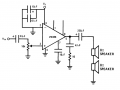
Great idea that seems like a much simpler way to block DC bias :) I've attached my final design below and I've also add a cap to pin 7 to isolate the high gain input stage of the LM386 from power supply noise.

Thanks again for all the help guys it is very much appreciated considering I strayed off the original topic slightly lol. I'll get to ordering my parts now.

Cheers for bearing with me guys :)

speaker amp.png
 

MikeML

Joined Oct 2, 2009
5,444
Minor nit. I would be more inclined to put the speakers in parallel. After all, the 386 will drive a 4Ω speaker. The parallel connection will give you 4X the audio power compared to the series connection.
 

Thread Starter

Marcus2012

Joined Feb 22, 2015
425
Minor nit. I would be more inclined to put the speakers in parallel. After all, the 386 will drive a 4Ω speaker. The parallel connection will give you 4X the audio power compared to the series connection.
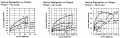
Ahh ok, the main reason I was going to use them in parallel was that the 386 power dissipation is at it's lowest with 1W output power over a 16Ohm load (Vs=12V). Should I be concerned about minimizing device dissipation or more concerned with output power?

Untitled.png
 
Last edited:

MikeML

Joined Oct 2, 2009
5,444
Up to you. Try it both ways. See which one gives lowest heating of 386 consistent with low distortion; loudest volume. One speaker might be better.
 

Thread Starter

Marcus2012

Joined Feb 22, 2015
425
Up to you. Try it both ways. See which one gives lowest heating of 386 consistent with low distortion; loudest volume. One speaker might be better.
Yeah good idea I'll get two speakers and just play around with the configuration and see which is best like you say. Thanks again :)
 
Top