High impedance, negative pin voltage excursions - are they a concern?

Thread Starter

Heath Raftery

Joined Dec 13, 2015
25
A few years ago crutschow provided an excellent one-shot circuit that I'll reproduce here:
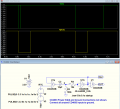
1616594770931.png

I noticed when the input to U1a goes low high, the node marked "2" goes negative while C2 discharges. The input pins to U1b are only rated down to -0.5V. However, there's a 10kΩ on the input, so if it's simply a case of protection diodes activating, they're only going to see a minute current.

In this case, do you think the negative voltage worth worrying about? What about in general? This scenario is not uncommon - is it a matter of trying to determine what the potential failure mechanism is and making an assessment based on that, or do you think it's too risky to ignore abs. max. ratings?
 
Last edited:

ronsimpson

Joined Oct 7, 2019
4,646
The CD40xx series has input protection diodes that are good to 10mA. Don't use than at 10mA but they are 10mA diodes. 3.3V and 10k is not much current. You are OK.
I don't know if the SPICE model you are using has the diodes included. Look at U1b inputs to tell.
 

Thread Starter

Heath Raftery

Joined Dec 13, 2015
25
Is the negative excursion in the simulation or in the actual circuit?? That does matter.
I nearly mentioned up front I noticed it in sim. But then I realised it was fundamental to the circuit design, and the sim results probably weren't worth focusing on when discussing abs. max. ratings.

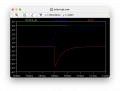
FWIW though, here's what it looks like in sim for me. U1a_B and U1a_B are the NAND inputs. 2 is the signal in question.

Also note I double-negatived myself in my original post - I've struck out "low" where I meant "high".

Screenshot 2024-11-07 at 3.20.12 pm.png
 
Last edited:

Thread Starter

Heath Raftery

Joined Dec 13, 2015
25
Look at U1b inputs to tell.
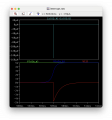
Sub-µs spikes of 80µA coming out of the inputs, so not very diode-y. Regardless though, I guess I'd prefer not to rely on a sim to reason about this.

Are you suggesting it's a bit of a case-by-case basis, and that if protection diodes are present one only needs to ensure they don't cook? Not worth worrying about other failure mechanisms?

Screenshot 2024-11-07 at 3.27.41 pm.png
 

AnalogKid

Joined Aug 1, 2013
12,043
Is the negative excursion in the simulation or in the actual circuit?? That does matter.
Both.

The circuit action is the same as in a charge pump. R4 limits the current through the U1B input stage protection diodes. Another approach is to add a fast small-signal diode in parallel with R2, anode to GND. This clamps the negative voltage spike to 1 Vf below GND.

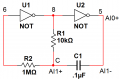
BTW, the standard two-inverter oscillator circuit has the same issue. That is why there are 2 resistors: R1 for timing and R2 to protect the U1 input stage from both positive and negative overvoltage spikes. If the R2 value is less than 10x the R1 value, current through the U1 input stage diode clamping action will be high enough to shift the oscillator's frequency above its calculated value.

Note: Random innergoogle schematic grab. The output is at node 5.

ak

1730957626220.png
 
Last edited:

Thread Starter

Heath Raftery

Joined Dec 13, 2015
25
Good points all round.

If I may, I'm still keen on insights into the original question, which I'll now make a bit more specific:

If a pin has a large series resistor, do you think exceeding negative abs. max. voltage ratings is worth worrying about? Certainly, I wouldn't expect a device to behave to spec (eg. additional current flow due to protection diodes activating), but is there a damage path to consider? Can you generally assume protection diodes are present and reason about behaviour that way, unless the datasheet says otherwise?
 

ronsimpson

Joined Oct 7, 2019
4,646
Can you generally assume protection diodes are present and reason about behaviour that way, unless the datasheet says otherwise?
The diodes are there.
do you think exceeding negative abs. max. voltage ratings is worth worrying about?
The diode acts like a diode. You can't have -3V on it. The diode has a max current. The max voltage comes along for the rid.

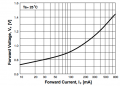
I just picked a diode that is about 10x bigger just for reference. This diode is rated at 100mA at 100% duty cycle. This happens at 0.9V. On the IC don't worry about the voltage rating but worry about the current rating.
1731035013893.png
 

eetech00

Joined Jun 8, 2013
4,704
Good points all round.

If I may, I'm still keen on insights into the original question, which I'll now make a bit more specific:

If a pin has a large series resistor, do you think exceeding negative abs. max. voltage ratings is worth worrying about? Certainly, I wouldn't expect a device to behave to spec (eg. additional current flow due to protection diodes activating), but is there a damage path to consider? Can you generally assume protection diodes are present and reason about behaviour that way, unless the datasheet says otherwise?
Input protection diodes are standard protection for CD4000 devices including CD4093B.
See below.

1731035598634.png

However, I would put a diode in parallel with the One-Shot RC timing resistor. But that's just me....

Also...

The CD4000B LTspice model libraries have input protection diodes, but they are not activated. A user has to manually edit the library to make them active. I believe it was done this way because of the potential for convergence issues. I don't know that these issues still exist today.
 
Last edited:

Thread Starter

Heath Raftery

Joined Dec 13, 2015
25
The diodes are there.
Generally? Your turn of phrase seems to suggest you're referring to something in particular, so just wanted to check.

I thought some ICs might do away with them for capacitance or cost/process reasons, but I now I look I can't find any examples. Seems prudent to never say never, but this would indeed be a useful simplification!

The diode has a max current
So you're saying you'd only worry about the diode itself? Again, an extremely useful simplification. In that case, I would look at the negative abs. max. spec very differently - instead of "damage may occur beyond this", it's actually "current flow starts here". This is a very useful insight, if I can generally be sure about it.

Off topic, but I was picking parts and I thought this headline (literally the first 2 sentences) from the HEF4093B datasheet was too good not to share:

The HEF4093B is a quad 2-input NAND gate with Schmitt-trigger inputs. Inputs include clamp diodes. This enables the use of current limiting resistors to interface inputs to voltages in excess of VDD.
 

ronsimpson

Joined Oct 7, 2019
4,646
I thought some ICs might do away with them
I am not sure if this is true but:
The first CMOS logic I used were different. My memory thinks they did not have input diodes. They had a bad failure rate. Not many were made. I remember going through the lab and factory looking for the older parts and removing them. I think the first parts did not have the "B" on the end.
I might not remember right. It has been a long time.
 

sarahMCML

Joined May 11, 2019
695
I am not sure if this is true but:
The first CMOS logic I used were different. My memory thinks they did not have input diodes. They had a bad failure rate. Not many were made. I remember going through the lab and factory looking for the older parts and removing them. I think the first parts did not have the "B" on the end.
I might not remember right. It has been a long time.
I just looked up the old RCA datasheets for both the CD4013A and the CD4017A (both of which I still have and prototype with) and both have the protection diodes and resistor on all inputs stated as being there.

Mind you, I always add the extra diode across the resistor when doing the differentiator type input circuit being discussed!
 

MisterBill2

Joined Jan 23, 2018
27,164
I have not ever considered the negative spike produced that way. And I have done oscillators that way, and also in one of our standard products (in a triggered "flop-shot", and in 20years we never had a problem.
Of course,that negative going pulse has the output resistance of the CMOS gate in series, which will also limit the current. So the actual negative voltage may be less than anticipated
 

crutschow

Joined Mar 14, 2008
38,316
I always add the extra diode across the resistor when doing the differentiator type input circuit being discussed!
I see no reason for adding a diode if the input protection diode current limits are not exceeded since it adds unnecessary parts and expense, but if you are a belt-and-suspenders type of designer, it doesn't hurt.
 

ronsimpson

Joined Oct 7, 2019
4,646
I see no reason for adding a diode
The internal diode at 10mA has 0.5V. An external diode (1N4148) at 0.5V pulls 100uA. I see no advantage to adding that diode.
Now if you add a 100 or 1k resistor so the 1N4148 gets the current first and limits the voltage to 1V. Then the resistor limits the current into the internal diode. Now that works.
 
Top