High current PCB design - Actuators and LED panels

Thread Starter

kyleh04

Joined Jun 18, 2017
54
Hello all. I am working on a project which needs to control an array of high current devices.

The devices are as follows:
LED Zone 1-4: 4 @ 7.2A each, 28.8A total

Linear Actuator Zone 1: 4 @ 5A each, 20A total

Linear Actuator Zone 2: 2 @ 4A each, 8A total

Total: 56.8A

This will be controlled by a AVR microcontroller, probably a 328/329 depending on GPIO needs.

I will be using a 12v 1000W power supply.

For the LED zones, no PWM is needed, simple ON/OFF is fine. I plan on using a simple electromechanical relay for each zone.

For the Actuators, their direction is controlled via polarity of voltage, so I am planning on using a DPDT electromechanical relay for each zone.

My question(s) is/are:
Ideally, the easiest/cleanest way for this to work, is to have the power to go directly from the power supply to the PCB, and channel to each relay. Then each device would just plug into the indicated slot for +/-. But, I don't think it is a good idea to have ~60Amps in a single PCB with low current MCU's along side it.

My other solution, was to use a distribution block like this. Each lead would go into a tab for a relay, and out the other side, similar to how simple arduino relay shields are. This makes it so only the current from a single unit is touching the PCB. But, this requires a lot of hassle in the connections of all of the zones.

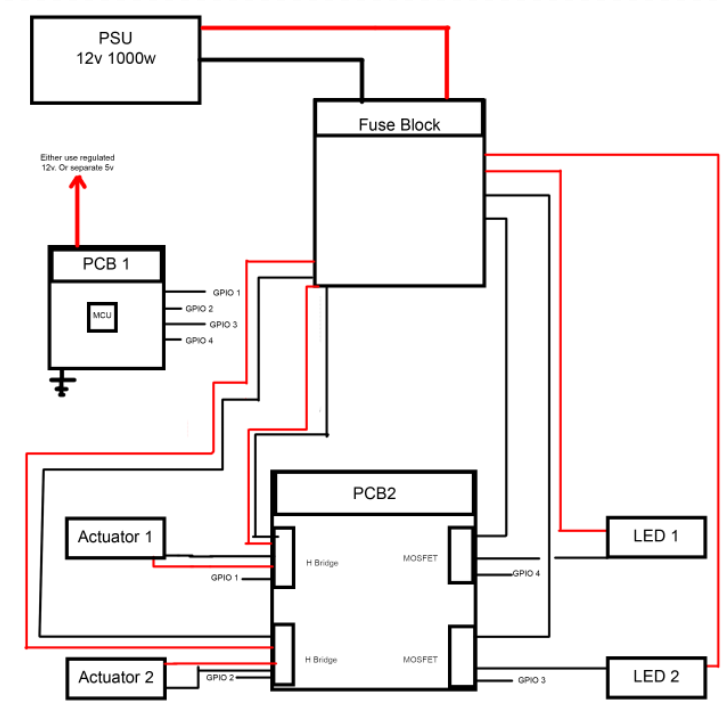
This is a quick sketch of what I mean for the second solution:
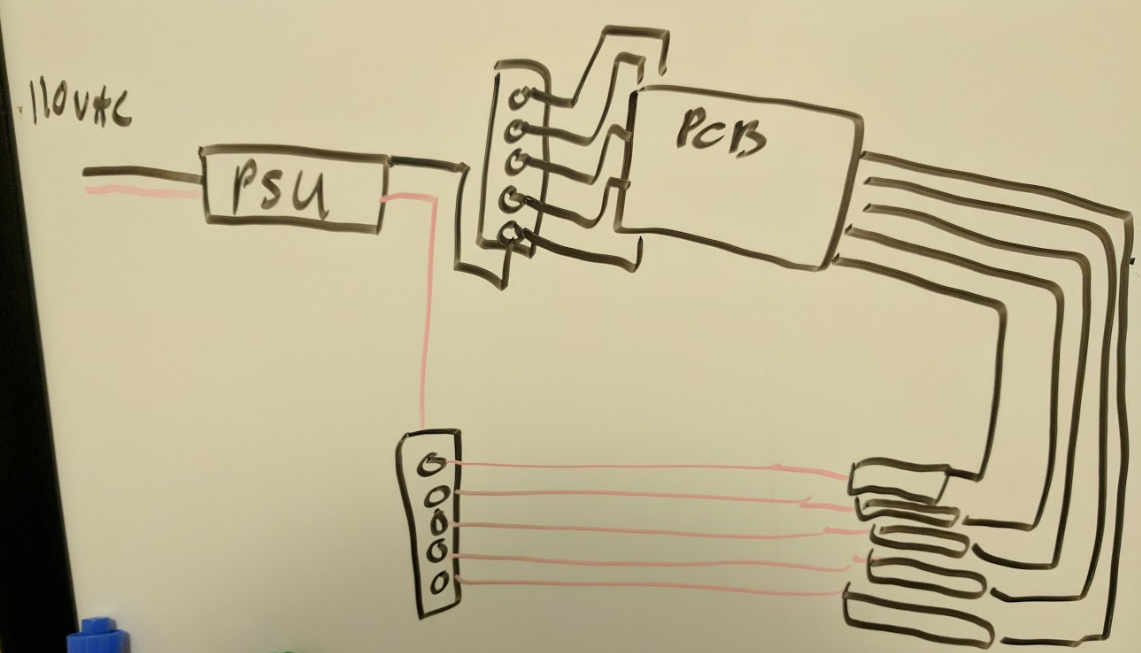


Where the connections come to the PCB, they would be on separate connectors, like this relay shield:
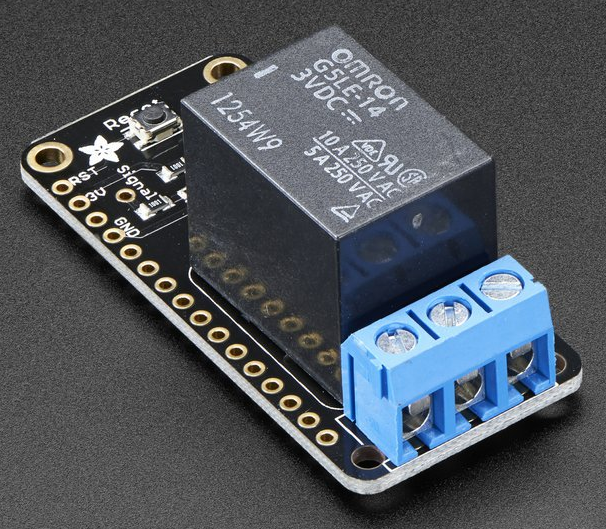

So the current only touches the PCB for a very short trace.

Are either of my thoughts/questions valid? What is the standard way of doing a high current setup like this?

Another idea I had was to have two PCBs, to separate the MCU from the relays.

Thanks a lot!
 

#12

Joined Nov 30, 2010
18,224
20 amps on copper foil? There are Internet calculators to do the math on this, but the results are so awkward that you will find a different way.
 

Thread Starter

kyleh04

Joined Jun 18, 2017
54
20 amps on copper foil? There are Internet calculators to do the math on this, but the results are so awkward that you will find a different way.
No, I would control the zones from separate relays. So only 4/5/7.2 Amps would go to each one. That's why I thought of the second solution.
 

Thread Starter

kyleh04

Joined Jun 18, 2017
54
I'm happy that you already have the solution to the problem.
OK cool. Yeah I had assumed that I had to break up the currents like that, just wanted to double check.

Now the issue is, that i'm quite limited with the outputs, since the biggest distribution block I can find, is the one linked. It doesn't give any room to add additional components.
 

Thread Starter

kyleh04

Joined Jun 18, 2017
54
Something like this really seems perfect for my application. Has fuses and everything built in.

Is there anything like this aimed at non marine uses, and has home/automotive certifications? Marine stuff tends to be so expensive, and I really won't gain anything from the corrosion resistance

 
Last edited:

Reloadron

Joined Jan 15, 2015
7,891
I have a question. Rather than using relays why not consider using MOSFETs? You will have a single 1.0 KW 12 volt power supply. MOSFETs for example the FQP30N06 can easily be controlled by any micro-controller. They also cost about a buck apiece. Unlike relays which have inductive spikes when their field coils collapse and can give micro-controllers the fits, even when using flyback diodes.Another consideration with using relays for motor reversal is the reversal is instant. Using a DPDT relay to reverse a motor leaves no stop time before reverse so the linear actuator is always extending or retracting. Rather than using relays the actuators could be driven using MOSFET H Bridges which can be built or simply bought off the shelf as a turn key solution. MOSFET H Bridges are open to any number of micro-controller inputs and most will allow braking the actuator motor and pausing the motor before direction reverse. All in all I would consider the use of MOSFETs for your circuits and MOSFET H Bridges for reversing and controlling your linear actuators. You may want to look at Pololu High-Power Motor Drivers available through a wide range of distributors for various applications. Popular with robotics.

As to fuse holders? There are dozens of Auxiliary Automotive Fuse Box Holder devices out there in about any size you could want. The link is merely an example. Just select the auxiliary fuse holder to accommodate the number of circuits and current handling ability you need.

Ron
 

Thread Starter

kyleh04

Joined Jun 18, 2017
54
I have a question. Rather than using relays why not consider using MOSFETs? You will have a single 1.0 KW 12 volt power supply. MOSFETs for example the FQP30N06 can easily be controlled by any micro-controller. They also cost about a buck apiece. Unlike relays which have inductive spikes when their field coils collapse and can give micro-controllers the fits, even when using flyback diodes.Another consideration with using relays for motor reversal is the reversal is instant. Using a DPDT relay to reverse a motor leaves no stop time before reverse so the linear actuator is always extending or retracting. Rather than using relays the actuators could be driven using MOSFET H Bridges which can be built or simply bought off the shelf as a turn key solution. MOSFET H Bridges are open to any number of micro-controller inputs and most will allow braking the actuator motor and pausing the motor before direction reverse. All in all I would consider the use of MOSFETs for your circuits and MOSFET H Bridges for reversing and controlling your linear actuators. You may want to look at Pololu High-Power Motor Drivers available through a wide range of distributors for various applications. Popular with robotics.

As to fuse holders? There are dozens of Auxiliary Automotive Fuse Box Holder devices out there in about any size you could want. The link is merely an example. Just select the auxiliary fuse holder to accommodate the number of circuits and current handling ability you need.

Ron
Thanks for that.

Yeah I had initially thought of using MOSFETs, but I like the idea of the logic being isolated from the high current. But if I'm using fuses on all lines, maybe it is less of an issue.

Isn't it best to use the relay/MOSFET/SSR as a high side switch, so the voltage always at the actuator isn't high?

Yeah I looked at those fuses, but it's tough to find one that doesn't require jumping all the terminals to make it a power distribution block like the one you pasted.

Thanks!
 

Reloadron

Joined Jan 15, 2015
7,891
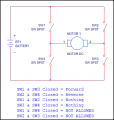
MOSFETs can be used as either a high or low side switch. The basic concept is pretty simple. Here is a very crude H bridge, We can see how it was named as it looks like a letter H. :)
H Bridge Basic.png

The switches are replaced with Transistors and MOSFETS, especially Logic Level mosfets do well. Then a few more components are added giving the circuit more features, They are also very easily controlled by a single micro-controller.

LEDs are really very simple. I was playing around with reels of 5050 RGB LEDs running on 12 VDC and using the 5 volt signals from an Arduino micro-controller to drive dozens using the MOSFET I linked to, well one mosfet for each color. The LEDs are common anode 12 VDC so I switched the cathodes to ground using the three mosfets (Red, Green and Blue).

Originally I used relays in large switching matrix affairs, including high current. I was thrilled when logic level mosfets came about. Anyway, just something to consider.

Ron
 

Thread Starter

kyleh04

Joined Jun 18, 2017
54
Thank you so much. You really have been a huge help.

Two more quick questions if you don't mind:
1) So, you wouldn't worry about safety of not having the supply's isolated?
2) I know you can use MOSFETs in a high or low configuration, but is there a safety advantage to using a high side switch like I said, to avoid having the loads always with hot voltage?

Wow, those bad boys are expensive. I might just stick with the marine one. I've used it a fair few times in wiring boats as well haha.

If this product were to ever be sold, the fact that it is a marine fuse block, would that pose a problem?
I don't think so, since most of the fuse blocks out there are automotive or marine aimed.
 

Reloadron

Joined Jan 15, 2015
7,891
Two more quick questions if you don't mind:
1) So, you wouldn't worry about safety of not having the supply's isolated?
2) I know you can use MOSFETs in a high or low configuration, but is there a safety advantage to using a high side switch like I said, to avoid having the loads always with hot voltage?
Here is what you have going. You mentioned using a 12 volt 1,000 watt power supply:
I will be using a 12v 1000W power supply.
That is a 12 volt about 80 amp supply. You also mention using a micro-controller:
This will be controlled by a AVR microcontroller, probably a 328/329 depending on GPIO needs.
Now just about anything you read involving using a micro controller to drive a relay coil will point you to using a transistor to actually drive the relay coil. Using the Atmega 328P as a micro-controller example:
  • The absolute maximum for any single IO pin is 40 mA (this is the maximum. You should never actually pull a full 40 mA from a pin. Basically, it's the threshold at which Atmel can no longer guarantee the chip won't be damaged. You should always ensure you're safely below this current limit.)
  • The total current from all the IO pins together is 200 mA max
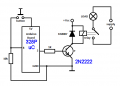
So none of your relay coils can draw more than about 30 mA to stay in a safe margin. Combined you really want to remain under 150 mA. Typically you end up with a circuit like this where your uC drives a small switching transistor which in turn drives a relay coil:
Transistor Driver.png

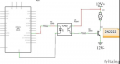
The problem is that the relay coil produces an inductive kick when power is removed and thus the 1N4007 diode to act as a "flyback diode" the uC and relay coils should not share the same PSU. Micro-controllers tend to just reset and do strange things. One option which helps is using an Opto-Coupler for isolation and using different supplies.This gets you something like the below:
Arduino opto coupler.png

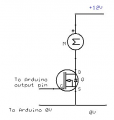
Finally we come to using a simple MOSFET switch for our load(s):
MOSFET SWITCH.png

There is nothig wrong with using low side switching as shown above. There are also plenty of similar circuits for doing high side switching using P channel MOSFETS. I have driven plenty of large and long RGB LED strips using simple low side switching as seen above. I would come off your 12 volt supply,use a simple 5 volt regulator circuit to power your micro-controller.

As to the fuse block you can get as simple or expensive as you wish. Littlefuse offers a wide range of fuse blocks for standard 3AG type fuses. That being a single example opf the dozens of similar fuse blocks out there.

Ron
 
Last edited:

Reloadron

Joined Jan 15, 2015
7,891
That would work fine. Something I omitted in my little crude MOSFET drawing is that it is wise to place a resistor between the MOSFET (N Channel) gate and ground. Typically a 100K is fine and all it does is make sure that when a signal is removed from the gate the MOSFET turns off.

Ron
 

Thread Starter

kyleh04

Joined Jun 18, 2017
54
That would work fine. Something I omitted in my little crude MOSFET drawing is that it is wise to place a resistor between the MOSFET (N Channel) gate and ground. Typically a 100K is fine and all it does is make sure that when a signal is removed from the gate the MOSFET turns off.

Ron
Great! Yeah I've used MOSFETs a lot in the past, just never with such a high current use.

Would you suggest getting a H-bridge IC, or making my own with MOSFETs?

Because looking here The IC's require a decent bit of external circuitry, with a lot of pins. I would need 6 of them. That's a lot of external components
 

Sensacell

Joined Jun 19, 2012
3,785
The tricky aspect to this project is the fact you potentially have 60A flowing in your circuit.
It's easy to end up with voltage drops appearing between boards, due to wiring resistance.
The design should make these voltage drops non-critical.

With 3.3 volt logic, it doesn't take much voltage drop to cause problems.
You would need very low gate voltage threshold MOSFETS, these are less available and can have higher Rds-ON resistance than units with higher threshold voltages.

A high-side switch configuration with a single NPN to interface between the boards can make life easy, you can then drive the gates with 12V with little concern for voltage drops in your grounds.
 

Reloadron

Joined Jan 15, 2015
7,891
Great! Yeah I've used MOSFETs a lot in the past, just never with such a high current use.

Would you suggest getting a H-bridge IC, or making my own with MOSFETs?

Because looking here The IC's require a decent bit of external circuitry, with a lot of pins. I would need 6 of them. That's a lot of external components
You can either build or buy an H bridge circuit. Here is an example of a simple turn key off the shelf dual channel (2 motors) H Bridge module. Also basedon your original post I did assume 5.0 Volt logic verse 3.3 volt logic as I see Sensacell mentioned 3.3 Volt logic. The N Channel MOSFET I mentioned is a logic level gate and works fine on 5 volt logic. Choosing 3.3 volt logic will change things a bit as was pointed out. Building an H Bridge is not as complex as the link you posted. Just a simple Google of H Bridge MOSFET circuits should yield a dozen circuits.

Ron
 

Thread Starter

kyleh04

Joined Jun 18, 2017
54
You can either build or buy an H bridge circuit. Here is an example of a simple turn key off the shelf dual channel (2 motors) H Bridge module. Also basedon your original post I did assume 5.0 Volt logic verse 3.3 volt logic as I see Sensacell mentioned 3.3 Volt logic. The N Channel MOSFET I mentioned is a logic level gate and works fine on 5 volt logic. Choosing 3.3 volt logic will change things a bit as was pointed out. Building an H Bridge is not as complex as the link you posted. Just a simple Google of H Bridge MOSFET circuits should yield a dozen circuits.

Ron
OK yeah, I will definitely be using 5v logic.

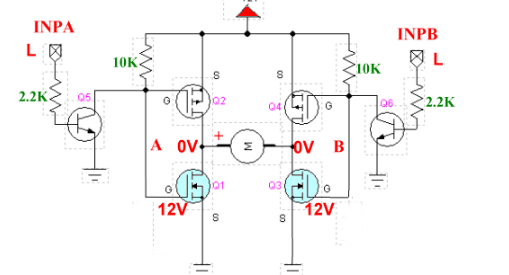
I guess I will just make an H bridge for each actuator:


So many components will be needed haha. I'll need 24 MOSFETs just for the actuators
 

Reloadron

Joined Jan 15, 2015
7,891
Try to use complimentary MOSFETs. :) Also as we mentioned earlier Logic Level MOSFETs designed for a logic level gate signal. You also still have the option of using relays with the considerations we mentioned earlier.

Ron
 
Top