How can I design a high-current channel that can temporarily achieve a higher current than it's battery can discharge?

Thread Starter

Moddog09

Joined Oct 18, 2024
3
I am currently designing a rocketry flight computer that must fire an ignitor (1-ohm bridgewire resistance, 1A recommended firing current). In my previous version I used a battery with a high enough current discharge rating to fire the ignitor straight from the battery. With this new version it is crucial to make the board and the device as a whole as small as possible. The battery I used was the largest component in the device and it's capacity was far more than the device required for it's application. I want to use a smaller battery but with the constraint that I can't use a LiPo (as per competition rules) the current required to fire the ignitor is over 3 times the max discharge current rating of the battery I have. How can I increase the current through the ignitor to 1A if my battery can only discharge 0.3A? I am trying to gain a better conceptual understanding of the relationship between V, R and I in practical application. Ohm's law says that my 3.7V battery connected in series with a 1-ohm resistor (the ignitor) should have 3.7A flowing through it right? But the battery can't discharge 3.7A. If the ignition happens when the resistance to the flow of current creates enough heat to ignite the pyrogen is it the amount of current that does that or the power (I*V)? Is a buck converter able to do this by stepping the voltage down from ~3.7V to ~1V is the output current then increased to 1A? Or only if the connected load draws that much? The output power hasn't changed other than minor losses but could that now successfully fire the ignitor? Are there other solutions? I am aware that a large capacitor would accomplish this but I am more focused on the conceptual understanding here as well as finding a solution that has a smaller footprint/volume than the required capacitor. Any explanations or learning resources anyone could share would be greatly appreciated!
 

Sensacell

Joined Jun 19, 2012
3,767
It's about delivering power to your load, to do that, you need to know it's characteristics.
What is the typical range of resistance for an ignitor and it's lead wires?

What is the desired power level that must be delivered to the ignitor?

How long do you need to supply this energy to ignite?
 

Thread Starter

Moddog09

Joined Oct 18, 2024
3
It's about delivering power to your load, to do that, you need to know it's characteristics.
What is the typical range of resistance for an ignitor and it's lead wires?

What is the desired power level that must be delivered to the ignitor?

How long do you need to supply this energy to ignite?
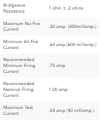
The manufacturer has no datasheet or anything. These are the only specifications they provide. The lenght of each lead before the bridge is ~1in. The resistance in the wires is negligible (<1 mOhm).
1729317041392.png
 

Ian0

Joined Aug 7, 2020
13,097
If you want 1A into 1Ω, you need 1W. If you have 3.7V@ 0.3A then that can supply 1.11W. All you need is a buck regulator that is more than 90% efficient.
 

Sensacell

Joined Jun 19, 2012
3,767
If you want 1A into 1Ω, you need 1W. If you have 3.7V@ 0.3A then that can supply 1.11W. All you need is a buck regulator that is more than 90% efficient.
The whole setup with igniter and long leads might be a couple ohms, might take more than 1 Volt?

The whole premise seems a bit marginal to me, trying to get a lions roar from a bag of kittens?
 

BobTPH

Joined Jun 5, 2013
11,463
Charging a capacitor at a low current over a long time allows you to draw a much higher current for a short time. This is how photoflash circuits work. For the time of the flash, far more wattage is being delivered than the battery can deliver continuously.

A capacitor could work for you, but it might be larger than the required battery.

A fresh AA alkaline cell can easily deliver over 1A. How small does the battery have to be? Is two AAs too big?
 
Last edited:

MisterBill2

Joined Jan 23, 2018
27,159
BOB certainly has the right idea. Use the battery to boost the voltage to charge a super-capacitor to a higher voltage. Since it seems that the only data you have is the "must fire" current and the recommended firing current and the EBW one ohm resistance, you need to take a guess at the maximum leads resistance.
So if we make a guess that the maximum resistance in each lead will be two ohms, then five volts becomes the voltage to deliver one amp. So your super capacitor will need to be able to deliver five volts at one amp.
It appears that you are allowed up to 40 milliamps to test the resistance in the loop. I suggest ten milli-amps because that makes the resistance calculation simpler.
The simple regulator will use an LM78L05 regulator with a resistor between the common and the output to drop 5 volts at ten milliamps. R= V/I= 5 volts/ 0.010 amps =500 ohms. You can power that from a small 9 volt battery, and read the voltage with a multimeter: ten millivolts per ohm.
Knowing the resistance will allow setting the voltage to provide a one amp firing pulse.

But if it were my project, I would charge the capacitor to at least 12 volts, or maybe even 24 volts, if there might be a higher resistance in the connections.
 
Last edited:

WBahn

Joined Mar 31, 2012
32,702
I am currently designing a rocketry flight computer that must fire an ignitor (1-ohm bridgewire resistance, 1A recommended firing current). In my previous version I used a battery with a high enough current discharge rating to fire the ignitor straight from the battery. With this new version it is crucial to make the board and the device as a whole as small as possible. The battery I used was the largest component in the device and it's capacity was far more than the device required for it's application. I want to use a smaller battery but with the constraint that I can't use a LiPo (as per competition rules) the current required to fire the ignitor is over 3 times the max discharge current rating of the battery I have. How can I increase the current through the ignitor to 1A if my battery can only discharge 0.3A? I am trying to gain a better conceptual understanding of the relationship between V, R and I in practical application. Ohm's law says that my 3.7V battery connected in series with a 1-ohm resistor (the ignitor) should have 3.7A flowing through it right? But the battery can't discharge 3.7A. If the ignition happens when the resistance to the flow of current creates enough heat to ignite the pyrogen is it the amount of current that does that or the power (I*V)? Is a buck converter able to do this by stepping the voltage down from ~3.7V to ~1V is the output current then increased to 1A? Or only if the connected load draws that much? The output power hasn't changed other than minor losses but could that now successfully fire the ignitor? Are there other solutions? I am aware that a large capacitor would accomplish this but I am more focused on the conceptual understanding here as well as finding a solution that has a smaller footprint/volume than the required capacitor. Any explanations or learning resources anyone could share would be greatly appreciated!
I'm assuming that this is for a circuit that is in the rocket, such as something to fire an upper stage motor, and hence the desire for it to be as small and light as possible?

One possibility I'll throw out, without any claim that it is particularly suitable for your needs, would be to charge up an on-board capacitor from an external source just prior to launch and not carry any battery at all, or at least not a battery that is capable of firing the ignitor, but just powering the electronics.

Have you actually tried to fire an ignitor with the battery you want to use? You may discover that it has the ability to reliably fire your ignitor even though it is being operated beyond its recommended conditions, since recommended conditions usually don't include one-time peak-delivery applications.

If it can't, then you have a couple of options. One is to use a DC-DC converter to drop the voltage and increase the current. That sounds like it may be a reasonable option given your numbers.
 

MisterBill2

Joined Jan 23, 2018
27,159
I had not considered that the EBW igniter might be inside the model rocket to launch a second stage. THAT would totally change everything, because weight would then be a HUGE consideration.
So we must have that additional information as there is no reason to continue guessing.

AND, for "C", an Exploding Bridge-Wire igniter (EBW) is a very momentary actuation, where a section of wire is intentionally vaporized by means of a high current, to create not only a high temperature to ignite a charge, but also it creates a shock wave to propagate the detonation. so it is a short pulse, just a very few milliseconds.
Of course, it is also possible that this is only a HOT bridge-wire igniter, in which case the time might be as long as two or three seconds. There is a very large difference.
AN EBW igniter is for applications where the response time must be tightly controlled.
 

Ya’akov

Joined Jan 27, 2019
10,226
Adding a chemical energetic might allow for a much lower initiating power. A more easily ignited intermediary chemical compound could be considerably lighter while allowing for a very low power and reliable ignition of the stage.

This could even be combined with @WBahn‘s suggestion of precharging a cap on the pad freeing the controllers power source form the task of providing the higher current. I believe the weight cost of something like smokeless powder would be considerably less than that of a cell with similar capacity for ignition.
 

MisterBill2

Joined Jan 23, 2018
27,159
For hobby-class rocket engines I would not suggest any changes because not all folks are adequately skilled. But they still can get good lawyers.
Certainly the suggestion is reasonable, though. I have made that change a few times, but I do not suggest it for those unaware of the needed precautions. IT is fairly simple to change an ignition scheme into a detonation scheme. A simple error is all it takes.
 

Thread Starter

Moddog09

Joined Oct 18, 2024
3
Thank you for all the suggestions and info! For those asking for more information about the specific application, I will give a more in-depth overview of the system and some background info.

The flight computer I am designing will control the operations of a reefing recovery system. For those unfamiliar with amateur rocketry it is standard to use a dual-deploy recovery system in flights over a few thousand feet. Dual-deploy works by deploying a smaller (drogue) parachute at apogee and a main chute closer to the ground. If you were to deploy the main chute thousands of feet above the ground, even with only minor wind speeds, the rocket can drift miles away. If you wait to fall to a reasonable deployment altitude (~1000ft) the resulting force of deploying a large chute at hundreds of feet per second will most likely shred your parachute. The drogue slows the rocket down enough not to shred the main but still not enough to drift a crazy distance. The main then slows you down to a safe touchdown velocity. Reefing works by constraining the skirt of the main parachute and then controlling the speed the chute opens and/or the deployment altitude. Reefing is used in industry to stage chute deployment and in my case allows the main chute to also function as a drogue. One chute, one recovery bay, and one deployment event. It's more complicated than dual-deploy but more efficient. The device I am designing cuts a line constraining the chute with a pyrotechnic line cutter once the desired deployment altitude is reached. The ignitor I referenced in my first post ignites a small amount of black powder in the line cutter. The competition the rocket is built for banned the use a lithium-polymer batteries and requires us to arm the computer only once vertically on the pad. The previous generation of my design was already small enough that the weight was negligible compared to the 80lb rocket. The main goal of this iteration is to decrease the volume of the device. Last year with three devices integrated there was barely enough room and the parachute pack was sketchy as a result. This year the parachute needs to be even larger and the airframe diameter needs to stay the same so the reefing devices need to get smaller. The biggest component last year was the battery by far. I already brought the current draw below one milliamp so even a 30mAh battery would be more than enough. The issue with these tiny non-LiPo batteries is that they aren't able to fire the ignitor directly (I assume because of the max discharge current). Most commercial flight computers use a supercapacitor or need to be used with a LiPo. The supercapacitor would work it's just that it would be bigger than the battery itself. Might as well just use a bigger battery at that point. My goal is to find and design a circuit that is inexpensive and very very small that can fire the ignitor using a tiny battery. For context, my previous design had board dimensions of 30mmL 15mmW 8mmH.

Thanks again!

(Also don't worry about suggesting changes to things outside of the device itself, the rest of the system is set and out of my control)


MisterBill2

Joined Jan 23, 2018
27,159
OK, so the event is determined by altitude, and the discussion is about a much larger class of civilian rockets than I have experience with. Some of the smaller class rockets use a simple time delay fuse.
For this class of operation, it might work to use an "externally charged before the flight" super capacitor in parallel with the battery to power the device. I suggest externally charged because charging the huge capacitance will certainly use a good bit of the battery charge. The size and weight of a single super capacitor may be acceptable. Additional evaluation of this suggestion is needed, though. BUT the voltage is certainly within the realm of a single supercap.
 

BobTPH

Joined Jun 5, 2013
11,463
my previous design had board dimensions of 30mmL 15mmW 8mmH.
Including the battery or not? How much space do you have for the battery? What battery type(s) have you considered? You are not giving us much to go. It says 1Ω, but that changes as it heats.

And then there is the igniter.

Can you use an adjustable power supply to determine the voltage needed to cause ignition reliably? I am going to guess that it is more than the 1V that 1A at 1Ω implies.
 

Ya’akov

Joined Jan 27, 2019
10,226
Thank you for all the suggestions and info! For those asking for more information about the specific application, I will give a more in-depth overview of the system and some background info.

The flight computer I am designing will control the operations of a reefing recovery system. For those unfamiliar with amateur rocketry it is standard to use a dual-deploy recovery system in flights over a few thousand feet. Dual-deploy works by deploying a smaller (drogue) parachute at apogee and a main chute closer to the ground. If you were to deploy the main chute thousands of feet above the ground, even with only minor wind speeds, the rocket can drift miles away. If you wait to fall to a reasonable deployment altitude (~1000ft) the resulting force of deploying a large chute at hundreds of feet per second will most likely shred your parachute. The drogue slows the rocket down enough not to shred the main but still not enough to drift a crazy distance. The main then slows you down to a safe touchdown velocity. Reefing works by constraining the skirt of the main parachute and then controlling the speed the chute opens and/or the deployment altitude. Reefing is used in industry to stage chute deployment and in my case allows the main chute to also function as a drogue. One chute, one recovery bay, and one deployment event. It's more complicated than dual-deploy but more efficient. The device I am designing cuts a line constraining the chute with a pyrotechnic line cutter once the desired deployment altitude is reached. The ignitor I referenced in my first post ignites a small amount of black powder in the line cutter. The competition the rocket is built for banned the use a lithium-polymer batteries and requires us to arm the computer only once vertically on the pad. The previous generation of my design was already small enough that the weight was negligible compared to the 80lb rocket. The main goal of this iteration is to decrease the volume of the device. Last year with three devices integrated there was barely enough room and the parachute pack was sketchy as a result. This year the parachute needs to be even larger and the airframe diameter needs to stay the same so the reefing devices need to get smaller. The biggest component last year was the battery by far. I already brought the current draw below one milliamp so even a 30mAh battery would be more than enough. The issue with these tiny non-LiPo batteries is that they aren't able to fire the ignitor directly (I assume because of the max discharge current). Most commercial flight computers use a supercapacitor or need to be used with a LiPo. The supercapacitor would work it's just that it would be bigger than the battery itself. Might as well just use a bigger battery at that point. My goal is to find and design a circuit that is inexpensive and very very small that can fire the ignitor using a tiny battery. For context, my previous design had board dimensions of 30mmL 15mmW 8mmH.

Thanks again!

(Also don't worry about suggesting changes to things outside of the device itself, the rest of the system is set and out of my control)
Things like boost converters trade current for voltage with a net loss in power. No circuit can give you more power than you put in, even for a short time. The capacitor works because aside from losses, it is trading time for power, You charge it (over time) putting in all the power you will get back, then discharge it in less time giving you more power (then the steady state of the source) for a shorter time—but not more then you put in. Capacitors used to be called condensors which is the key to this application.

Unfortunately, you are going to find that as a general rule the ability to store charge is proportional to volume. You are up against physics here. If you could add something like smokeless powder to the igniter, you would be taking advantage of the energy store in the powder which weighs less than the equivalent chemical cell. Smokless powder burns it can’t detonate and so long as it isn’t contained in a pressure vessel there can be no explosion. I’d imagine such a scheme would contravene the rules, though.
 

MisterBill2

Joined Jan 23, 2018
27,159
"Y" is certainly correct, and THAT is why I suggested using an EXTERNALLY CHARGED super-capacitor with a battery in parallel to both hold the charge and also ad to the available current.
The specifications were described in good detail way back towards the start of the thread. Probably two fully charged and topped off size AA"heavy duty"cells in series can provide 3.5 volts, in parallel with the externally charged super capacitor will be able to put at least an amp thru the bridge wire for a few seconds. As I see it, this is no place for a "just enough" approach. When the results of "not quite enough" are rather nasty, it is much better to be towards the "More than what the worst case requires" level of capability.
 

BobTPH

Joined Jun 5, 2013
11,463
One thing about capacitors: The energy stored grows as the square of the voltage.

Use a 3v volt battery plus a boost circuit to, say, 12V, and you can use 1/16 of the capacitance to get the same energy. I think that is your best bet.
 
Top