High current oscillator: hints? ideas?

Thread Starter

hensle

Joined Dec 31, 2011
46
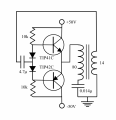
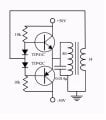
I want to drive current through a coil and capacitor at the resonant frequency. The circuit I am trying is attached. By using the tank circuit itself to create the oscillator, it is guaranteed to match the resonant frequency.

There is only one problem. It doesn't work. The resonant frequency is about 80kHz. I am using an Armstrong-type feedback. I ran a test 10V peak AC through the circuit to confirm that the feedback coil produced more than 10V. I biased the transistors so that there would not be a dead zone.

I know I am not understanding something, because it seems like it should work.

I would greatly appreciate it if somebody could enlighten me on how I messed up.
 

Attachments

KeithWalker

Joined Jul 10, 2017
3,607
I want to drive current through a coil and capacitor at the resonant frequency. The circuit I am trying is attached. By using the tank circuit itself to create the oscillator, it is guaranteed to match the resonant frequency.

There is only one problem. It doesn't work. The resonant frequency is about 80kHz. I am using an Armstrong-type feedback. I ran a test 10V peak AC through the circuit to confirm that the feedback coil produced more than 10V. I biased the transistors so that there would not be a dead zone.

I know I am not understanding something, because it seems like it should work.

I would greatly appreciate it if somebody could enlighten me on how I messed up.
You do not have a dc reference point for the emitters or bases of the transistors. Change the tuned circuit to a Hartley oscillator using a parallel rather than series tuned circuit and connect the feedback winding directly to the diodes, without the capacitor, and it should work.
NOTE: The transistors will probably not last too long. You are powering them at their absolute naximum VCE
 
Last edited:

MisterBill2

Joined Jan 23, 2018
27,508
I want to drive current through a coil and capacitor at the resonant frequency. The circuit I am trying is attached. By using the tank circuit itself to create the oscillator, it is guaranteed to match the resonant frequency.

There is only one problem. It doesn't work. The resonant frequency is about 80kHz. I am using an Armstrong-type feedback. I ran a test 10V peak AC through the circuit to confirm that the feedback coil produced more than 10V. I biased the transistors so that there would not be a dead zone.

I know I am not understanding something, because it seems like it should work.

I would greatly appreciate it if somebody could enlighten me on how I messed up.
No, really there is no way that it should work unless it is being powered by a split power supply, with both positive and negative outputs, and the middle tied to what is tagged eith a ground symbol.. There has to be a path for emitter current, and presently there is no way for base current to bias either transistor into conduction. Thus the comment in post #2 is correct. The suggested change should work. It may also be that you will need to reverse the connections of the feedback winding. In an oscillator the feedback polarity does matter a lot.
And it still seems that there needs to be a resistor between the junction of those two diodes and the connection of the two emitters.
You can also try operating this circuit as an amplifier by disconnecting the feedback capacitor from the transformer abd feeding in a signal.
 
Last edited:

Eric Matias

Joined Jun 14, 2019
4
Does the frequency to be very stable, is a pure sine wave required?

What about the load, and does it vary under operation?

When frequency stability is not of importance, some distortion is allowed and you can live with about 70..80% efficiency, you can make a >100W Class C oscillator with a single transistor (did this several times) or 2 transistors (balanced oscillator).

When higher efficiencies are required, you can make a class D or E oscillator, this requires some more components.

When the impedance of the load varies strongly with frequency, you may get some problem when trying to generate the power with an oscillator only.
 

Janis59

Joined Aug 21, 2017
1,894
Everything depends on the frequency.

At 20 kHz the Royer circuit works brilliantly, however for induction heating purposes the kids are telling its rather tricky about self-starting. At least be warned that may happen problems at ignition point so the adaptive biasing must be a central care in the circuit.

When the frequency is say 1-3 MHz then nothing is better than Hip6301+HiP6601. Its is multiphase controller+driver (elaborated for CPU PS) capable until 6 MHz with half-bridge or full bridge in the exit.

When the frequency is more serious, say 13 MHz, then bridge made of IXYS DE275 is the ultimate solution, like those designs used for Quadrupole Mass Spectrometry, I meanPS for plasma guns.

However the 27 MHz is something what those brilliant transistor already not able to digest, thus those vomit all their internals straight into nearest human face. Smell is indeed bad, may say it from own experience.

Then in the range between 30-60 MHz the best available choice is OR old good vacuum gauge (I joke, however it isnt a joke but sad truth at all) or IXFH42W60 in "reduced" Clapp resonant circuit, where all those irritating input capacitative dividers are factually inner transistor parasitic C(gs). So, if choose this circuit, and 100-200W are OK, take a rather powerful PC cooler, screw IXFH on in the left bottom corner, and at left whole edge screw the tank capacitor. As the reactive power of those capacitor will be near to MVAR, then I dont know ANY capacitor with price less than 3KEur capable to withstand such 10A*15 000V. So, my advice then is to use a pcb piece made capcitor, however FR4 is not applicable because of tan(delta)=0,15. Sorry, You need to buy Rogers coorp Duroid 6035HTC or 5880R3. At least the price will not exceed the 325 USD. Coil must be screwed between the aluminium of radiator and this capacitor, in series. Whole lower side of radiator is occupated by larger pcb containing miriades of SMD filtering capacitors, just cover all without of gap, but somewhere fix the Source coil (some 10-30 turns on 1 inch air-core, may use a champain cork or teflon) and very small 0,1-1 Ohm 10 W resistor, as well the 12V stabilizer. Dont use any 317, 7812 or any kind of IC - they will show a worst out of nightmares in high intensity RF field. Use most slowest bjt be able to find, the 2N3055 is fine, the russian kT805 is fine too, they not listen anything above couple of MHz. So, the last, as I told, classical Clapp circuit shown both C(gs) are unneeded, completely unneeded. No, they are harmful. So last job is to organize the gate bias. As You have stabilized 12V for fan rotating, just the adjustable one-turn type of "frog" is one You need, say, 10KOhm. But joke is that potentiometer will carbonize in the first second because of Focault, thus want to survive, make a small RF coil between frog and gate. May use a 2-3 mm ferrite rod and some 100 turns with 0,1 mm wire or even 50 turns will be better as nothing. Voila! Turn on! However the RF burns on the fingers are healing about half of year long. Be careful and spit in the face to those telling You that RF HV touching are innocent and never risky.
So, now come to 60-120 MHz - here is the only candidate APT6038, but Clapp is still the best alternative.
However if we are speaking of plasma capable 1GHz up to 3 GHz resonant systems, there circuit techniques are completely another, with MRF284 or similar. May recommend to read it by own, at http://gnativ.ru/vch-generator-na-tranzistore-mrf284l/ and http://gnativ.ru/moshhnyj-generator-vch-na-mosfet-tranzistore/ (hope everyone knows how to find translate.google.com). Very scary device. But one thing what never are told for students are - as less is the frequency, the colder plasma is (it is actually unbalanced plasma what ionic temperature are orders and orders below the electronic temperature. But as higher the frequency, the more balanced is plasma, thus it is felt hotter by touch.

P.S. Ah ya, for me was needed the very high voltage whilst You asked for very high current. Means just shift from serial resonance toward the parallel resonance. That is all.
 
Last edited:

Janis59

Joined Aug 21, 2017
1,894
Here is one rather well designed circuit for induction melting 4 kW, the paralell tank is wag-controlled by PLL (CD4046). When resonance is not inherrently self-adjusted like autogenerators have a habit, then PLL is sth "must to be" without of question. Circuit of rather good example stays at www.chipmaker.ru/blogs/entry/2171/ and actually all alien languaged text is not so obligeous to read through. Just look the circuit and everything is clear.
 

MisterBill2

Joined Jan 23, 2018
27,508
That single ground symbol does confuse the issue quite a bit.
Er.. Yes.. Bound to fail.
Never noticed that :oops:
On many power oscillators the feedback winding has fewer turns, since the transistors have a fair amount of gain.
One of my earlier suggestions was to try running the circuit as an amplifier by disconnecting from the feedback winding and driving the bases with an external signal. That is still a worthwhile thing to do, it will allow a comparison of the 14-turn output with the input to see if the feedback would be adequate as well as the right polarity. It would also allow checking to see if the intended power level could be reached. AND it can probably be done in simulation quite easily. So it will be a very useful experiment.
 

DickCappels

Joined Aug 21, 2008
10,661
Sorry for momentarily diverting the thread.

After some thought, there is voltage gain to be had. At resonance the reactance of the coupling capacitor cancels the reactance of the primary inductance, that can result in a lot of current which will cause an I x XL drop across the primary inductance. If the voltage follower is capable of enough current the voltage across the winding (and also the capacitor) can be very large.

This gain only occurs at the series resonant frequency.

By careful selection of the impedance of the series resonant components and enough current gain from the complimentary emitter follower it should be possible to achieve oscillation. In other words, keep trying.

Remember to have the output of the transformer in phase with the input and make sure your primary is high Q (low resistance).
 

Thread Starter

hensle

Joined Dec 31, 2011
46
Thank you for the response (and nice circuit edit). There are two issues.

1. Since the transistors actually act as emitter followers. The output voltage is slightly less than the input voltage, so for example if there were a 10V input signal, the maximum voltage across the coil would be 10V and the feed back would only be about 2V which would not be enough to maintain the oscillations. It could be done with this circuit (I presume) if there were a voltage amplification before these transistors and the feed back would be to that stage. The beauty of the series tank circuit is that when I put a 10V signal (at resonance) the voltage across the coil is over 100V and the feedback coil has over 10V which should be enough to maintain oscillations. I actually tested this as mentioned in the OP. The resistance of the coil at resonance is 10 Ohms.

2. The ultimate goal of this circuit is to drive current through a capacitor and coil in series at resonance as I need as much voltage on the capacitor as possible. So it has to be in series in any case.
 

Thread Starter

hensle

Joined Dec 31, 2011
46
No, really there is no way that it should work unless it is being powered by a split power supply, with both positive and negative outputs, and the middle tied to what is tagged eith a ground symbol.. There has to be a path for emitter current, and presently there is no way for base current to bias either transistor into conduction. Thus the comment in post #2 is correct. The suggested change should work. It may also be that you will need to reverse the connections of the feedback winding. In an oscillator the feedback polarity does matter a lot.
And it still seems that there needs to be a resistor between the junction of those two diodes and the connection of the two emitters.
You can also try operating this circuit as an amplifier by disconnecting the feedback capacitor from the transformer abd feeding in a signal.
Thank you for the response. I did use it as an amplifier and fed a 10V signal through so that I could establish that I had enough voltage in the feed back. It is also being powered by a split supply.
 

Thread Starter

hensle

Joined Dec 31, 2011
46
Sorry for momentarily diverting the thread.

After some thought, there is voltage gain to be had. At resonance the reactance of the coupling capacitor cancels the reactance of the primary inductance, that can result in a lot of current which will cause an I x XL drop across the primary inductance. If the voltage follower is capable of enough current the voltage across the winding (and also the capacitor) can be very large.

This gain only occurs at the series resonant frequency.

By careful selection of the impedance of the series resonant components and enough current gain from the complimentary emitter follower it should be possible to achieve oscillation. In other words, keep trying.

Remember to have the output of the transformer in phase with the input and make sure your primary is high Q (low resistance).
Thanks for the reply and you have hit the nail on the head so to speak. This is the plan.
I actually fed into it a 10V signal at resonance (which applied over 100V on the main coil) and compared it with the voltage on the feed back which was more than 10V and in phase. That is why I can't understand why it does not work......that is the mystery.
 
Top