High current 12V input switching

Thread Starter

RonV-AU

Joined Jan 19, 2026
19
Hello,

The slide out on my caravan works off 12V only, even when the van is plugged into 240V on a camp site. I’d like to change this to add a 12V power supply so the slide out motors would take 12V from the power supply when plugged into the mains but use battery when not on mains power.

I found this post here which seems very simple and effective, however the current draw of the slide out is much higher than the device in that application.
The slide out is on a 50A fuse so I was thinking to make a circuit capable of working up to 60A which should also help with heat. The slide motors run for 2 minutes max to push it out, or pull it back in.

But what diodes would I need, or should I have multiple in parallel to cope with the high current, or would this simple solution using diodes not work in my case?

Any help is greatly appreciated!

Thanks,
Ron
 

sghioto

Joined Dec 31, 2017
8,633
Why do that, if it only takes two minutes or less to move the slide.
The slide out probably draws 25 or 30 amps when first activated but closer to 10 amps when running, not much of a load for only two minutes.
 
Last edited:

Thread Starter

RonV-AU

Joined Jan 19, 2026
19
Fair enough question, we were using the van off grid but near a house. The battery didn’t have enough charge to pull the slide in, we could charge it from 240v but that took a lot longer than 2 minutes to get it going. Which made me think, why can’t it just work when I plug the van into mains power.

Ron
 

sghioto

Joined Dec 31, 2017
8,633
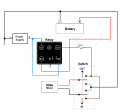
If I were to do this I would use a change over relay activated by the power supply.
When the Power Supply is OFF the Switch gets power from the Battery via contacts 30 and 87A, which are normally closed.
When the Supply is ON the Switch gets power through contacts 30 and 87, which are normally open.
The relay coil pins 85 and 86 connected to the +12 volt Supply.
Relay
1768946604391.png
 
Last edited:

AnalogKid

Joined Aug 1, 2013
12,042
There is a difference between the current that a set of switch contacts can switch, and the current they can carry. As long as you *never* flip the switch when the motor is running, a SPDT switch rated for 50 A DC should work. You already have an on/off switch that handles direction changing, so all you need is something to change the source when the motor is off.

An automatic changeover system powered by the DC supply would be nice, but then you would need either a 50 A contactor ($) or two banks of power MOSFETs, heatsinks, etc. $

Another approach is less efficient but less work. Thanks to the switching power supply industry, there are lotsa high-current dual diodes out there. Motorola used to make some 100-200A parts complete with screw terminals. IXYS still makes them, but their website is very poor at helping a parametric search. Still, the basic approach is valid. Measure the battery voltage, adjust a 12 V, 1kW power supply output to be 1 V higher, and connect the diodes. Heatsink required, and one larger than would be needed for the MOSFET approach.

ak
 
Last edited:

MisterBill2

Joined Jan 23, 2018
27,159
It is usually NOT a good choice to leave a battery in a state of discharge,
You could also just use a single high current diode and connect the extra power supply in parallel with the battery. If the supply is set at 12 volts then not much, if any, current will flow into the battery, and the diode will prevent any current backflow to the supply.

Also, if the slide out is part of an actual motor vehicle, and not a caravan (trailer), the battery should normally be charged by the engine electrical system. AND,, if the slide-out is part of any kind of travel trailer that I am familiar with, it may be able to operate from the internal power supply that is normally part of the package. At least here in my part of the US.
 

Thread Starter

RonV-AU

Joined Jan 19, 2026
19
Thank you all. I’ve ordered a 12V 50A power supply and when it is here, check if the output power can be adjusted. If not, then running in parallel with the battery could be an option.

The van is a caravan, not a motorhome. Yes the battery would still be charged while behind the car however the failed battery had its voltage drop too low once while standing in the backyard without power. That shouldn’t happen any more as it is now in shed at home and plugged in to a 240V 15A socket.

I don’t have a 240V diagram for the van but from the components used it seems similar to a home setup with power going to a board and split between 2 circuits RCD protected. Unplugging the 240v, there is no power to any of the sockets in the van so there is no inverter and no power supply either as the 240v and 12v circuits are separate and only meet in the battery charger. I think the set up in the van is very basic but ok.

I would like to add an inverter as well at some stage to feed a the 240v sockets while on battery. The idea being that when the van is plugged into 240V, the inverter would be able switch between passing 240v through and when on battery the inverter switches to provide 240v from battery.
At the same time replace the charger for a battery management system with monitoring.

That is the longer term plan.

Ron
 
Last edited:

MisterBill2

Joined Jan 23, 2018
27,159
I suggest caution when you add the inverter, to avoid the possibility of the external 240v supply being accidentally connected to the inverter output! Since they would, i presume, feed the same electrical outlets.
 

sghioto

Joined Dec 31, 2017
8,633
That shouldn’t happen any more as it is now in shed at home and plugged in to a 240V 15A socket.
If this is true then you don't need the power supply.
Every trailer has a converter that keeps the battery charged and powers the 12 volt circuits when plugged into house voltage.
 

Thread Starter

RonV-AU

Joined Jan 19, 2026
19
I suggest caution when you add the inverter, to avoid the possibility of the external 240v supply being accidentally connected to the inverter output! Since they would, i presume, feed the same electrical outlets.
Agreed, in the setup with inverter the external 240v would supply the inverter, the inverter would feed the sockets. I was looking at inverters that will pass through the 240v directly when connected to mains.

Ron
 

Thread Starter

RonV-AU

Joined Jan 19, 2026
19
The inverter would also be connected to the battery and switch between battery and mains. So when not on mains, the sockets can still be used for 240v which is not the case at the moment - no 240v to the van, sockets don’t work.
 

kaindub

Joined Oct 28, 2019
176
Have you measured the actual motor current? Whilst the circuit may be 50A , 50A is a lot of current for a motor.(ie its a big motor in that case)
 

Thread Starter

RonV-AU

Joined Jan 19, 2026
19
I haven’t, but the manufacturer of the slide out (Lippert Schintek) has some data suggesting up to 13A when starting and settling down to 3A. There are 2 motors so according to their measurements 26A max current.
 
Last edited:
Top