High current brushed DC motor controller for outboard motor

The gate driver I used for my application was: https://www.mouser.co.uk/ProductDet...T*MTY5NjYwMDEwNy4xLjAuMTY5NjYwMDEwOC41OS4wLjA.

You'd have to check whether this is suitable for your application though.

I noticed you have 2 resistors between the 555 output and the gate of your MOSFETs. This will also slow the switching time as the gate has to be charged/discharged via these resistors.

They are most likely there to protect the 555 from damage, but you could try removing them assuming you don't mind sacrificing a 555.

Thanks

Dale
 

Thread Starter

Timothee L

Joined Oct 4, 2023
36
On the contrary, it seems rather low for your 1kHz PWM frequency. A dedicated gate driver IC typically can source/sink at least 1 Amp to ensure the gate capacitance charges quickly. If a FET is not driven quickly on and off it generates considerable heat.
Hey Alec,
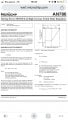
I’ve been doing some research and i think i get it now, on this paper(check photo) it clearly indicates the typical gate current which is way higher than what i was using ! Tell me if thats what you were refering to ?
 

Attachments

Thread Starter

Timothee L

Joined Oct 4, 2023
36
No. It's nothing to do with duty cycle. It means in the microseconds it takes for the FET to switch from fully off (Rds say 1 megohm) to fully on (Rds say 20 milliohms), or vice versa, at each PWM pulse edge. In the 'half-way' state Rds might be, e.g, an Ohm or so. Passing lots of Amps through 1 Ohm generates lots of Watts of heat, albeit for a brief period. The shorter that period the better.
Wow ok omg thats a great explanation got it chief ;)) Ok so the problem might be coming from here I need a higher gate current which is what REAL proper gate drivers do they are ableto deliver high gate current to rapidly change the off state of the mosfet to a on state right ??
 

Thread Starter

Timothee L

Joined Oct 4, 2023
36
I went back and checked and the motor specification sheet ONLY GIVES NO LOAD CURRENT! So the only other hints are the "K" factors shown farther down on the sheet, which can be used to eventually give a hint at full load current. That is less than stall current, and happens to be a useful piece of information that is not provided.
Of course we do not know what the load is with the prop installed and the motor in the water, and so we have no clue as to how much current the motor is drawing.
The relationship between the prop size, torque, and RPM is an area where I have no experience. But given that the motor HP rating is provided, although without any current or RPM conditions, But that HP information should help you select an optimum prop size. Based on the few trolling motors I have seen, the prop will be rather small.
Yes the 3.2amps is the no load current right ? Yes I've heard a bit about the K factor you can use the Kt and Kv, I'm sorry I should have given the link to the motor you can see the charts that compare current vs torque vs rpm all in one chart go find the motor E30-400-24 on this link: https://www.ampflow.com/motors/highPerformance/threeInch/#economy !
Yes I'm not very familiar with the relationship between the prop size rpm and torque either and I kinda left that out to eventually improve in the futur but i think right right now it does not correlate to the explosion of the mosfets I think it will only lead to ineficient propulsion thats all. My prop is around 30cm in diameter (plastic one).
Thanks for the input ;)
 

Thread Starter

Timothee L

Joined Oct 4, 2023
36
The gate driver I used for my application was: https://www.mouser.co.uk/ProductDetail/Microchip-Technology/TC4422EPA?qs=mKuojOqe%2BqPqLHOJDeNApA==&_gl=1*1g3mm8*_ga*MjAzODk2MDEzMC4xNjk2NjAwMTA4*_ga_15W4STQT4T*MTY5NjYwMDEwNy4xLjAuMTY5NjYwMDEwOC41OS4wLjA.

You'd have to check whether this is suitable for your application though.

I noticed you have 2 resistors between the 555 output and the gate of your MOSFETs. This will also slow the switching time as the gate has to be charged/discharged via these resistors.

They are most likely there to protect the 555 from damage, but you could try removing them assuming you don't mind sacrificing a 555.

Thanks

Dale
yes thanks for the help were on the same page now with Alec you guys are great ahah
 

bassbindevil

Joined Jan 23, 2014
922
TLDR, but I bought a PWM speed controller off ebay for my friend's electric trolling motor. The motor pulled around 40 amps from 12V when immersed in a rain barrel for testing (original speed control was broken, so it was wired directly). If you're sizing power MOSFETs, note that this thing has 8x90A in parallel, yet is only rated for 60A. Also, you can't build one from parts as cheaply.

https://www.ebay.com/itm/60A-DC-10-...ed-Control-PWM-HHO-RC-Controller/202992808923
board says Xinrui XR-180 which doesn't find anything on Google; pictures on listing showed XY-1260

D1-4: 2CZ20100
20A 100V schottky

Q1-8: NCE7190
N-channel, 90A, 71V, 6.8 milliohms at 10V
 

HasBeen

Joined Jul 28, 2023
30
Hello everyone,

This is the first time I have ever written on a forum and this is my first electronic project,
My name is Timothee I am an electrical hobbyist and I am working on a project where the goal is to create a functional electric outboard motor, I am trying to create an electric controller for a brushed DC motor (80amps continuous output)
The problem ?
Everytime I try using the controller in my garage with the controller everything is fine it can run forward and backward and the RPM changes accordingly to the PWM signal send by my potentiometer (see schematics). But once in the water i start accelerating slowly to not overload the motor the 4 parallel N channel mosfets (IRFZ44N, Id=49Amps continuous, Vdss=55 volts) explode... And I do not understand what is wrong with my schematic (very simple with no programming I am still learning progressively).
My assumptions:
Water creates more resistance and evidently overload the motor making it consume more amps (but since I have a BMS it lets out max 80amps) and in a perfect world each mosfet should have and Id=80/4=20A BUT I guess there has to be an increase in the junction temperature that creates a snowball effect and makes them overheat even though i used a big heatsink to counter this...
I do not know how to properly scale my heatsink to counteract the increasing junction temperature so any help would be greatly appreciated !
Also I was wondering if IGBTs where better in that case or if mosfets would just do the job ? Like if someone is working in power electronics for those application what would be the best ?

PS: PWM switching frequency is around 1kHz
Battery voltage goes from 18V to 29,4V when fully charged
Vgate/source goes from 1,2V to 13V when full throttle

If you have any question ask me i will be reactive ! Thanks a lot

Timothee
Tell me there is / are bigger diodes across the motor terminals than the 1n4004s shown. Also, what other components, besides the big FETs, get blown when they blow up?
 

HasBeen

Joined Jul 28, 2023
30
Yes i understand but the BMS will only allow 80 amps to flow at max so the real problem is why can't my 4 transistors hold this 80amps while they are rated for 35amps at 100°C ?
I doubt that the transient response of your BMS is fast enough to limit the current to 80A before a spike of much greater current can be passed. The required time that such a spike must exist in order to blow the FETs is essentially ZERO.
 

shortbus

Joined Sep 30, 2009
10,050
Is a mosfet even the correct device to use for this? To my limited knowledge a IGBT would be a better choice. High amperage and low switching frequency are the realm of the IGBT. Low amperage and high frequency work better with mosfets.

80A and 1kHz seem like the IGBT would work better.
 

Thread Starter

Timothee L

Joined Oct 4, 2023
36
TLDR, but I bought a PWM speed controller off ebay for my friend's electric trolling motor. The motor pulled around 40 amps from 12V when immersed in a rain barrel for testing (original speed control was broken, so it was wired directly). If you're sizing power MOSFETs, note that this thing has 8x90A in parallel, yet is only rated for 60A. Also, you can't build one from parts as cheaply.

https://www.ebay.com/itm/60A-DC-10-...ed-Control-PWM-HHO-RC-Controller/202992808923
board says Xinrui XR-180 which doesn't find anything on Google; pictures on listing showed XY-1260

D1-4: 2CZ20100
20A 100V schottky

Q1-8: NCE7190
N-channel, 90A, 71V, 6.8 milliohms at 10V
Tell me there is / are bigger diodes across the motor terminals than the 1n4004s shown. Also, what other components, besides the big FETs, get blown when they blow up?
Yes they are bigger dont worry its just that Im new to eagle free software and couldnt select exactly the diodes I had, no other components get blown !!
 

Thread Starter

Timothee L

Joined Oct 4, 2023
36
I doubt that the transient response of your BMS is fast enough to limit the current to 80A before a spike of much greater current can be passed. The required time that such a spike must exist in order to blow the FETs is essentially ZERO.
Yes but there is no reason to have a current spike right ? Only at the motor start up but since i have a soft start this is avoided !
 

Thread Starter

Timothee L

Joined Oct 4, 2023
36
Is a mosfet even the correct device to use for this? To my limited knowledge a IGBT would be a better choice. High amperage and low switching frequency are the realm of the IGBT. Low amperage and high frequency work better with mosfets.

80A and 1kHz seem like the IGBT would work better.
Yes that was also one of my main questions since Im learning all about transistors (FETs and IGBTs) I didnt know what would be best suited for my application, so I went with FETs. But one more question for you is, how is my frequency going to affect my FETs or IGBTs response ? like if i decide to increase the frequency are my mosfets going to be more efficient ? But if i understand correctly having a too high switching frequency will lead to partial charge discharge of the FETs and thus having an intermediate resistance which will lead to high power loss (heat) and ultimatly blowup the FETs.
 

Thread Starter

Timothee L

Joined Oct 4, 2023
36
TLDR, but I bought a PWM speed controller off ebay for my friend's electric trolling motor. The motor pulled around 40 amps from 12V when immersed in a rain barrel for testing (original speed control was broken, so it was wired directly). If you're sizing power MOSFETs, note that this thing has 8x90A in parallel, yet is only rated for 60A. Also, you can't build one from parts as cheaply.

https://www.ebay.com/itm/60A-DC-10-...ed-Control-PWM-HHO-RC-Controller/202992808923
board says Xinrui XR-180 which doesn't find anything on Google; pictures on listing showed XY-1260

D1-4: 2CZ20100
20A 100V schottky

Q1-8: NCE7190
N-channel, 90A, 71V, 6.8 milliohms at 10V
Hi,

Thanks for the input, but it seems crazy to me that you need to have 720amp capacity fets for only a max 60amp application but ok !
Sorry but your link doesnt work im curious to see what you sent me !
 

BobTPH

Joined Jun 5, 2013
11,514
The amp capacity of MOSFETs is mostly fiction. They cannot be operated continuously anywhere near their rating. That is what the SOA graph is about.
 

shortbus

Joined Sep 30, 2009
10,050
Yes that was also one of my main questions since Im learning all about transistors (FETs and IGBTs)
The first thing is do what has been already suggested, get dedicated gate drivers. The same driver works on both mosfets and IGBT circuits. As to the on time a driver actually sinks more current than it sources.

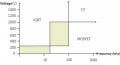
Here is a diagram showing what the difference is in frequency and choosing which to use. but read the whole link to better understand. https://www.utmel.com/blog/categori...characteristics-structure-and-market-analysis

1696719668044.jpeg
 

Thread Starter

Timothee L

Joined Oct 4, 2023
36
The amp capacity of MOSFETs is mostly fiction. They cannot be operated continuously anywhere near their rating. That is what the SOA graph is about.
Why does it say continuous drain current Id then ? if there is proper cooling souldnt the 39Amp mosfet be able to handle at least 30amps ? I get that there is a SOA but for high current application such as mine what kind of mosfet should be used then ? A Id of around 400 amps ? seems weird
 

Thread Starter

Timothee L

Joined Oct 4, 2023
36
The first thing is do what has been already suggested, get dedicated gate drivers. The same driver works on both mosfets and IGBT circuits. As to the on time a driver actually sinks more current than it sources.

Here is a diagram showing what the difference is in frequency and choosing which to use. but read the whole link to better understand. https://www.utmel.com/blog/categori...characteristics-structure-and-market-analysis

View attachment 304410
Great article thanks a lot !
 

Boggart

Joined Jan 31, 2022
82
Hi Boggart,
Thanks a lot for that input, I am very curious to know and understand why this IRFB7537PBF FET is more suited for these kind of low frequency switching applications than the IRFZ44N I amjust missing some knowledge and if you could explain it would be great ! :)
Wouldn't that be an overkill to have a 173A continuous for a 30A application ? just curious
So in my case 1 or 2 in parallel would do the job ? But using parallel FETs has drawbacks like for example if I checked the datasheet correctly the gate threshold voltage is between 2.1 and 3.7V meaning that at 3V I may have one FET that is on and not the other ones so do I need to buy like 10 of them and test which ones how the same (or close) gate threshold voltages ?
How do I properly scale my FETs for the application, and also in your case how did you calculate the Heatsink you needed for the proper power dissipation of your single FET ?
Thanks again help a lot, I am considering in buying more appropriate FETs like you told me
Timothee
Hi Timothee, when driving large current loads you want to do several things. The first is to minimise the Rds (on resistance) of the FETs, the FETs I suggested have a much lower Rds than the IRFZ44, so less heat produced when fully conducting.

The next thing you want to do is minimise the switching time, which is the time from non-conducting to fully conducting, and back again. This is the linear region and the FET has a much higher resistance when in this region, so more heat produced, albeit for a short time period. To minimise this transition time you need FETs with as low a gate capacitance as possible (gate capacitance slows transition time because the gate has to be charged and discharged each time the FET is switched) and you also need to be able to drive the gate with a decent current level to charge and discharge it rapidly (as someone else here mentioned).

So, a single FET with the appropriate specs will have a lower gate capacitance than multiple parallel less-capable FETs (most likely), but you need to check the specs sheets and go from there. A FET gate driver is a good idea, as someone else mentioned, but I've generally found at lower switching frequencies that it is less necessary as the FET will still spend most of its time fully on or fully off.

So, I would look at a beefier FET, one designed specifically for this sort of use, and if that doesn't solve it then add in a FET gate driver to speed up the switching.
 
Top