Help with remote display

AnalogKid

Joined Aug 1, 2013
12,128
I thought the diode stack was cute, but I knew someone would go to all-resistors to get higher noise immunity.

Here is a circuit from another thread that lets you alternate between two LEDs with only one open collector or open drain transistor and one current limiting resistor. For low current LEDs, the LM358 or LM324 car drive the LED cathodes directly. For higher currents, an appropriate N-channel MOSFET works well as shown.

Also, if the opamp outputs are the wrong logic polarity, you can swap the inputs to get what you need. For the amber channel it is a simple swap. For the r/g channel there are more circuit changes, but it still is doable with the same component count.

ak
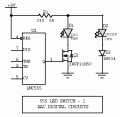
LED-Switch-555-1-c.gif
 

Attachments

Are there requirements for the distance of the remote display? How about conductors in the cable? Any control inputs from the remote display? aka alarm acknowledge
 

Thread Starter

Nick Bacon

Joined Nov 7, 2016
130
Are there requirements for the distance of the remote display? How about conductors in the cable? Any control inputs from the remote display? aka alarm acknowledge
I am fairly sorted on this now I think. Went with 10 core. Distance approx 500m, no acknowledge of fault. Just 12 leds.
 

AnalogKid

Joined Aug 1, 2013
12,128
A constant current source is an idealized concept that pushes a constant amount of current through a load no matter what the load resistance is. Per Ohm's Law, this means that the output voltage must vary directly with the load resistance. Since the circuit has a fixed voltage source powering it, it is possible for the load resistance to be so high that the circuit cannot increase the output voltage enough to keep the output current constant. The voltage range over which the circuit stays in constant current mode is called its voltage compliance. For example, a 20 V circuit designed to produce 20 mA into the load will work as long as the effective load resistance is below 1000 ohms. With a 100 ohm load, the output voltage will sag down to 2 V and the current will be 20 mA.

There are two common ways to do this. For precise control and bidirectional currents there is an opamp circuit called a Howland Current Source. For something less stringent there is a 1-transistor circuit that can either source (PNP) or sink (NPN) a moderately-regulated current, a 2-transistor improvement, and a 1-opamp improvement. Another popular approach is to use a 3-terminal regulator like an LM317, but that is overkill for driving an LED.

If you want to go down this path, I recommend the 1-transistor approach. Here is a link to how it works, using a PNP as the example. Flip everything over for an NPN. OTOH, if you calculate the round trip wire resistance and compare that with the LED's current limiting resistance, you might decide to skip all of this.

http://www.circuit-fantasia.com/cir..._current_source/simple_bjt_current_source.htm

ak
 

parkerea

Joined Oct 16, 2011
4
As long as we are in analog mode, how about only 2 wires, driving up to 10 LEDs one at a time, with only 1 IC and a couple resistors -- and no dropping resistors for the LEDs? Try an LM3914 LED bar or dot graph driver. It is one my favorite old school devices. I would also recommend the constant current source described above.
http://www.ti.com/product/LM3914
 

AnalogKid

Joined Aug 1, 2013
12,128
The 3914 is a dot/bar graph driver, not a circuit that can drive any of the LEDs in any combination. See posts 1, 4, and 7 for a description of the project requirements. Some LED combinations are mutually exclusive, some are always in combinations, etc. At a minimum, at least 4 LEDs are on at all times.

ak
 
Top