You're going to need to provide more information. What is the supply voltage, what color is the LED, what current do you want to operate them at?
Members here like to help, but we (at least I) don't work for free.
You can search this site and the internet for light dependent circuits. They usually use a LDR (Light Dependent Resistor), so you could use that in your search term(s).
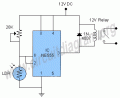
Sounds like you need a Dark detector circuit, when the sensor is in darkness or low light, the leds come on, and turn off when the light returns.
Give more info as to what voltage you want to use.
You're going to need to provide more information. What is the supply voltage, what color is the LED, what current do you want to operate them at?
Members here like to help, but we (at least I) don't work for free.
You can search this site and the internet for light dependent circuits. They usually use a LDR (Light Dependent Resistor), so you could use that in your search term(s).
Ahh okay. Sorry for the lacking of informations. I just want to add an LED for my wall clock(analog) just to enhance what I got on last Christmas. A 9v battery operated I think would do?
View attachment 143068 Sounds like you need a Dark detector circuit, when the sensor is in darkness or low light, the leds come on, and turn off when the light returns.
Give more info as to what voltage you want to use.
Do you want the LEDS to be on or off vs. varying brightness according to ambient light?
You still haven't specified LED color or desired operating current. Assuming a forward voltage of 2.5V, you could connect as 4 strings of 3. Operating each string at 10mA would require 40mA.
You might get overnight runtime with a 9V alkaline battery.
Yes sir, all 12 LEDs be on at the same. And if a 9v battery cant last long could you attach a power supply diagram also? I have extra 12-0-12 2amp power supply.
Do you want the LEDS to be on or off vs. varying brightness according to ambient light?
You still haven't specified LED color or desired operating current. Assuming a forward voltage of 2.5V, you could connect as 4 strings of 3. Operating each string at 10mA would require 40mA.
You might get overnight runtime with a 9V alkaline battery.
Different color LEDs have different forward voltages. Even LEDs of the same color from the same lot will have variation, but not as much as different colors which use different chemistries.
I just checked out a super bright white led. With a series resistance of 115k, the led was very visible in a dark room using a 5 volt power supply.
I have not tried a higher resistance, but I am sure it could be larger.
Current thru the led was on the order of 55uAmp.
A garden variety 9v battery is good for .3 Amp hours. The battery should be good for nearly 1.5 years. Assuming 8 hours of operation per day the battery should be good for around 4 years.
Using a couple of CD4017 Johnson counters, each led could be lit sequentially.
Yes sir, all 12 LEDs be on at the same. And if a 9v battery cant last long could you attach a power supply diagram also? I have extra 12-0-12 2amp power supply.
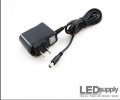
You might have a bunch of these around. I know I do. If you don't have any they can be bought very cheap. I would forget the battery idea. Two much messing around to have to chane it or charge it.
A garden variety 9v battery is good for .3 Amp hours. The battery should be good for nearly 1.5 years. Assuming 8 hours of operation per day the battery should be good for around 4 years.
You're asking for someone to design a circuit for you. Typically we charge 15¢ per answer. 25¢ for good answers; $1.00 for accurate answers. Fortunately, dumb looks are still free.
It's sounding like you might not understand fully what is required to build a circuit using a battery, an LED and a necessary resistor. You need to know the forward voltage of the LED and subtract that from the supply voltage. Then knowing a final voltage you need to calculate the resistor needed to keep from burning out the LED. You further complicate the issue by wanting 12 LED's lit at once. If you could see fast enough you would see that your typical alarm clock with 4 digits, 7 segments per digit, that only one solitary segment is lit at any given instant. Because we can't see that fast we perceive all the segments lit at the same time. It's called "Strobe Affect". You THINK you see a number, but you really only see 1/7th of a number at any given instant.
ME? First I wouldn't opt for battery powered LED's. The battery voltage drops over time and the LED's diminish in brightness. Eventually the battery is not strong enough to light the LED's. If you REALLY want to build a circuit then follow the advice of MARCF. You'll need a timer circuit to run the counter through its steps. Then you'll need two counters, be they octal (8) or decade (10) output devices. You need 12. But now you have to understand the logic behind cascading counters and triggering the reset at the 13th count.
Just using a simple decade counter and a 555 timer, and 10 LED's and resistors, you can strobe the counter so fast that it would appear as if all 10 LED's were on at the same time, when actually only ONE LED would be lit. A HUGE saving in current. But you also need to consider the amount of current the counter will draw PLUS the current needs of the 555. In the short end of it - you'll probably end up using more power going with a counter than with simply lighting 12 LED's.
The BEST suggestions you've gotten so far is to use 3 LED's in series with a series resistor to limit the level of light to something that won't keep you up at night. That and the use of an old cell phone charger. I have chargers from old cordless phones I no longer use. They're typically 9 volts direct current. So using a white LED (assuming a forward voltage of 3.5 volts) you could use two LED's in series (dropping 7 volts) and a resistor to drop two more volts. A "Super Bright White" LED is really bright at 10 mA. Even at 5 mA it's bright enough to disturb your sleep. Set up 12 of them and you're going to be washing the room with tons of annoying light. If ANYTHING, I'd opt for some old red LED's with a typical forward voltage of around 2 volts. That way you can put 4 in series with a series resistor and limit the current to - I don't know - maybe 3 mA for a dim glow all day and night long. You won't see them in the day time but you will when it gets dark.
Like I said, there's a lot more to lighting an LED than just sticking a battery and resistor on it. Sure, that'll work. But you have parameters you want to achieve. Lit all night (for instance). Power source of a battery. Available stock of LED's and resistors. Decisions on how bright you want them to be will dictate how much current you will design for. Now, if you want US to do that for you • • • Make your check payable to * * * . But I can still sit here with a free dumb look on my face if you prefer.
Just using a simple decade counter and a 555 timer, and 10 LED's and resistors, you can strobe the counter so fast that it would appear as if all 10 LED's were on at the same time, when actually only ONE LED would be lit. A HUGE saving in current.
I don't understand how that really saves you any current. To get the same perceived brightness when strobing ten LEDs in sequence so that each is effectively on 10% of the time, you have to run 10x the current per LED that you would have used when running them simultaneously. Our eyes respond to the average brightness, not the instantaneous brightness.
So, you could run 10 LEDs, strobing in sequence, with 1mA of current running through each one when it's on, and have 1mA of current consumption (ignoring switching mechanisms for the moment.)
Or, you could run all ten LEDs at the same time, with 0.1mA running through each, for a total of 1mA of current consumption.
Either way, each LED's AVERAGE current consumption is 0.1mA, so perceived brightness is the same. Either way, the total AVERAGE current consumption is 1mA.
Strobing is great when you need to multiplex things and get a lot of LEDs controlled individually with as few control pins as possible, but I don't see any advantage in this case.
I don't understand how that really saves you any current. To get the same perceived brightness when strobing ten LEDs in sequence so that each is effectively on 10% of the time, you have to run 10x the current per LED that you would have used when running them simultaneously. Our eyes respond to the average brightness, not the instantaneous brightness.
So, you could run 10 LEDs, strobing in sequence, with 1mA of current running through each one when it's on, and have 1mA of current consumption (ignoring switching mechanisms for the moment.)
Or, you could run all ten LEDs at the same time, with 0.1mA running through each, for a total of 1mA of current consumption.
Either way, each LED's AVERAGE current consumption is 0.1mA, so perceived brightness is the same. Either way, the total AVERAGE current consumption is 1mA.
Strobing is great when you need to multiplex things and get a lot of LEDs controlled individually with as few control pins as possible, but I don't see any advantage in this case.

 Facebook
 Google
 GitHub
 Linkedin