Simple voltage drop question

Thread Starter

Human2

Joined Dec 22, 2017
51
Well I am a student a currently have EE at collage, I learned some things
and some things not. Anyways I bought a few components and stuff to play around.
I am shocked that I don't know how to calculate voltage drop in this circut:
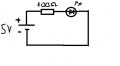
Bez naslova.png

Okay so I actually have a 9 V battery connected to a LM7805 voltage regulator so I get 5V.

I don't know resistance of my 3mm red led, how can I then find out voltage drop on both a resistor and a LED :/ ?
 
Last edited by a moderator:

Alec_t

Joined Sep 17, 2013
15,112
You don't need to worry about the LED's resistance. The important parameters are its forward voltage (Vf) and the maximum rated current (Imax, found from the datsheet). For a typical red LED, Vf is about 2V and Imax is about 20mA.
Never run components at their maximum current rating if you want them to have a long life.
 

MrChips

Joined Oct 2, 2009
34,690
This is a typical question given to students in the first lesson of semiconductor electronics.

There are two ways of solving this:

1) Mathematically, if you know the I-V equation of the diode

2) Graphically, by drawing the load line superimposed on the I-V characteristic curve of the diode.


Thread Starter

Human2

Joined Dec 22, 2017
51
Thanks guys, one more question:

Voltmeter shows 3 V on resistor and 2 V on LED. If my LED would be 5 mm, not 3mm,
would then voltage drops also change ?
 

dl324

Joined Mar 30, 2015
18,260
If my LED would be 5 mm, not 3mm,
would then voltage drops also change ?
Any slight variation would be due to temperature differences. Forward voltage is temperature sensitive and the larger package would tend to dissipate heat better.

That should be swamped out by the heating caused by forward current.
 

MrChips

Joined Oct 2, 2009
34,690
The solution I offered will give exact or close to exact voltages.

In practical electronics, you learn to live with approximations.

For all intent and purposes, 2V forward voltage is close enough for most red LEDs.
This goes up to about 3.5V for blue LEDs.


Thread Starter

Human2

Joined Dec 22, 2017
51
Well I'm asking because I was following the guy in this video, and he had 5mm
led and I had 3mm one and well at the end you can see at 06:05
(
) it says resistor should be 2 V voltage drop and led 3V.

I used 100 ohm also, and got 3V when connected multimeter to resistor and 2 v when connected to led :/
 

bertus

Joined Apr 5, 2008
22,905
Hello,

When you measure 3 volts accross the 100 resistor, there will be a current of 3 Volts / 100 Ohms = 0.03 Amps = 30 mAmps through the led.
This might be well over the specs of the led and the led will have a short life.
Try to repeat the test with a 150 Ohms resistor to limit the current to about 20 mAmps.

Bertus
 

Thread Starter

Human2

Joined Dec 22, 2017
51
Oh, I have only 100's and 1000's, will then use 2*100's in series.

But why does the guy in the video get voltage drop on resistor 2V and voltage drop on led 3V
and I get it other way around :/
 

WBahn

Joined Mar 31, 2012
32,746
As already pointed out, the forward voltage across an LED is primarily determined by the type of LED. You are using a red LED and the video appears to be using a green LED. So you can expect a different voltage across it. Also, the more current you put through an LED, the more the voltage will be across it. At low currents the voltage is roughly constant as the voltage changes, but above some point the resistive portion of the LED begins to dominate and you get much more voltage change as the current continues to increase.
 

Audioguru

Joined Dec 20, 2007
11,248
Why don't you look at the datasheet of the LED you are using? It will tell you its range of forward voltage and its maximum allowed current.

There are dim old green LEDs that are about 2.2V and there are very bright modern green LEDs made with the same chemistry as blue and white LEDs that have a forward voltage of about 3.2V.
 
Top