Help with developing an intermittent circuit.

Thread Starter

JuanCaste

Joined Dec 8, 2021
16
Geez @shortbus - I was going to say the same thing. From where are you going to get hydrogen? If you're thinking HHO - yeah people have managed it, but it's not very practical. And at best they've just barely managed to achieve the results. But now your HHO generator is going to draw a lot of current. What are you going to have left over to run the electrical generator? And a lot of those HHO video's where they show you how they make liters per minute are questionable. I have messed with HHO and I can tell you - it's not so easy to produce those kinds of quantities. And many of those video's are faked.
Thanks for the help! But I mostly need advice on the circuit I need to develop to cancel the "back end spark". Can you help me with that?
 

Reloadron

Joined Jan 15, 2015
7,891
Thanks for the help! But I mostly need advice on the circuit I need to develop to cancel the "back end spark". Can you help me with that?
OK, main problem is you have a fixed spark. You can remove the coil which is also the pickup. Then as shortbus suggested earlier go with a cam and points system. You can maybe try a reluctor type design similar to what replaced points or use points on a cam you will need to fabricate, signal condition into a square waveform and then run that into a divide by two circuit. Using points the signal off points will likely need cleaned up and filtered. Since you already have a 12 VDC system you might be able to have the points to ground and for the high side a 10K pullup resistor. That will give you 12 volt pulses which you divide by two. You want to be able to adjust the points, not just gap but swell time and timing. Much like an old automotive distributor design. Pretty much as short bus described earlier. If I were to do it that is how I would start I guess and this is only a guess suggestion. Once you have the divide by two using a chip like a CMOS 4027 configured to divide by two you will need a power transistor to drive an ignition coil, maybe a coil similar to the coil used on larger motorcycles. I see no easy way to use the current magnetic induction coil you currently have. Maybe someone else has a way and schematic? Shortbus is the guy who is really good with this sort of stuff.

That or use a hall effect sensor to pickup the flywheel magnets and divide by four since I think there are two magnets on the flywheel. Again, you may need some signal conditioning. Then a transistor capable of driving an ignition coil.

Ron
 

LowQCab

Joined Nov 6, 2012
5,101
Thanks for the help! But I mostly need advice on the circuit I need to develop to cancel the "back end spark". Can you help me with that?
You haven't been reading any of the responses to your question.
You're just going blow a lot of Money and create an expensive pile of junk.

A Camshaft-Sensor can probably be epoxied or bolted to the exterior of the Engine-Crankcase,
BUT, the Engine must be completely disassembled,
and then the Cam-Shaft-Gear must be machined to accept a powerful Neodymium-Magnet,
which must be Epoxied into the precision machined-hole in the side of the Gear,
The Magnet must be strong enough to create a Magnetic-Field that will
permeate the Aluminum-Crank-Case-Cover.

The Ignition-System does NOT need to be modified in any way.
Simply have the Cam-Sensor short the "Stop-Wire" to Ground ....... Done.
.
.
.
 

Thread Starter

JuanCaste

Joined Dec 8, 2021
16
You haven't been reading any of the responses to your question.
You're just going blow a lot of Money and create an expensive pile of junk.

A Camshaft-Sensor can probably be epoxied or bolted to the exterior of the Engine-Crankcase,
BUT, the Engine must be completely disassembled,
and then the Cam-Shaft-Gear must be machined to accept a powerful Neodymium-Magnet,
which must be Epoxied into the precision machined-hole in the side of the Gear,
The Magnet must be strong enough to create a Magnetic-Field that will
permeate the Aluminum-Crank-Case-Cover.

The Ignition-System does NOT need to be modified in any way.
Simply have the Cam-Sensor short the "Stop-Wire" to Ground ....... Done.
.
.
.
Again, thanks for all the help! I love these forums... I have been reading everything and I am posting on three different forums. I really hope I can find somebody to give me advice on how to build a circuit that will come on and stay on when I pass the magnet on the hall effect sensor and then will shut down and stay off when I pass the magnet again. That's it. I already figure out how to do an electronic ignition system for the generator. That is the circuit diagrams I posted. It's acutally simple and proven. I will remove the big magnet from the flywheel and install one (or several if needed) small neodymium magnet. This will trigger the hall effect sensor and fire the spark plug at whatever angle needd using the circuit that includes a coil. I can control the angle by the position where I glue the magnet. This idea I got from www.model-engine-ignition.com. I might use their PICTIM system, or maybe some other one. But need to figure out how to make it fire on the first revolution and not fire on the second. I am a mechanical engineer and have the mechanical part of the system all figured out, but need help with the electrical engineering part... I am doing this for research. I have a way of making a lot of hydrogen from water without too much power!!
 

shortbus

Joined Sep 30, 2009
10,050
I need to develop to cancel the "back end spark"
You claim to be a mechanical engineer but you don't seem to grasp what your trying to eliminate is not a problem. It's also not called "back end spark" the term is "waste spark". It has been used since back in the 1920's on Harley-Davidson and other engines, and in the 1980s to 1990s on cars, and small gas 4 cycle engines for ever. I say small engines like yours because back in the days of points in them the point cam was on the crankshaft. All of these things with out any problems.

You seem to think there is a sufficient amount of fuel left in the exhaust of the engine to cause a problem, but it's not. Not now and never has been. You need to do some research before destroying your generators engine. You want to spend money and time to build an electronic ignition like in the link you gave, but you don't even realize that is what the flywheel magnet triggered coils is, a transistor ignition. But hey, it's your money and your time to waste.
 

Thread Starter

JuanCaste

Joined Dec 8, 2021
16
You claim to be a mechanical engineer but you don't seem to grasp what your trying to eliminate is not a problem. It's also not called "back end spark" the term is "waste spark". It has been used since back in the 1920's on Harley-Davidson and other engines, and in the 1980s to 1990s on cars, and small gas 4 cycle engines for ever. I say small engines like yours because back in the days of points in them the point cam was on the crankshaft. All of these things with out any problems.

You seem to think there is a sufficient amount of fuel left in the exhaust of the engine to cause a problem, but it's not. Not now and never has been. You need to do some research before destroying your generators engine. You want to spend money and time to build an electronic ignition like in the link you gave, but you don't even realize that is what the flywheel magnet triggered coils is, a transistor ignition. But hey, it's your money and your time to waste.
Dear shortbus, I am a mechanical engineer. You do not know me, so please do not doubt me or rush to baseless conclusions. All you say is true for a normal engine, but I am doing something else, something new. I just need somebody to help me with the specific design I am trying to implement. I don't really need any advice or opinions on other topics. If you know how I can do it or know of somebody that can, please let me know. Otherwise stay out of it. With Love, JC
 

LowQCab

Joined Nov 6, 2012
5,101
You might well be a Mechanical-Engineer,
but You don't know how a 4-Stroke-Cycle Engine works.
I've been working on all types for ~50-years.

I know the reason for not wanting a Waste-Spark-System on a Hydrogen powered engine,
been-there-done-that, and have the T-Shirt to prove it.

It's not necessary on a Small-Engine like the one in a Portable-Generator.
An Exhaust-Back-Fire is only a minor annoyance on a small Engine,
but can potentially split the Muffler open on a Car,
and, it can only happen when there is an Ignition-Misfire, or more likely, a series of misfires.
A hot Muffler can set-off Hydrogen just as easily as an extra Spark.

It's super easy to design a Circuit that skips every other Ignition-Pulse,
but how is that Circuit going to know the position of the Camshaft ??????????

Post #23 spells out what is required.
.
.
.
 

Reloadron

Joined Jan 15, 2015
7,891
Just use a sensor like a like a Hall Effect and run the pulse out to a divide by two counter like a simple D flip flop. I mentioned that many post ago. Best of luck with it and I also suggested you start with a used cheaper generator set.

Ron
 

MisterBill2

Joined Jan 23, 2018
27,547
Shortbus is right in that there will not be enough unburned fuel at the top of the exhaust stroke to ignite. Nor even half way up. If there was fuel it would still be burning, but there is not. So you are chasing a nonexisting problem there. A camshaft pickup would solve the problem, you could use it to inhibit the wasted spark and not mess with the engine or risk damaging it..
And unfortunately, while hydrogen from a convenient high pressure tank is a fairly clean fuel, when the energy needed to provide clean dry hydrogen at those storage tank pressures is added to the discussion then it is not so very efficient or environmentally good.
Run the standby generator on natural gas, which is clen and reliable and much cheaper thn hydrogen, and also much more available.
 

LowQCab

Joined Nov 6, 2012
5,101
"" Shortbus is right in that there will not be enough unburned fuel at the top of the exhaust stroke to ignite. Nor even half way up. If there was fuel it would still be burning, but there is not. So you are chasing a nonexisting problem there. ""

This is not an accurate statement ........
There most definitely IS Fuel still burning as the Intake-Valve is starting to open,

and it continues to burn quite a ways down the Exhaust-System.
Fortunately, it is usually at a very low pressure at that point in the cycle.

Valve-Timing can be critical when running Hydrogen.

The "Second-Spark" occurs about ~10-degrees before the Intake-Valve starts to open,
and if the mixture has not been previously ignited, it will then ignite,
possibly causing a nasty Backfire through the Intake-Manifold and Carb,
and possibly the Exhaust-System as well.

A Multi-Spark-Discharge, (MSD), Ignition-System will prevent the possibility of a misfire,
substantially reducing the chances of a backfire.

A poor Intake-Valve-Seat seal may cause regular backfiring under heavy-loads.

For all these reasons, and more, Hydrogen is a poor choice for a Piston-Engine Fuel.
It's too easy to ignite, and the Flame-Front-Speed is too fast.
.
.
.
 

MisterBill2

Joined Jan 23, 2018
27,547
If fuel is still burning then a spark will have no effect towards igniting it. The high-reving, supercharged, very rich burning engines in dragsters certainly are blasting flames out of the exhaust pipes and not having problems with it. Of course those engines are not quite the same as a smaller power generator, but as spark and flame aresters are mandatory in most areas that is not an issue. So if the TS still wants to modify the ignition system then really, a pickup from the camshaft is the only way to go. THAT is the only way to know which cycle the engine is in and which TDC firing is the correct one to inhibit..

And the only reasons to consider using hydrogen as fuels in a generator are that it does not deteriorate in storage, and that the exhaust will not contain carbon monoxide, which is toxic. Indoor operation of generators is otherwise very unsafe.
 

Tonyr1084

Joined Sep 24, 2015
9,744
Hydrogen is extremely difficult to "Valve Off". By that I mean even when the intake valve is closed, there will likely be some leakage past the valve seat. During the compression stroke it's likely you'll get some leak-back into the intake manifold. During the combustion stroke it's easy to get a tiny spark back through the intake and boom - you have a major back fire. Other things to consider is the hydrogen leaking past the piston rings. You don't want hydrogen building up in the crank case. Worse, you don't want sparks getting inside there with explosive gasses building up inside the case. I've seen plenty of small engines run on hydrogen, but I've also seen a few unfavorable results.

You want to eliminate the wasted spark. We all get that. Since the spark fires before top dead center on both the combustion and exhaust strokes you're not looking at a real problem. Yes, I understand the advanced spark before TDC can be an issue with more explosive gasses, and hence, the chance of blowing the piston out of the bottom of the motor.

As mentioned before:
The Ignition-System does NOT need to be modified in any way.
Simply have the Cam-Sensor short the "Stop-Wire" to Ground ....... Done.
I have to agree. A D type FF can be used to short one of the two sparks via the "Stop-Wire". But there's a problem with that approach too. Timing. You COULD be stopping the combustion firing stroke if you don't get it exactly correct. And like I mentioned before, building a HHO system capable of providing sufficient fuel to run a small motor will not be a small thing. Maybe that doesn't worry you, but it would worry me. I've seen HHO systems get a back spark and set off the reaction chamber in very spectacular ways.

This is just my opinion - take it for what it is. Or leave it - it's up to you. You shouldn't be messing with running this engine on hydrogen. It wasn't designed with that in mind. Not even with natural gas in mind. Engineers know the differences in explosive forces and rates of expansions. My opinion is that this is a failed idea from the get-go. And I'm not an engineer.
 

Thread Starter

JuanCaste

Joined Dec 8, 2021
16
Hydrogen is extremely difficult to "Valve Off". By that I mean even when the intake valve is closed, there will likely be some leakage past the valve seat. During the compression stroke it's likely you'll get some leak-back into the intake manifold. During the combustion stroke it's easy to get a tiny spark back through the intake and boom - you have a major back fire. Other things to consider is the hydrogen leaking past the piston rings. You don't want hydrogen building up in the crank case. Worse, you don't want sparks getting inside there with explosive gasses building up inside the case. I've seen plenty of small engines run on hydrogen, but I've also seen a few unfavorable results.

You want to eliminate the wasted spark. We all get that. Since the spark fires before top dead center on both the combustion and exhaust strokes you're not looking at a real problem. Yes, I understand the advanced spark before TDC can be an issue with more explosive gasses, and hence, the chance of blowing the piston out of the bottom of the motor.

As mentioned before:

I have to agree. A D type FF can be used to short one of the two sparks via the "Stop-Wire". But there's a problem with that approach too. Timing. You COULD be stopping the combustion firing stroke if you don't get it exactly correct. And like I mentioned before, building a HHO system capable of providing sufficient fuel to run a small motor will not be a small thing. Maybe that doesn't worry you, but it would worry me. I've seen HHO systems get a back spark and set off the reaction chamber in very spectacular ways.

This is just my opinion - take it for what it is. Or leave it - it's up to you. You shouldn't be messing with running this engine on hydrogen. It wasn't designed with that in mind. Not even with natural gas in mind. Engineers know the differences in explosive forces and rates of expansions. My opinion is that this is a failed idea from the get-go. And I'm not an engineer.
Can you help with being more specific on the "A D type FF can be used to short one of the two sparks via the Stop-Wire " system? I am at a loss here... need a schematic or something. Thanks!
p.s. I have a few trick on my sleeve to account for all the issues that you mention and many some others you do not realize.
 

Thread Starter

JuanCaste

Joined Dec 8, 2021
16
"" Shortbus is right in that there will not be enough unburned fuel at the top of the exhaust stroke to ignite. Nor even half way up. If there was fuel it would still be burning, but there is not. So you are chasing a nonexisting problem there. ""

This is not an accurate statement ........
There most definitely IS Fuel still burning as the Intake-Valve is starting to open,

and it continues to burn quite a ways down the Exhaust-System.
Fortunately, it is usually at a very low pressure at that point in the cycle.

Valve-Timing can be critical when running Hydrogen.

The "Second-Spark" occurs about ~10-degrees before the Intake-Valve starts to open,
and if the mixture has not been previously ignited, it will then ignite,
possibly causing a nasty Backfire through the Intake-Manifold and Carb,
and possibly the Exhaust-System as well.

A Multi-Spark-Discharge, (MSD), Ignition-System will prevent the possibility of a misfire,
substantially reducing the chances of a backfire.

A poor Intake-Valve-Seat seal may cause regular backfiring under heavy-loads.

For all these reasons, and more, Hydrogen is a poor choice for a Piston-Engine Fuel.
It's too easy to ignite, and the Flame-Front-Speed is too fast.
.
.
.
...you mean the "Exhaust-Valve" is starting to open, right?
I know about MSD systems but they are tailored toward cars and multi cylinder systems.
do you have any ideas on how to do a circuit to stop the signal with passing of the magnet on the second rotation?
 

Reloadron

Joined Jan 15, 2015
7,891
Can you help with being more specific on the "A D type FF can be used to short one of the two sparks via the Stop-Wire " system? I am at a loss here... need a schematic or something. Thanks!
p.s. I have a few trick on my sleeve to account for all the issues that you mention and many some others you do not realize.
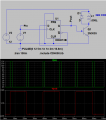
You are not shorting anything. Below is a very basic example of a simple Divide by Two circuit using a D Flip Flop.
CD4013 Divide By Two.png

V1 pulse in simulates your pulses from a sensor for example a Hall Effect. The green trace is the input. A typical 2 pole generator running 60 Hz runs at 3600 RPM. The red trace is the output. Two pulses in to one pulse out /2. I have no clue what coil you plan to use so I used a pretty generic 8.0 milli-henry ignition coil similar to what my bike uses. The schematic is a rough of what you likely want. This is as good as it gets. The coil will fire on the negative going transitions of the square wave out.

Ron
 

MisterBill2

Joined Jan 23, 2018
27,547
The major question is how will you see which rotation is the one to inhibit the plug firing on? Every flywheel rotation looks the same on the outside. So you will need to sense the camshaft and that will require getting into the engine hardware somehow. And that will not be simple. One other thing is that aside from digging into the engine mechanism, you will still need to arrive with a scheme to control the hydrogen feed.
 

Reloadron

Joined Jan 15, 2015
7,891
The major question is how will you see which rotation is the one to inhibit the plug firing on? Every flywheel rotation looks the same on the outside. So you will need to sense the camshaft and that will require getting into the engine hardware somehow. And that will not be simple. One other thing is that aside from digging into the engine mechanism, you will still need to arrive with a scheme to control the hydrogen feed.
Uh oh, another picky little detail. Good point.

Ron
 
Top