Facebook
 Google
 GitHub
 Linkedin

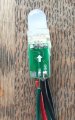
I have a large number of addressable, 3-Wire RGB LED's. (Power, Data, GND)
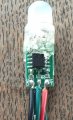
I don't have any information about them, so I autopsied one to see what's inside.
The chip seems to be a GW6202B, which I find only sparse reference to on the Internet, just a few pages about LED's and addressable controllers, but NO DATA SHEETS? It seems super odd that I cannot find the data sheet for this beast?
I did find a partial description on a Chinese page, but it has nothing about the pin-out or protocol.
It looks to be a 5V unit, as it says "+5V" on the PCB.
I am hoping it uses a protocol similar to the WS2812 chip, which uses a pulse-width coding scheme- I wrote a PIC32 DMA based driver that works great for these parts.
Anyone have any experience or knowledge about the GW6202B part?
I don't have any information about them, so I autopsied one to see what's inside.
The chip seems to be a GW6202B, which I find only sparse reference to on the Internet, just a few pages about LED's and addressable controllers, but NO DATA SHEETS? It seems super odd that I cannot find the data sheet for this beast?
I did find a partial description on a Chinese page, but it has nothing about the pin-out or protocol.
It looks to be a 5V unit, as it says "+5V" on the PCB.
I am hoping it uses a protocol similar to the WS2812 chip, which uses a pulse-width coding scheme- I wrote a PIC32 DMA based driver that works great for these parts.
Anyone have any experience or knowledge about the GW6202B part?
Attachments
-
 199.5 KB Views: 10
 -
 227.9 KB Views: 10
 -
 535 KB Views: 9