Help wiring inverter

Status
Not open for further replies.

Thread Starter

earlybird

Joined Dec 23, 2023
1
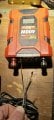
I have an Everstart 400watt inverter. I want to plug it into my cigarette lighter outlet in my vehicle. The problem I'm having is wiring my cord for the cigarette lighter outlet 17033224939495284016592257474119.jpgto the terminals on the inverter itself. I know if you get them reversed it could fry the inverter and possibly damage my vehicle. My cord has 1 black wire and 1black and white wire. My inverter has a black terminal and a red terminal. Can someone please help me? Thanks in advance!
 

ericgibbs

Joined Jan 29, 2010
21,425
Hi early,
Welcome to AAC.
All the DC type cables I have used, the Positive is the one with a White tracer.
Do you have a voltmeter, that could be used to determine the polarity

E
 

MisterBill2

Joined Jan 23, 2018
27,394
I have a 400 watt inverter and the first advice I can offer is that the cable tha came with it is not suitable for powering the inverter at a 400 watts output level . Consider that at best the power in must be at least equal to the power out, if it were 100% efficient.My 400 watt inverter draws 10.2 amps powering a 100 watt incandescent light bulb, with a supply voltage of 12.0 volts. So at 400 watts output it will probably require about 40.8 amps. I doubt that the terminals on my inverter would last very long carrying 40 amps, even with terminals on the correct sized wire. Heat would be a problem in a short time.

The wire shown in the picture in post #1 is probably not suitable for even ten amps.. The wire looks like the insulation has already burned off., or maybe just melted off.

On my inverters the red terminal is positive and the black terminal is negative..
 

MisterBill2

Joined Jan 23, 2018
27,394
Is there an instruction sheet that came with this inverter? Or is it from amazon with no information at all provided??
If you post the photo of the whole end with the input terminals we may see some markings. Also, there should be a tag on the underside with information there.
 

ericgibbs

Joined Jan 29, 2010
21,425
Is there an instruction sheet that came with this inverter?
Bill,
It is NOT the Inverter that's the query, it’s the twin cable polarity if you read the post!
The problem I'm having is wiring my cord for the cigarette lighter outlet
E
 

MisterBill2

Joined Jan 23, 2018
27,394
My post explains that there is no part of that cord adequate for powering that inverter. My inverter also came with a cord like that, which seemed to have been an afterthought because it was no way able to carry the power needed for the 400 watt inverter to power a 25 watt soldering pencil.
 

Tonyr1084

Joined Sep 24, 2015
9,744
@MisterBill2 I'm having a problem understanding how you come to 41 amps. I'm not disputing your numbers just asking how you arrived at them.

I'm imagining a 400W inverter is supposedly capable of supplying 400 watts at 120VAC. A 100W bulb would draw 1/4 the power. In a perfect world a 400W 120VAC output inverter would require 400W at 12VDC. Again, that's in a perfect world. I'm sure I'm missing something but I come up with 33.3A at 12V and 400W. With the engine running a car's electrical system should see at least 13.6V. For 400W at 13.6V that comes to 29.4A.

If I assume 80% efficiency then those numbers go up to
from 33.3A to 40A (39.9)
from 29.4A to 35.3A

@earlybird In my 1972 Chevy Nova the cigarette lighter was fused at 15A. My 2017 Tacoma (now called) power outlet is fused at 10A. I'd be suspicious that your inverter might blow the fuse.

If you don't have a meter you can try a trick: Take a good 9V battery and touch one terminal to the two side wings of the plug. That's going to be the negative lead on the plug. Then take one of the two wires and tap it to the other battery terminal and watch for a spark. Don't try that with the springy center tip - it likely contains a fuse and you might blow it. Probably not but why risk it. Another method if you have a speaker laying around, take that 9V battery and again, touching the side wings, connect one wire to the speaker and the other speaker terminal taps back to the battery. If you have the right wire the speaker will make a single pop. No, you won't blow the speaker out, you'll just hear the speaker respond to the current. It's how I've tested speaker wires in the car when hooking up a new stereo. Not knowing which wires go to what speakers I'd use the battery trick to determine which wires go to what speakers.

OR you can take an old coin cell battery and an LED. Touching the LED to both sides of the battery you will determine the polarity of the LED. Then use the plug and wires to make the connections. When the LED lights up you have continuity. The side wings are negative and the springy tip is positive.
 

Tonyr1084

Joined Sep 24, 2015
9,744
ANOTHER thought: If you have a diode, connect the marked end (with the white band) to the positive terminal. Then wire the two wires to the inverter and plug it in. If it works then you know which wire is which. If it doesn't work then you know to switch the two wires. Again, through the diode, if it works then you know.
 

MisterBill2

Joined Jan 23, 2018
27,394
I arrived at the 41 amps by guessing at constant efficiency of my inverter . My initial test was with a lab supply set to 12.0 volts The load was a 100 watt (labeled) incandescent bulb. The inverter drew 10.2 amps under those conditions Then I guessed that the current at 400 watts out would be 4 x the current at 100 watts out, but I did round 40.8 amps up to 41 amps.
At 100% efficiency and 12 volts supply the full load current would be 33.33 amps. But that is not believable, and still way too much for what can't be larger than #16 wire.
 

MisterBill2

Joined Jan 23, 2018
27,394
You should use fork terminals crimped on the ends of the wires. They're color-coded by size, so, use the yellow ones and the thickest wire to the lighter jack possible. It would be better to fit a Powerpole socket on the dash; lighter plugs make poor quality electrical connections that heat up with a mere 4 amps of current. Like this:
https://www.aliexpress.com/item/1005005472074707.html
Not a crimped terminal, but a correctly soldered terminal is the way to do it.
 

Tonyr1084

Joined Sep 24, 2015
9,744
Not a crimped terminal, but a correctly soldered terminal is the way to do it.
Well, OK, this is one man's opinion. I disagree. A correctly crimped terminal is as good as any soldered terminal.

One mistake some make is to solder a terminal then crimp it. That's the worst thing you can do. If you choose to - you can crimp it FIRST, then solder it. But my opinion is that a crimp can be as good. Soldering can lead to wicking up under the insulation, which can put stress on the joint. Crimping allows the wire to flex at the joint while still holding tight. Flexing a soldered wire can lead to it cracking and failure.
 

MisterBill2

Joined Jan 23, 2018
27,394
Well, OK, this is one man's opinion. I disagree. A correctly crimped terminal is as good as any soldered terminal.

One mistake some make is to solder a terminal then crimp it. That's the worst thing you can do. If you choose to - you can crimp it FIRST, then solder it. But my opinion is that a crimp can be as good. Soldering can lead to wicking up under the insulation, which can put stress on the joint. Crimping allows the wire to flex at the joint while still holding tight. Flexing a soldered wire can lead to it cracking and failure.
Certainly that is correct. and a terminal lug does not need so much solder that it wicks up the strands past the barrel of the lug. It also requires a lug with a barrel only slightly larger than the wire diameter. Which is seldom the case with consumer grade terminals
 

MisterBill2

Joined Jan 23, 2018
27,394
The big problem powering inverters like these is definitely the connections. The reality that watts in must always be a bit more than watts out is rather brutal. Whatever the output amps are at 120 volts, the input amps will exceed ten times those amps at 12 volts. And on the cheap inverters, the red terminal is the positive terminal. At least, in the several that I have seen.
 

Reloadron

Joined Jan 15, 2015
7,882
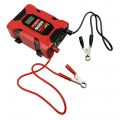
This should be your inverter.

This is an image of what should be your inverter.
Inverter 400 watt.png

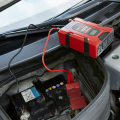
Note MrBill's comments regarding wire size. Note the size of the wires provided with the unit in the above image. Just winging it and not considering inefficiency of the inverter 400 watts / 12 volts = 33.33 amps so I agree with MrBill that if the inverter is even under 1/2 maximum load (200 watts) using the wire in your image you can expect smoke and possible fire. You want to look at the ampacity of your cables feeding your inverter. You also may want to fuse your supply lines. For a short run I would use AWG 8 and longer than about 10 ft. I would run AWG 6. They also make fuses designed for inline use and direct connection to battery terminals in vehicles. Note how the inverter is connected in the below image using clamps.

Inverter 400 watt connect.png

Ron
 

MisterBill2

Joined Jan 23, 2018
27,394
As I look at the color photos it is clear that the plastic housing is not part of a heat sink, and that the apparent air flow will not be adequate for heat removal unless the efficiency is very close to 100%.
I have an inverter claimed to provide up to 800 watts, which I would use to power a disc cuttoff grinder with a tag power input of 4.3 Amps at 120 volts. I anticipate that the no-load draw is less, but I have not yet measured it. The grinder has a universal motor and thus is not very picky about power quality, so it is a good match for the inverter.
These units do appear to be internally fused, but replacing internal fuses that are soldered in place would be a pain.
My power leads are short, about #6 wire, so only good for short term load operation.
 
Status
Not open for further replies.
Top