HELP-transistor constant current source problems

WBahn

Joined Mar 31, 2012
32,854
If Vce = Vcesat = 0.2V, what is the voltage across the load?

If the current in the load is still 1 mA, what must the load resistance be?

What happens to Vce if we increase the load resistance and the load current remained 1 mA?

Would that violate the requirement that Vce not be less than Vcesat? If so, then what must happen to the current?
 

Jony130

Joined Feb 17, 2009
5,598
Now lets say we have changed load resistance to a new value..its obvious now Vc will change ok...and if we substitute new values of Vc and Rc in equation------> Iload=(Vcc-Vc)/Rc
it would definitely change Iload..which is not demanded now here where does transistor regulatory internal behaviour comes into picture?
Are you trying to say that transistor has no "control" ability over his collector current ?? Did you forget already that the Ib current has control over Ic current ? And notice that in your circuit Vb and Ve are held constant, which means that as long as transistor is in active region Ic is constant and equal to Ie.
Please take a look here
http://forum.allaboutcircuits.com/threads/which-method-npn.97963/#post-731172
 

Attachments

Thread Starter

Himanshoo

Joined Apr 3, 2015
265
Are you trying to say that transistor has no "control" ability over his collector current ?? Did you forget already that the Ib current has control over Ic current ? And notice that in your circuit Vb and Ve are held constant, which means that as long as transistor is in active region Ic is constant and equal to Ie.
Please take a look here
http://forum.allaboutcircuits.com/threads/which-method-npn.97963/#post-731172
Here is what i got so far....

Since the emitter voltage is made constant to 1v ,thus the voltages which would vary accordingly would be Vce and Vc for various Rload values ok..As per your explanation if the Rload is 7k then Vc would be 7V...now if Rload is increased to 8.8K then Vc would be 8.8V....and now according to the relation-->(Vc+Vce+Ve=Vcc) ........ 8.8+Vce+1=10 and Vce is found to be 0.2V.Now the limit is reached where transistor is on the edge of getting saturated.and if now we further increase the Rload value lets say to 9k then an incorrect assumption would be to assume Vc=Ic*Rc=1ma*9k=9V ,Ve=1v and to follow ohms law Vce should become 0V which is probably not possible..since practically the saturation voltage cant be 0v...ie it should be some value higher than 0V....thus to compensate this and in order to maintain ohms law finally Ic changes..

Iam I right??
 

Thread Starter

Himanshoo

Joined Apr 3, 2015
265
If Vce = Vcesat = 0.2V, what is the voltage across the load?

If the current in the load is still 1 mA, what must the load resistance be?

What happens to Vce if we increase the load resistance and the load current remained 1 mA?

Would that violate the requirement that Vce not be less than Vcesat? If so, then what must happen to the current?
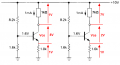
If Vce=Vcesat=0.2V then the voltage across load will be 8.8V only if Ic flowing is 1ma which is controlled by base voltage divider.

Your second query is the same as your first query but asked in different way..so the answer to it would be same ..the load resistance would be 8.8k for Iload=1ma and Vce=0.2V. Just found out by applying ohms law.Remember that if we change load resistance to any value below 8.8k ...Iload will remain constant to 1ma...but Vce wont remain constant at 0.2v ...it will vary ofcourse...in order to compensate the total resistance of circuit to a constant value.
 

WBahn

Joined Mar 31, 2012
32,854
You seem to have gotten the idea in Post #23 but didn't articulate that same idea in Post #24. But I think you have made sufficient progress to benefit from a more detailed explanation.

The voltage from ground to Vcc through the transistor's emitter to collector is always

Vcc = Ie·Re + Vce + Ic·Rc

This doesn't matter whether the transistor is off, on, or saturated as it is simply a direct application of KVL. Now, by itself this doesn't do us a lot of good because, assuming we treat Re and Rc as knowns, it is a single equation with three unknowns, namely {Ie, Ic, Vce}. So we need to come up with two additional equations to solve it. Some of those equations come from assumptions about the mode that the transistor is in and we have to keep in mind that those assumptions ONLY apply when the transistor is actually in that mode. For instance:

IF the transistor is in cutoff, then we assume that there is no current in it and we have the constraint

Ie = 0
Ic = 0

which let's us solve for Vce

Vcc = (0)·Re + Vce + (0)·Rc
Vce = Vcc

This is all fine and correct, but we have to ask if all of the requirements are satisfied for the transistor to actually be in cutoff and the other constraint for that to be the case is that Vbe < Vd (a diode drop). But if Ie=0 then Ve = 0V and Vb = 1.6V and Vbe=1.6V, so the transistor can't be in cutoff.

IF the transistor is in the active region of operation, then we assume that Ic = βIb making Ic = αIe where α = β/(β+1). If β>>1, then we often assume that Ic≅Ie, which serves as one of our two additional equations. The third comes from the requirement that, in the active region, Vbe≅Vd. This means that we can find Ie if we know Vb since

Ve = Vb - Vbe = (Vb - Vd)

This means that our two additional equations are

Ie = Ve/Re = (Vb - Vd)/Re
Ic = Ie

Using this we can solve for Vce

Vcc = (0)·Re + Vce + (0)·Rc
Vcc = ((Vb - Vd)/Re)·Re + Vce + ((Vb - Vd)/Re)·Rc
Vcc = (Vb - Vd) + Vce + (Vb - Vd)(Rc/Re)
Vce = Vcc - (Vb - Vd)(1 + Rc/Re)

As before, this is all fine and correct, but we have to ask if all of the requirements are satisfied for the transistor to actually be in the active region. The major other constraint for that to be the case is that Vce ≥ Vcesat. From that we have

Vce = Vcc - (Vb - Vd)(1 + Rc/Re) ≥ Vcesat
(Vb - Vd)(1 + Rc/Re) ≥ Vcc - Vcesat
(Vb - Vd) ≥ (Vcc - Vcesat)/(1 + Rc/Re)
Vb ≥ Vd + [(Vcc - Vcesat)/(1 + Rc/Re)]

That's if we know Rc and Re and want to find the constraint on Vb. But if we know Vb and Re and want to find the constraint on Rc, the we just solve for that instead.

Vce = Vcc - (Vb - Vd)(1 + Rc/Re) ≥ Vcesat
(Vb - Vd)(1 + Rc/Re) ≥ Vcc - Vcesat
1 + Rc/Re ≥ (Vcc - Vcesat)/(Vb - Vd)
Rc/Re ≥ (Vcc - Vcesat)/(Vb - Vd) - 1
Rc ≥ Re[(Vcc - Vcesat)/(Vb - Vd) - 1]

For the parameters for this circuit, that means

Rc ≥ (1.0kΩ)[(10V - 0.2V)/(1.6V - 0.6V) - 1]
Rc ≥ (1.0kΩ)[(9.8V/1.0V) - 1] = 1.0kΩ·8.8
Rc ≥ 8.8kΩ

We also need to check our assumption that we can neglect the base current. If we assume a reasonable value for β, say β=100, then what we are looking for is that this current is small compared to the primary current flowing in the base bias circuit. I'll leave that to you to determine.

IF the transistor is in saturation, then we assume that Vce = Vcesat. While we generally still assume that Vbe≅Vd, we cannot assume that Ic=βIe or, rather, we can no longer assume that β is large, which also means that we can't assume that Ic≅Ie. That, in turn, often means that we can't neglect the base current's effect on the base bias circuit.

So, with that in mind, what will all of the currents be in this circuit if we set Rc=20kΩ?
 

Thread Starter

Himanshoo

Joined Apr 3, 2015
265
let me simplify what you want to ask--->
you said that when a transistor is saturated the relation Ic=BIb doesnt hold..but since Ie is constant because of the voltage divider...then Ic should also be constant...moreover you have replaced Rc to 20k..if Rc is changed then Ic should also change in order to compensate ohms law as said earlier...but what will happen to Ie ...it is maintained constant due to base voltage divider...so here the condition is that.. Ic changed due to load variation but on the same side Ie is constant due to voltage divider....so Ic and Ie seem to be different here ...probably this made you think that Ic is not equal to Ie ...is this what you want to ask?? (neglect base current for a moment)
 

WBahn

Joined Mar 31, 2012
32,854
let me simplify what you want to ask--->
you said that when a transistor is saturated the relation Ic=BIb doesnt hold..but since Ie is constant because of the voltage divider...then Ic should also be constant.
Think about this. If the Ic=βIb constant no longer holds (at least for β = some constant), then why would Ic still be a constant if Ie is a constant. You are forgetting about Ib (despite my explicitly stating that you can usually NOT neglect Ib in saturation). What if Ie = 1mA and Ib = 0.9mA, what would Ic be then?

..moreover you have replaced Rc to 20k..if Rc is changed then Ic should also change in order to compensate ohms law as said earlier...but what will happen to Ie ...it is maintained constant due to base voltage divider...so here the condition is that.. Ic changed due to load variation but on the same side Ie is constant due to voltage divider....so Ic and Ie seem to be different here ...probably this made you think that Ic is not equal to Ie ...is this what you want to ask?? (neglect base current for a moment)
If you are operating in a mode where Ic is not (approximately) equal to Ie, then you CAN'T neglect the base current!
 

Jony130

Joined Feb 17, 2009
5,598
For Rc > 8.8kΩ transistor entry into saturation region because there is not enough voltage "headroom" in the circuit.
For example for Rc = 20kΩ we will have Vc (voltage at collector with respect to ground) = 10V - 1mA*20kΩ = -10V which is of course impossible.
So from this we can tell that transistor will in fact be in saturation. And in saturation Ic = β*Ib don't hold anymore. The only thing that now holds is a Kirchoff's laws. So for transistor we have Ie = Ib + Ic . Also notice that if we ignore the base current (very bad idea especially in saturation) we can roughly approximate new value for Ic.
Ic_sat ≈ (10V - 0.2V)/(20kΩ + 1kΩ) = 0.467mA

I think a reasonably simple yet useful description of the saturation process goes something like this:

Think of a transistor as a device that tries to create a situation in which the collector current, Ic, is β*Ib. The mechanism by which it does this is by controlling the "resistance" of the collector-emitter path through the device. If the present resistance is such that the collector current is less than β*Ib, then the transistor reduces the resistance. This generally results in a lower collector-emitter voltage which means that the voltage dropped across the external components increases which generally allows more collector current to flow. The reverse happens if the present collector current is more than β*Ib in order to reduce it.

But this process can only be carried so far. The transistor can only lower the collector-emitter voltage so far and, once that point is reached, the transistor no longer has any tools in its bag to increase the collector current up to the point it would like it to be, so the collector-emitter voltage stops dropping and the collector current is less β*Ib.

Ideally this saturation voltage would be 0V and the collector-emitter junction would simply look like a short circuit allowing any current to flow as long as it doesn't go above β*Ib (since, at that point, the transistor will come out of saturation and start increasing Vce in order to hold the current to β*Ib).

In practice, real transistors have a saturation voltage that is greater than 0V, but it is generally only a few hundred millivolts.

written by WBahn
 

Thread Starter

Himanshoo

Joined Apr 3, 2015
265
Think about this. If the Ic=βIb constant no longer holds (at least for β = some constant), then why would Ic still be a constant if Ie is a constant. You are forgetting about Ib (despite my explicitly stating that you can usually NOT neglect Ib in saturation). What if Ie = 1mA and Ib = 0.9mA, what would Ic be then?


If you are operating in a mode where Ic is not (approximately) equal to Ie, then you CAN'T neglect the base current!
yes in saturation Ic=BIb donot hold...that means that Ic no longer depends on Ib..Saturation is something where Ic is independent on Ib ...or with a change in Ib ,Ic no longer changes..But on the other hand KCL (Ie=Ib+Ic) do applies as what Jony 130 said..logically Ic in saturation is something..no matter what Ib is(as Ic=BIb donot hold any more)...but if we apply this logic to KCL equation then with a change in Ib ..the addition(Ib+Ic) changes which brings offcourse a changed Ie..so i think its some kind of a paradox where Ic is independent of Ib at one time and on the other instance.. Ic depends on Ib ie (Ic=Ie-Ib) in order to satisfy KCL equation...so may be nature utilizing this paradox tells the constant current circuit to misbehave in saturation mode....
pls correct me if iam somewhere wrong...
 
Last edited:

WBahn

Joined Mar 31, 2012
32,854
Saturation doesn't mean that if Ib changes that Ic doesn't change. It merely means that Ib no longer has the strong, largely linear effect on Ic that it has in saturation.

It is a constant current source ONLY when the transistor is in the active region. Once that transistor saturates or gets cutoff then it is no longer a constant current source.
 

hobbyist

Joined Aug 10, 2008
892
It is a constant current source ONLY when the transistor is in the active region. Once that transistor saturates or gets cutoff then it is no longer a constant current source.
With that real good example given above, you can see that a constant current source is a source that needs to adjust itself to every load it drives, (within reason) it is NOT the maximum current it can deliver, but the most stable output value it can deliver under changing load values.
 

Thread Starter

Himanshoo

Joined Apr 3, 2015
265
Saturation doesn't mean that if Ib changes that Ic doesn't change. It merely means that Ib no longer has the strong, largely linear effect on Ic that it has in saturation.

It is a constant current source ONLY when the transistor is in the active region. Once that transistor saturates or gets cutoff then it is no longer a constant current source.
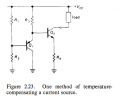
Pls refer the attachment…


If we say that a transistor is temperature compensated we means that with a rise in ambient temperature the Vbe of the transistor should decrease so that the transistor should ‘on less’ which will decrease the collector current…which would otherwise in absence of compensation increases and drive the transistor into thermal runaway…ok


now this circuit shows a way to temperature compensate a current source..in which Q2 Vbe is compensated by Q1 as both transistors are well matched…

lets assume that temperature rises…then Q1 Vbe rises which further increases Ic of Q1….If Ic rises then there would be more voltage drop across R3..resulting in low Vb for Q2..Now if Vb of Q2 decreases then it would further decrease Vbe of Q2. But earlier we have assumed that both transistor are matched..so according to this Vbe of Q2 should increase following Vbe of Q1…So how could this be possible that once Vbe of Q2 decreases and then it increases??whats going on …Hows temperature compensation is achieved…?


Or does it means that with the rise in ambient temperature if Vbe of Q1 increases by some amount then by the same amount Vbe of Q2 will decrease.??

pls clarify?
 

Attachments

Jony130

Joined Feb 17, 2009
5,598
You must revise your knowledge. In BJT Vbe temperature coefficient is -2 mv/degree C, that is based on a specific current value.
 

WBahn

Joined Mar 31, 2012
32,854
Pick a value for Vbe and go from the base of Q1 to the emitter of Q2.

Ve = Vb + Vbe - Vbe = Vb

Notice that Vbe drops out of the equation entirely. So it doesn't matter what Vbe is.

Now, since the current in both transistors isn't the same the Vbe of the two transistors isn't the same, so what we really have is:

Ve = Vb + Vbe1 - Vbe2 = Vb

But what we are interested in is how this changes as temperature changes. So we have

Vbe1 = Vbe1_0 + K1·ΔT1
Vbe2 = Vbe2_0 + K2·ΔT2

where Vbe1_1 & Vbe2_0 are the Vbe values at some specific reference temperature, K1 & K2 are the Vbe thermal coefficients for each transistor, and ΔT1 & ΔT2 are the temperature differences of the junction from the reference temperature.

Plugging these in we have

Ve = Vb + (Vbe1_0 + K1·ΔT1) - (Vbe2_0 + K2·ΔT2)
Ve = [Vb + Vbe1_0 - Vbe2_0] + K1·ΔT1 - K2·ΔT2 = [Ve] + ΔVe

There terms in [] are just the nominal conditions at the reference temperature. We are interested in the change, namely

ΔVe = K1·ΔT1 - K2·ΔT2

If we use the same type (e.g., silicon vs germanium) then the voltage coefficients will be nearly identical and we can call this K.

ΔVe = K(ΔT1 - ΔT2)

And if the transistors are thermally mated, then the temperature differences are the same, and thus

ΔVe ≈ 0

Notice that while this might make Ve insensitive to temperature changes, it does not necessarily mean that Ic is insensitive since the emitter resistor also has a temperature coefficient that has to be taken into account.
 

Thread Starter

Himanshoo

Joined Apr 3, 2015
265
Pick a value for Vbe and go from the base of Q1 to the emitter of Q2.

Ve = Vb + Vbe - Vbe = Vb

Notice that Vbe drops out of the equation entirely. So it doesn't matter what Vbe is.

Now, since the current in both transistors isn't the same the Vbe of the two transistors isn't the same, so what we really have is:

Ve = Vb + Vbe1 - Vbe2 = Vb

But what we are interested in is how this changes as temperature changes. So we have

Vbe1 = Vbe1_0 + K1·ΔT1
Vbe2 = Vbe2_0 + K2·ΔT2

where Vbe1_1 & Vbe2_0 are the Vbe values at some specific reference temperature, K1 & K2 are the Vbe thermal coefficients for each transistor, and ΔT1 & ΔT2 are the temperature differences of the junction from the reference temperature.

Plugging these in we have

Ve = Vb + (Vbe1_0 + K1·ΔT1) - (Vbe2_0 + K2·ΔT2)
Ve = [Vb + Vbe1_0 - Vbe2_0] + K1·ΔT1 - K2·ΔT2 = [Ve] + ΔVe

There terms in [] are just the nominal conditions at the reference temperature. We are interested in the change, namely

ΔVe = K1·ΔT1 - K2·ΔT2

If we use the same type (e.g., silicon vs germanium) then the voltage coefficients will be nearly identical and we can call this K.

ΔVe = K(ΔT1 - ΔT2)

And if the transistors are thermally mated, then the temperature differences are the same, and thus

ΔVe ≈ 0

Notice that while this might make Ve insensitive to temperature changes, it does not necessarily mean that Ic is insensitive since the emitter resistor also has a temperature coefficient that has to be taken into account.
Since in the figure one transistor is npn and other is pnp ..thus equation---> Ve=Vb + Vbe -Vbe applies..but if both transistor would be npn or pnp then this would invalidate the equation..,so temparature compensation wont be possible??
 

WBahn

Joined Mar 31, 2012
32,854
Since in the figure one transistor is npn and other is pnp ..thus equation---> Ve=Vb + Vbe -Vbe applies..but if both transistor would be npn or pnp then this would invalidate the equation..,so temparature compensation wont be possible??
Not in that configuration. You generally need a configuration in which the key governing relationships involve the difference between the parameters of two devices that are properly matched. Properly matched does not require that the devices be identical (though that is often the case), but that the parameters of interest are properly matched. In this case it's the thermal coefficients of Vbe and the temperatures.
 

Thread Starter

Himanshoo

Joined Apr 3, 2015
265
Not in that configuration. You generally need a configuration in which the key governing relationships involve the difference between the parameters of two devices that are properly matched. Properly matched does not require that the devices be identical (though that is often the case), but that the parameters of interest are properly matched. In this case it's the thermal coefficients of Vbe and the temperatures.
So here the configuration(circuit arrangement) decides the difference between the parameters of two transistors (I mean that the circuit is such arranged that the parameters of the two transistors which is ofcourse Vbe..in this case.are certainly contradictory of each other)...and secondly..properly matched means parameters of interest should be similar in magnitude but opposite of each other polarity wise ....so they could cancel each other...
Am i right?
 
Last edited:

WBahn

Joined Mar 31, 2012
32,854
Yes, I think that's a reasonable understanding. Keep in mind that there are lots of clever ways of doing things, but when the idea is to get some effect to cancel out, then the most straight forward way is to cancel it by subtracting something that is equal to it (or adding something that is equal and opposite). Another way is to multiply it by something that is the reciprocal of what is changing, generally referred to as gain compensation.
 

Thread Starter

Himanshoo

Joined Apr 3, 2015
265
Yes, I think that's a reasonable understanding. Keep in mind that there are lots of clever ways of doing things, but when the idea is to get some effect to cancel out, then the most straight forward way is to cancel it by subtracting something that is equal to it (or adding something that is equal and opposite). Another way is to multiply it by something that is the reciprocal of what is changing, generally referred to as gain compensation.
Ok just to be a little inquisitive....in the circuit just to cancel the effect of Vbe ..we literally subtracted Q1's Vbe from Q2 's Vbe as the equation--> Ve=Vb + Vbe -Vbe ..says
But if we wish to cancel the effect of Vbe by multiplying with some reciprocal..or something.. as you stated earlier then what could be the circuit configuration..or how the circuit can be modified??
 

WBahn

Joined Mar 31, 2012
32,854
I'm talking in general terms. In a given circuit you have things that combine additively and things that combine multiplicatively. If what you want to cancel can be combined multiplicatively with something else, that is when you look for something that will have a reciprocal relationship or, if you have something that has a reciprocal relationship to what you want to cancel, you look for ways to combine it multiplicatively with what it is you want to compensate for. I am NOT saying that it is easy or even possible to do it either way for any given circuit or parameter.
 
Top