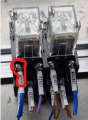
help to identify supporting electrical components

MisterBill2

Joined Jan 23, 2018
27,159
For terminating wires at screw terminals there are crimp on lugs available for all wire sizes. For identifying wires there are both custom printed sleeves as in the photos and also wrap-around tape with printed numbers . (Brady Wire Markers). For industrial applications there are terminal strips.
 
Last edited:

MisterBill2

Joined Jan 23, 2018
27,159
There are a large variety of crimp types, which use different crimp tools. The crimp tool needs to be correct for the type of terminal to be crimped.
A "universal" crimp tool will mostly produce universally inadequate crimps for the different varieties of terminals.

And I am, unfortunately, uncertain of exactly what you are asking for in post #1.
There do exist screw-type terminals untended to work directly with stranded wire, and there may also be relay sockets that are made with that type of screw terminals. But I am unable to advise on the suppliers or the sources.
 

MaxHeadRoom

Joined Jul 18, 2013
30,557
I tend to use Weidmüller hand tools—costly, but very good.
The nice thing is they do not rely on hand pressure; they have a built in compression crimp.

1762007091805.png
 

Tonyr1084

Joined Sep 24, 2015
9,744
I'm with Bill on this one - not sure what you're asking for.
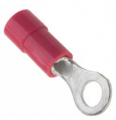
The blue wire you've highlighted has what looks to be a ring terminal. ASSUMING that's a 16 gauge wire (not familiar with metric wire sizing) a simple red ring terminal of sufficient ring diameter to fit into the space and held down by the screw head; it's a simple matter of getting the right ring terminal and wire size and simply crimp the wire using a cheap crimper that forces an indent into the side of the crimp barrel portion of the lug. It's cheap and quick. Max suggests using ferrel's crimped on the end of the stripped wire and inserted under the screw. However, I don't see a square plate under the screw head (unsure what to call it). That square head will trap one or two wires beneath it as the screw is tightened. Yours doesn't appear to be like that.

Now; regarding the relay socket - - - well, that's what it is. A socket that you plug the appropriate size relay into it. The screw terminals make it easy to rewire or reconfigure it for a different use. The socket itself is a DIN type. Don't know off hand what DIN stands for but it is used for quick builds where several different types of DIN mounted connectors can be installed and tightened down in place. Easy to move around and fairly reliable. You show them in your second post. However, it appears to be in German language, which I don't speak or read. But those are also DIN type terminal blocks. Unfamiliar with how they're configured.
 

MisterBill2

Joined Jan 23, 2018
27,159
Certainly the tool shown relies on only hand force/effort, although it probably is set up to ot release without adequate crimp movement.

AND I am wondering now if the TS is actually asking how to know which terminal is which. I saw such diagrams in a post on another thread here very recently. It can be confusing, no doubt. But it was explained recently.

Certainly the actual connections to that array of twelve terminals is not clear. I do not have the drawing available and my explanations are not always perfect. But there are drawings with very good markings, so I hope somebody can post that for the TS.
 
Last edited:
Top