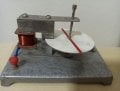
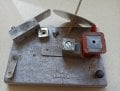
Hello everyone, I need help to identify this device

Thread Starter

piz

Joined Jan 6, 2026
8
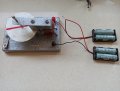
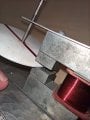
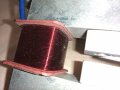
I found an electrical device for studying electricity. This device has a flat base with 2 electrical terminals: one is red, and the other is black. Both are connected to a sort of induction coil that has a horseshoe-shaped metal core, and in the gap there is an aluminum disk with a vertical shaft in the center that allows it to rotate. This shaft connects to both the upper and lower parts of the iron core. It has sort of a handle at the top to spin it by hand. On the base there is a sticker with the letters DC 6~10v. There are no magnets anywhere. Searching online led me to "shaded pole motor" and "Faraday disk generator", but I didn't find a device that has both a coil and an aluminum disk. I tried to connect an incandescent bulb (2.5V / 0.5W) and spin the disk, but it doesn't generate any sign of power. I also tried to connect the red and black terminals to 4 and then 6 1.5V AA batteries (in series) and helped the disk to spin, but there was no difference in speed with or without the batteries. Does it require a power supply with more amps to work? Can you tell me what this device is and how it works?

Thanks in advance.
 

Attachments

joeyd999

Joined Jun 6, 2011
6,204
Google says:

This device appears to be a vintage educational model of a homopolar motor or electric motor, used for physics demonstrations. It's designed as a didactic tool to illustrate the basic principles of electromagnetism and how electrical energy is converted into mechanical energy.

Key Components
  • Electromagnet: The visible copper coil wraps around an iron core, which becomes magnetized when an electric current passes through it.
  • Rotating Disk/Armature: The flat disk rotates between the poles (implied) of the magnetic field created by the electromagnet. In a homopolar configuration, current flows radially through this disk.
  • Base and Connections: The apparatus is mounted on a sturdy metal base with terminals (a red knob is visible) to connect a power source, typically a low-voltage DC source like a 4-volt battery.
  • Brushes/Contacts: A metal rod and contacts are used to provide current to the rotating part.
The design is very similar to models produced in the Soviet Union in the 1980s for use in schools.
 

ElectricSpidey

Joined Dec 2, 2017
3,312
From what I can gather from the Wiki article, the demonstration would involve spinning the disk then applying power and observing the stopping time of the disk in relation to not applying power.
 

Thread Starter

piz

Joined Jan 6, 2026
8
Hi, thanks for your quick response and detailed explanation.
My immediate diagnosis when I saw this device was that it was designed to teach how the electrical energy of the batteries is converted into kinetic energy using electromagnetic induction of a coil with an iron core. The magnetic field in the core induces radial electric currents (Eddy Currents) in the aluminum disk.
As far as I understand, a change in the magnetic flux must be created along the disk to make it rotate. I saw that in alternating current, sometimes need to use a small copper ring on one end of the core, to inhibit the magnetic field in part of the pole compared to the other exposed part of the core (Shaded Pole).
According to what is written on the sticker at the base of the device (DC 6~10V) I used a 6V DC battery and it did not work. It seems to me that without connecting a voltage source that provides AC power, there will be no change in the magnetic flux, and therefore according to Faraday's law, no current will be created in the disk, and according to Lenz's law, no force will be created to rotate it. I tried to change the magnetic flux by quickly turning the switch mounted on the base on and off, but that didn't work either. I should note that tiny sparks appeared at the switch contacts and it even got a little warm. At the moment, I could only visually check that everything was fine because I didn't have a multimeter to check the coil for short circuits/resistance. I checked that all the contacts connected to the base were insulated with a disc made of insulating material. I tried disconnecting the coil wires from the base and connecting them directly to the battery, but that didn't work either.

I wrote this before i saw all the other comments and now I realy don't know how to make it work.
Comments
I thought maybe this device was demonstrating disc braking while applying voltage, but it didn't change the rotation speed at all. Now I'm more confused. Maybe the purpose of the device is to demonstrate that only a change in magnetism produces motion.
Link to my video: https://streamable.com/4bo87e
 

Attachments

MrChips

Joined Oct 2, 2009
34,628
It is not a motor.
You spin the disc by hand, then apply DC current to the coil. The disc should stop spinning almost immediately.
 

Thread Starter

piz

Joined Jan 6, 2026
8
It is not a motor.
You spin the disc by hand, then apply DC current to the coil. The disc should stop spinning almost immediately.
‏אבל זה לא. מה חסר?‏
Google translate from Hebrew: But it's not. What's missing?
 

Thread Starter

piz

Joined Jan 6, 2026
8
From what I can gather from the Wiki article, the demonstration would involve spinning the disk then applying power and observing the stopping time of the disk in relation to not applying power.
OK, it worked. This time I tried with a 10V battery.
I didn't expect such a minor braking of the disk, but there is indeed a difference in the slowing down of the disk when no electrical voltage is supplied to the coil, and when electrical voltage is supplied.
I simply turned on the stopwatch on my phone and measured the time. 8 seconds without voltage and 4 seconds with voltage, approximately. It's certainly not accurate, but there is a difference after a few measurements.
The difficulty is trying to spin the disk (manually) in the same way and at the same speed every time, more or less.
 

Thread Starter

piz

Joined Jan 6, 2026
8
From what I understood from all the information that the members shared and helped with in this thread. I want to summarize (for myself) what the purpose of this device is and what physical laws can be learned from its operation. If I got anything wrong or if information needs to be removed/added, I would be happy to receive comments.

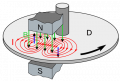
This device operates on several key physical principles from the field of electromagnetism. The device essentially functions as an eddy current brake.

Ampere's Law: The direct current (DC) flowing through the coil wound around the core creates a magnetic field.

The core made of iron (a ferromagnetic material) concentrates and amplifies the magnetic field in the gap between the two ends of the core.

Faraday's Law: When the aluminum disk rotates, its edge "cuts" the permanent magnetic field lines in the gap between the core. The change in magnetic flux relative to a point on the disk moving in and out of the field induces EMF (Electromotive Force) in the aluminum.

Eddy Currents: As a result of the induced EMF, small circular electric currents called "eddy currents" are created inside the aluminum disk (which is an excellent conductor).

Lenz's Law: This is the crucial law for understanding motion. The currents generated in the disk create their own magnetic field, which opposes the cause that created them (the motion). The magnetic field of the disk exerts a force in the direction opposite to the direction of rotation.

Lorentz force: The magnetic field of the core exerts a physical force on the electrons moving in the disk. This force converts the kinetic energy of the rotation into thermal energy (heat) in the disk due to its electrical resistance, which causes the rotation to slow down (braking).
 

MisterBill2

Joined Jan 23, 2018
27,181
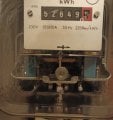
Do you mean this? We still use it in my city
That is exactly what I mean. Thanks for posting such a good photo! Years ago I got a lower power version of a single phase meter like that. I used it for monitoring the power consumption of the refrigerators and freezers at a charity food pantry. People immediately recognized it and so nobody argued. Years later i bought one of those "Kill A Watt" meters that does the same thing. The price at different stores varied more than 2:1! The cheapest was at Harbor Freight, at that time. (6 years ago)
 
Top