Oh so you want to start with just a repeating Ramp with no zero part between ramps?
That's not a bad idea to start with I don't think.
I'll look at that idea next.
So you are saying that V1 is the minimum voltage, and V2 is the maximum voltage and at the beginning and end of each cycle?
Then yes, V1 would not be equal to V2 because the cap is discharging between t_start and t_end.
Let me see if I can help a little more directly here although you probably know a lot of this already.
You know the filter transfer function is F(s). You know the Ramp function is R(s). To get the entire expression, you convolve F(s) with R(s):
Y(s)=F(s)*R(s).
Now you use the inverse Laplace Transform to get y(t):
y(t)=InverseLaplace(Y(s)), where the variable 's' becomes the variable 't' (time).
That gives you the first time domain expression where you can run the time variable over one cycle and see what the values come out to, then over the next cycle, etc., just to get a feel for what is going on. You should plot that.
From the y(t) we know that each cycle is exactly the same, where the start is t0 and the end is t1. This means that for any t0 and t1 after steady state, we can enforce:
y(t0)=y(t1)
and the simpler form is:
y(0)=y(t)
where 't' is the cycle time, y(t) is the cap voltage at the end of any cycle, and y(0) is the cap voltage at the start of any one cycle.
*****You can ignore this next part if you wish but it's interesting to think about at some point*****
This is the compactified Laplace version of the periodic Ramp with the zero-part time equal to the Ramp time as in the original problem:
Vc(s)=(1-(a*s+1)*A)/(a*s^2*(1-A^2)*(s*RC+1)), where A=e^(-a*s).
This is interesting so you may want to think about it later after you have made some more progress with the ramp problems.
This single expression encodes the entire problem of the ramp plus RC network into one single expression.
This should be a separate problem from what you are doing right now though so you should wait on this.
'A' in the numerator represents the time delay, and "(1-A^2)" represents the periodicity.
Why won't you just use the input function you were given?
Given f(t) which is periodic with period To, to find F(s) = Laplace{f(t)}, do the following:
Step #1: Write f1(t) for one period.
Step #2: Take the Laplace transform of f1(t) to get F1(s).
Step #3: Divide F1(s) by (1 - e^(-sTo)) to get F(s), the Laplace transform of the full periodic function.
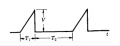
Here is the given f(t)
The period is To = T1 + T2.
We can shift the waveform in time all we want, since we are only looking for min/max values in steady state. So we can declare that t=0 at the beginning of the ramp.
What is the basic function of a ramp that goes from 0 at t=0 to V at t=T1 if we don't care about what it is before or after that?
Easy:
g(t) = (V/T1)·t
The only difference between g(t) and f1(t) is that we need to kill g(t) outside the window from t=0 to t=T1.
What if we multiply g(t) by a function h(t) that is 1 within this window and 0 outside of it?
We can shift the waveform in time all we want, since we are only looking for min/max values in steady state. So we can declare that t=0 at the beginning of the ramp.
What is the basic function of a ramp that goes from 0 at t=0 to V at t=T1 if we don't care about what it is before or after that?
Easy:
g(t) = (V/T1)·t
The only difference between g(t) and f1(t) is that we need to kill g(t) outside the window from t=0 to t=T1.
What if we multiply g(t) by a function h(t) that is 1 within this window and 0 outside of it?
I think it's a good idea to do this new problem with no zero parts for the ramp input. At the very least, it's another problem to be solved, and I believe that's a good idea so the student can get more experience with these problems. The all-ramps problem is probably easier to work with at first because the entire wave is confined to the start and stop times of the ramp. That makes things just a little bit simpler and still requires some work to obtain the right expressions.
Of course I don't mean he should skip the original problem, that takes everything one more step on complexity by introducing a second period where the input is zero.
Here is a worked example of a repeating triangle, but it starts by jumping up to 1v immediately (rather than ramping up) and then ramps down to 0v.
Note: "%e" is just 'e' the way Maxima likes to write it. Also, RC=R*C.
Start with the ODE for a capacitor being charged/discharged by a not-yet-defined source E: dVc/dt=(E-Vc)/RC
transform to the Laplace form (vc0=initial cap voltage, E=excitation input voltage): Vc(s)=(vc0*RC+E(s))/(s*RC+1)
The input voltage for this problem is a step Vpk/s minus a ramp Vpk/(s^2*Tp) with Tp the period: E(s)=Vpk/s-Vpk/(s^2*Tp)
Substitute E(s) into Vc(s) we get (Vpk is the ramp max voltage): Vc(s)=(s^2*Tp*vc0*RC+s*Tp*Vpk-Vpk)/(s^2*Tp*(s*RC+1))
Now we could go further with this as is, but to keep this simpler we set Tp=1, Vpk=1, and RC=1 and end up with: Vc(s)=(s^2*vc0+s-1)/(s^2*(s+1))
and transforming into the time domain we get: Vc(t)=%e^(-t)*vc0-2*%e^(-t)-t+2
Now because Vc(0) must equal Vc(1) (with Tp=1 again) we can set this up as: Vc(0)=Vc(1)
and so replacing t with both 0 and 1 we get: Vc(0)=vc0 Vc(1)=%e^(-1)*vc0-2*%e^(-1)+1
and then equating them: vc0=%e^(-1)*vc0-2*%e^(-1)+1
and now solving for vc0 we get: vc0=(%e-2)/(%e-1)
and numerically this is: vc0=0.41802329313067
Now we can go back to the simplified time solution: Vc(t)=%e^(-t)*vc0-2*%e^(-t)-t+2
and substitute vc0 with the solution 0.41802329313067 and get: Vc(t)=2-1.581976706869327*%e^(-t)-t
and checking this with both t=0 and t=1 we get the same for both: Vc(0)=Vc(1)=0.41802329313067
so our time domain solution is: Vc(t)=2-1.581976706869327*%e^(-t)-t
Taking the first derivative we get: dVc(t)/dt=1.581976706869327*%e^(-t)-1
and set that to zero: 1.581976706869327*%e^(-t)-1=0
and solve for t we get: tm=0.45867514538708
So now we can calculate the min or max using the time domain solution: Vc(t)=2-1.581976706869327*%e^(-t)-t
and that time t, and get: Vc(tm)=0.54132485461292
Taking a second derivative of Vc(t) we get: ddVc(t)/ddt=-1.581976706869327*%e^(-t)
and setting t=tm we get: ddVc(t)/ddt=-1
Since this is negative, the wave is concave down. Alternately, we take the wave itself: Vc(t)=2-1.581976706869327*%e^(-t)-t
and set t=tm-1e-4 and t=tm+1e-4 and get the two values: v1=0.54132484961275 v2=0.54132484961308
and subtracting Vc(tm) which was 0.54132485461292 we get close to: dv1=-5e-9 dv2=-5e-9
which means the waveform gets lower either to the right or to the left of the max voltage which helps to confirm that the waveform is concave down which means Vmax=0.54132485461292.
So for this solution we find that the cap voltage starts out with vc0=0.418v, gets to a max of 0.541v, and then back to 0.418v which of course shows it as being concave down also. The voltages 0.418v, 0.541v, 0.418v do not prove it is concave down however, but because we knew from the second derivative test it was concave down we could expect a behavior like that.
Thank you all for your support and time, i have almost done it and post my work. I need to understand another circuit as priority which i will post as new thread.

 Facebook
 Google
 GitHub
 Linkedin