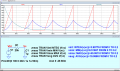
Help on Low Pass Circuit with Periodic Ramp Input

Thread Starter

Vihaan@123

Joined Oct 7, 2025
220
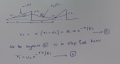
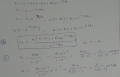
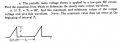
I am struck with another circuit i have few clarifications please help me to solve it.
1766116943408.png

1766117026441.png

1766119047006.png

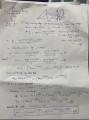
For equation 5 there is some mistake which does not depend on V1 the initial voltage. How do i solve it? Alpha = V/T1;
 

WBahn

Joined Mar 31, 2012
32,703
Just like your other problem, you are looking for the behavior in steady state. Solve it using the same process.
 

MrAl

Joined Jun 17, 2014
13,667
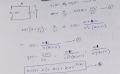
I am struck with another circuit i have few clarifications please help me to solve it.
View attachment 360779

View attachment 360780

View attachment 360782

For equation 5 there is some mistake which does not depend on V1 the initial voltage. How do i solve it? Alpha = V/T1;
Hello,

I take it that the input waveform goes from 0 volts to V volts. 0v is the lowest input and V is the highest input.
They did not label the 0v on the waveform diagram but it's probably 0v when they don't show it.
 

Thread Starter

Vihaan@123

Joined Oct 7, 2025
220
How do i create the above waveform in Ltspice i was able to create the ramp but not the above waveform to verify the result.
 

MrAl

Joined Jun 17, 2014
13,667
How do i create the above waveform in Ltspice i was able to create the ramp but not the above waveform to verify the result.
Hello again,

I am sorry to say, your result does not look right yet. It is probably because you are missing one detail and that is that the lowest part of the ramp does not coincide with the rise of the ramp. After some time, when the ramp goes up again the initial part of the ramp is still lower than the final value of the cap voltage, and so the cap keeps discharging for a time less than T1. This is what they hinted about in the problem description when they said the lowest part is not at the beginning of the ramp.

To find the lowest point, you might have to solve for the minimum value once you get the right time domain equation for the ramp time T1. To do that we usually take the time derivative and set it equal to zero, but you might find another way. Before you can do that though you have to have the right time domain solutions for both the ramp section during T1 and for the discharge section T2.

Here's my suggestion to make this simpler.
First, find the Laplace of the ramp convolved with the filter transfer function call that L1.
Second, find the Laplace of the initial voltage of the cap convolved with the reverse filter transfer function.
Then, add the two. That gives you the Laplace of the portion during T1.
The portion during T2 I am pretty sure you can figure out.

That gives you the capacitor voltage functions, then you can go on to find the steady state solution and then solve for the true minimum value. The maximum value is simpler to find.

If this seems too complicated, then start by solving for the response with a pulse like you did with the high pass filter problem. That will help figure out how to handle the ramp because the ramp is just a different Laplace function.

The solutions for the max and min values are very, very roughly, 0.4v and 0.15v respectively. That rough value 0.15v is less than the cap voltage when the ramp first starts to rise, so it is less than the initial cap voltage at that time which is what they told us. You can't use those two values though they could be as much as 20 percent off as I didn't want to just blurt out the solutions just yet.

I did a quick check by calculating the response cycle by cycle again and all of the values settle after just a few cycles.

Working with LT Spice you set the values for the ramp part, and that includes the zero voltage part, so it's just one source. For example if T1=1 second then the rise time is 1 second.
 
Last edited:

WBahn

Joined Mar 31, 2012
32,703
How do i create the above waveform in Ltspice i was able to create the ramp but not the above waveform to verify the result.
You use the PWL function, define the endpoints of each segment over one cycle, and then put those in a FOREVER REPEAT ( ) ENDREPEAT clause.

Though, in this case, you can use a PULSE function with a slow rise time, extremely short dwell time, and extremely short fall time.
 
Last edited:

ericgibbs

Joined Jan 29, 2010
21,390
hi V123,
Is this the type of waveform you are trying to simulate?
Note: The Tconst is calculated using my Voltage, & R/C values, you must use your values
E

.model IdealD2 D(Is=1e-14 Cjo=.1pF Rs=.1m N=0.01)

EG 1911.png
 

Attachments

Thread Starter

Vihaan@123

Joined Oct 7, 2025
220
Hello again,

I am sorry to say, your result does not look right yet. It is probably because you are missing one detail and that is that the lowest part of the ramp does not coincide with the rise of the ramp. After some time, when the ramp goes up again the initial part of the ramp is still lower than the final value of the cap voltage, and so the cap keeps discharging for a time less than T1. This is what they hinted about in the problem description when they said the lowest part is not at the beginning of the ramp.
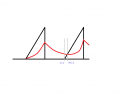
1766251586758.png
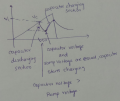
now is my understanding correct?
 

MrAl

Joined Jun 17, 2014
13,667
View attachment 360884
now is my understanding correct?
Hi,

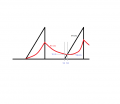
More like this...
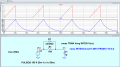
You can see at the time where Vc0 is shown the ramp voltage (black) is still beneath the cap voltage (red) so the cap is still discharging.
Once the ramp becomes equal to the cap voltage it will then start to charge the cap again. Since that is also the intersection of the ramp and the cap voltage, you can use that idea to solve for the min too.
Note that the labels Vc0 and Vmin are where the time points are, the voltages themselves are clearly above the zero line.

RampPulsed-04.png
 
Last edited:

Thread Starter

Vihaan@123

Joined Oct 7, 2025
220
It is very challenging for me to solve the problem, the things which i have to figure out
a. in case of low pass filter if i apply a pwm signal during the step fall i use the equation
Vo = Vf+(Vi-Vf)e-t/tau; and the voltage during the OFF condition will be Vfinal either 0V or -5V etc, here how do i figure out the Vf (vfinal) during the step fall after ramp up?
b. the discharge equation to be updated, where the initial capacitor voltage is greater than the power source
c. The ramp equation in case it is not starting from 0 and with initial value Vmin.
 

WBahn

Joined Mar 31, 2012
32,703
It is very challenging for me to solve the problem, the things which i have to figure out
a. in case of low pass filter if i apply a pwm signal during the step fall i use the equation
Vo = Vf+(Vi-Vf)e-t/tau; and the voltage during the OFF condition will be Vfinal either 0V or -5V etc, here how do i figure out the Vf (vfinal) during the step fall after ramp up?
b. the discharge equation to be updated, where the initial capacitor voltage is greater than the power source
c. The ramp equation in case it is not starting from 0 and with initial value Vmin.
The circuit is linear, right? Which means that you can solve for the total response, transient and steady state, using Laplace Transforms. Then just consider the steady-state portion of the solution.
 

MrAl

Joined Jun 17, 2014
13,667
It is very challenging for me to solve the problem, the things which i have to figure out
a. in case of low pass filter if i apply a pwm signal during the step fall i use the equation
Vo = Vf+(Vi-Vf)e-t/tau; and the voltage during the OFF condition will be Vfinal either 0V or -5V etc, here how do i figure out the Vf (vfinal) during the step fall after ramp up?
b. the discharge equation to be updated, where the initial capacitor voltage is greater than the power source
c. The ramp equation in case it is not starting from 0 and with initial value Vmin.
Hi,

(see attachment)

I am not sure how much of the solution you want me to tell you, and I am not sure how you encountered this circuit.
I'm not sure but did we ask if this was really homework yet or if you are just studying on your own?

First, I think I told you that the time of the initial value for the cap voltage just before the ramp is not the same time that Vmin occurs.
What do you already know?
Starting from the very first cycle, you can calculate the first cap voltage rise and then the final value which coincides with the end of the ramp, then the discharge which starts at the end of the ramp, and as that progresses in time that waveform (that you already know the function for) eventually crosses the next ramp voltage (ramping up from 0v even though the cap voltage is not 0v). Since you know the time of the falling cap voltage and the cap voltage for the entire fall, and you know the ramp voltage from the start of the next ramp (time T2 after T1) you should be able to calculate the point of intersection both in time and voltage value. The point of intersection in time will be the time of the Vmin, and the Vmin is then just that voltage where they both cross (see the previous waveform diagram).

Take this one step at a time. First develop the functions for the very first rise of the cap voltage, and then for the fall without paying attention to the intersection just yet. Make sure they look right, then equate the function for the falling cap voltage Fc(t) and the next ramp voltage Fr(t) and calculate the time:
Fc(t)=Fr(t)
and from that you get 't' the time of the intersection.
You can then use that in either Fc(t) or Fr(t) to get the cap voltage which is the minimum voltage.

You can observe that it is the min voltage because once the cap voltage and ramp voltage become equal, the ramp voltage is again capable of charging the cap again, so the cap voltage starts rising again. With the cap voltage falling just before that and now the cap voltage rising again, the min must be that intersection voltage.

As the cycles progress, this voltage can change slightly because the initial cap voltage changes. On the first rise the initial cap voltage is 0v but on the second rise (of the ramp) the initial cap voltage is slightly higher, and this may get a little higher with the next full cycle.

To get a good feel for what is happening, you really should do a cycle by cycle calculation first, for maybe a few full cycles. This will give you the intuition to figure out what to do next to get the ultimate final values.

Also, note that if you start the first ramp at t=0, then in the diagram t1=T1+T2 for the start of the second ramp.

RampPulsed-05.png
 
Last edited:

WBahn

Joined Mar 31, 2012
32,703
You know equation 6 is wrong. Both of the exponentials in it are growing in time without bound.

First things first. What is the Laplace transform of the input signal?

As I said in the thread for your other problem, trying to find the steady-state response by walking cycle-by-cycle through the transient response is not a very good approach. How do you know when you've reached steady state? What if it takes the system several hundred cycles to reach it?
 

Thread Starter

Vihaan@123

Joined Oct 7, 2025
220
You know equation 6 is wrong. Both of the exponentials in it are growing in time without bound.

First things first. What is the Laplace transform of the input signal?

As I said in the thread for your other problem, trying to find the steady-state response by walking cycle-by-cycle through the transient response is not a very good approach. How do you know when you've reached steady state? What if it takes the system several hundred cycles to reach it?
Yes equation 6 was wrong i need to look into that equation again. Laplace transform of the ramp signal Vi(t) = alpha * t;
is V(s) = alpha/s^2 that is what i used but may be i have messed it between the equations, i will verify again.

The biggest problem with the question is there are no R,C and other values are not provided, i will consider them and try to attempt the solution in steady state.
 

WBahn

Joined Mar 31, 2012
32,703
Yes equation 6 was wrong i need to look into that equation again. Laplace transform of the ramp signal Vi(t) = alpha * t;
is V(s) = alpha/s^2 that is what i used but may be i have messed it between the equations, i will verify again.

The biggest problem with the question is there are no R,C and other values are not provided, i will consider them and try to attempt the solution in steady state.
No, alpha*t is a linear ramp that never stops going up -- which is why your capacitor voltage grows without bound. But, even then, it should go up linearly, not expoentially.

You need to get the transform of the input right before there is any point going any further. If that's not correct, then any work you do after that is wasted effort the is guaranteed to yield a wrong answer.

Before you can get the transform correct, you need to get the time domain equation correct.

Go back to basics when you first learned transform methods. Think step functions and impulse functions to turn things on and off and to make step changes.
 

MrAl

Joined Jun 17, 2014
13,667
View attachment 360962
View attachment 360963

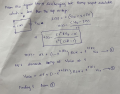
I could not complete the solution too much complicated equations.
Hi,

What I would recommend here is that you substitute some normalized values and rework it that way so you can get a feel for how the circuit works first, then go back to all variables.
For example, you can either start by:
1. Recognize that RC=T1, then substitute and go from there. This problem states that anyway. Then t=T1 (or T2 because T2=T1 for this) also.
2. Just supply some normal values like T1=1 and RC=1 and go from there. There is nothing wrong with doing this for a temporary solution and then you can gain a lot of insight as to how it works with any T1 or RC.
Once you get going like this you may find it a lot easier.

You may have done this already: It also helps to get the expressions for the very first cycle (a ramp for T1 and then zero for T2) as that will be the same for every cycle just with different initial cap voltages (Vc0).

I have to recommend using math software as that makes things a lot simpler.
 
Top