Help needed - wye to delta

Thread Starter

Phycho_cat

Joined Aug 23, 2024
26
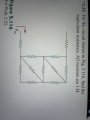
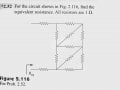
Hello!!!'m a first-year electrical engineering student, and today I came across this question. I wanted to use the wye to delta transformation to solve it, but I'm having a hard time visualizing the simplified circuit. How should I know which resistors to choose for the transformation, and where should I place the transformed resistors?Any guidance would be greatly appreciated.
 

Attachments

Ramussons

Joined May 3, 2013
1,567
In this circuit, you will need to do both S-D and D-S one after the other ( or first D-S and then S-D).
I would do the D-S first because it is easier to visualise.
For D-S conversion, choose 3 resistors that form a Triangle D.
Imagine a Point at the Centre of that Triangle. That will be the common point of the converted Y.
The equivalant resistors will be a Star from the Corners of the original triangle to the centre point.
 

WBahn

Joined Mar 31, 2012
32,702
Let's set aside the transformations for a moment.

The first thing I would recommend is putting upper and lower bounds on what you know the answer must fall between. This will give you a check on whatever answer you finally get -- if it is outside of those bounds, then you know something is wrong and that you are not done yet. The tighter you can make those bounds, the better.

The trick is to note that anytime we remove a resistor from the network, the resistance goes up (or possibly stays the same). So, if we remove resistors to make the determination of Req (for the modified network) easier, we have an upper bound on the answer. Similarly, anytime we short out a resistor, the resistance can only go down (or possibly stays the same), So, if we short out resistors to make the determination of Req (for the modified network) easier, we have a lower bound on the answer.

Right off the bat, we can see that the smallest that Req can be is 2 Ω and that the largest it can possibly be is 4 Ω.

By replacing the middle vertical resistor with a short, we get a new lower bound of 2.8 Ω (almost by inspection). This actually also gives us a new upper bound. By replacing that short with a 1 Ω resistor, the most that the total resistance can possibly increase by would be 1 Ω, so the upper bound is now 3.8 Ω. If we had to come up with a best estimate of the total resistance at this point, we could split the difference and call it 3.3 Ω and know that we are within 0.5 Ω of the correct answer. If that's good enough for our purposes, then we are done.

To see if we can get a better upper bound, we can remove that middle vertical resistor and the diagonal resistor to it's right. This results in a very easy to find upper bound of 3 and 1/7 ohms (3.14 Ω).

So now we know that 2.8 Ω < Req < 3.14 Ω, with a best estimate of about 2.97 Ω ± 0.14 Ω.

That's a pretty decent set of bounds, and they can be determined in a small fraction of the time it took me to write this up. Basically, it says that if our answer is more than a tenth of an ohm away from three ohms, we are probably wrong.

So let's shift over to actually finding the Req for the network.

First, it's important to realize that wye-delta conversions are not the only way to go.

1724441503827.png

You could analyze the above circuit using either node analysis or mesh analysis. After combining low-hanging-fruit resistances, you have three nodes/meshes to deal with, so it's not that bad. Whatever resistance you get for this, you then just add 2 Ω to account for the remaining resistors.

If you want to do wye-delta conversions, you have a number of ways to do it, and while some might be better than others, none of them are wrong and they will all produce the same result. Outside of academic situations, I don't recall every using delta-wye conversions (which is not to say that there aren't engineers that use them every day in their work). Part of it is likely the kind of circuit design that I've done, and (somewhat as a result of that), whenever I've had a situation in which such conversions probably would have been a sensible way to go, I've automatically gone the route of doing nodal or mesh analysis because I don't have the delta-wye conversions internalized and would have to look them up (or rederive them, which isn't difficult).

This article might prove useful.

So take out a piece of paper and pick some possibilities and sketch out what the transformed network looks like. You might need to do a transform on the transformed network, but don't be afraid of that. Also, don't do any computations at this stage, just sketch the topology of the transformed networks. Also, don't forget that while the original network might scream out for you do identify a delta connection to convert to a wye connection, that there might well be a set of wye-connected resistors that, if converted to delta, might simplify things quite a bit. But if you fail to spot it, don't worry -- the worst thing that happens is that you don't save a bit of effort. After you've identified a few options, pick the one that you think will result in the least amount of effort and go for it.

As it turns out, doing the estimation I talked about first saved my bacon on this one. I made a simple, common, mental math mistake in working with fractions and ended up with a total resistance of 3.34 Ω. Had I not already established that the upper bound was 3.14 Ω, I would have had no reason not to accept this answer, as it seems perfectly reasonable. But, since it was outside my bounds, I knew something was wrong -- either my final answer, or possibly my upper bound calculation. So I reviewed my work by looking at whether the delta-wye conversions agreed when I left one connection floating and found that one of them didn't. So I looked at that conversion work and quickly spotted my mistake. Working the problem from that point forward, I got a result that was well within my bounds. That doesn't guarantee that it is correct, but if it is wrong, it's not wrong by much. Plus, in most cases, if you make the effort to put decent bounds on your work and get an answer that is within those bounds, you are likely to get substantial partial credit even if you make a mistake.
 
Last edited:

MrAl

Joined Jun 17, 2014
13,667
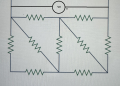
Here's the drawing cleaned up for easier reading.

The original drawing took over 3 megabytes to post. This one takes 84k a reduction of 36 to 1.
Most of the artifacts were removed but some were more resistant to the image processing algorithms.
 

Attachments

WBahn

Joined Mar 31, 2012
32,702
Here's the drawing cleaned up for easier reading.

The original drawing took over 3 megabytes to post. This one takes 84k a reduction of 36 to 1.
Most of the artifacts were removed but some were more resistant to the image processing algorithms.
That did do a nice job of cleaning it up, as well as reducing the size considerably. What tool(s) did you use to do that?
 

Thread Starter

Phycho_cat

Joined Aug 23, 2024
26
In this circuit, you will need to do both S-D and D-S one after the other ( or first D-S and then S-D).
I would do the D-S first because it is easier to visualise.
For D-S conversion, choose 3 resistors that form a Triangle D.
Imagine a Point at the Centre of that Triangle. That will be the common point of the converted Y.
The equivalant resistors will be a Star from the Corners of the original triangle to the centre point.
I just wanted to say a HUGE thank you for your detailed response to my question! Your explanation was incredibly generous and insightful. The technique you shared for finding the lower and upper bounds is genius! I’m definitely going to go over it a couple of times to make sure I fully understand it and can use it for more circuit problems in the future.

Thanks again for your help!
 

MrAl

Joined Jun 17, 2014
13,667
That did do a nice job of cleaning it up, as well as reducing the size considerably. What tool(s) did you use to do that?
Hello,

I used image processing algorithms that I had developed over the years. Unfortunately, I do not have any versions that I could publish, but when I think about it maybe I should create that kind of thing. I'd love to see these kinds of images clean up automatically and also help to reduce storage space on this website. The final image(s) I always check by eye though just to make sure nothing important got removed.
Some components include some simple techniques like rotation and size reduction and as simple as Jpeg quality setting. A lot of images I see are posted with such extreme dimensions like 4000x3000 or something, yet they are simple line drawings and the Jpeg quality is set at what appears to be a very high setting. When the image is that big, the quality setting can be much lower (even 30 percent vs 80 percent) and that reduces the file size by a very large amount. This only requires an image drawing program that allows setting the Jpeg quality factor which can vary from 1 to 100 percent (100 percent being no compression). When the amount of information is small (a small circuit diagram) the image can be reduced in size by at least 1/2 in many cases, which immediately reduces the number of pixels that have to be encoded by a factor of 1/4. That's a lot.

Lately I've been reading about the .webp file format which I think can provide images that are smaller than .jpg, but the rendering time is longer, maybe much longer, than .jpg, and another .avif that might even be better. I have not done too much with that though only the .webp format, but I have to say I don't really like the extra time to decode that format.
 

MrAl

Joined Jun 17, 2014
13,667
Hello!!!'m a first-year electrical engineering student, and today I came across this question. I wanted to use the wye to delta transformation to solve it, but I'm having a hard time visualizing the simplified circuit. How should I know which resistors to choose for the transformation, and where should I place the transformed resistors? Any guidance would be greatly appreciated.
Hello again,

After you do that, you might want to try using Wye to Delta transformations instead to reduce the network. You also have to combine parallel resistor combinations.
 

The Electrician

Joined Oct 9, 2007
2,986
Let's set aside the transformations for a moment.

The first thing I would recommend is putting upper and lower bounds on what you know the answer must fall between. This will give you a check on whatever answer you finally get -- if it is outside of those bounds, then you know something is wrong and that you are not done yet. The tighter you can make those bounds, the better.

The trick is to note that anytime we remove a resistor from the network, the resistance goes up (or possibly stays the same). So, if we remove resistors to make the determination of Req (for the modified network) easier, we have an upper bound on the answer. Similarly, anytime we short out a resistor, the resistance can only go down (or possibly stays the same), So, if we short out resistors to make the determination of Req (for the modified network) easier, we have a lower bound on the answer.

Right off the bat, we can see that the smallest that Req can be is 2 Ω and that the largest it can possibly be is 4 Ω.

By replacing the middle vertical resistor with a short, we get a new lower bound of 2.8 Ω (almost by inspection). This actually also gives us a new upper bound. By replacing that short with a 1 Ω resistor, the most that the total resistance can possibly increase by would be 1 Ω, so the upper bound is now 3.8 Ω. If we had to come up with a best estimate of the total resistance at this point, we could split the difference and call it 3.3 Ω and know that we are within 0.5 Ω of the correct answer. If that's good enough for our purposes, then we are done.

To see if we can get a better upper bound, we can remove that middle vertical resistor and the diagonal resistor to it's right. This results in a very easy to find upper bound of 3 and 1/7 ohms (3.14 Ω).

So now we know that 2.8 Ω < Req < 3.14 Ω, with a best estimate of about 2.97 Ω ± 0.14 Ω.

That's a pretty decent set of bounds, and they can be determined in a small fraction of the time it took me to write this up. Basically, it says that if our answer is more than a tenth of an ohm away from three ohms, we are probably wrong.

So let's shift over to actually finding the Req for the network.

First, it's important to realize that wye-delta conversions are not the only way to go.

View attachment 329928

You could analyze the above circuit using either node analysis or mesh analysis. After combining low-hanging-fruit resistances, you have three nodes/meshes to deal with, so it's not that bad. Whatever resistance you get for this, you then just add 2 Ω to account for the remaining resistors.

If you want to do wye-delta conversions, you have a number of ways to do it, and while some might be better than others, none of them are wrong and they will all produce the same result. Outside of academic situations, I don't recall every using delta-wye conversions (which is not to say that there aren't engineers that use them every day in their work). Part of it is likely the kind of circuit design that I've done, and (somewhat as a result of that), whenever I've had a situation in which such conversions probably would have been a sensible way to go, I've automatically gone the route of doing nodal or mesh analysis because I don't have the delta-wye conversions internalized and would have to look them up (or rederive them, which isn't difficult).

This article might prove useful.

So take out a piece of paper and pick some possibilities and sketch out what the transformed network looks like. You might need to do a transform on the transformed network, but don't be afraid of that. Also, don't do any computations at this stage, just sketch the topology of the transformed networks. Also, don't forget that while the original network might scream out for you do identify a delta connection to convert to a wye connection, that there might well be a set of wye-connected resistors that, if converted to delta, might simplify things quite a bit. But if you fail to spot it, don't worry -- the worst thing that happens is that you don't save a bit of effort. After you've identified a few options, pick the one that you think will result in the least amount of effort and go for it.

As it turns out, doing the estimation I talked about first saved my bacon on this one. I made a simple, common, mental math mistake in working with fractions and ended up with a total resistance of 3.34 Ω. Had I not already established that the upper bound was 3.14 Ω, I would have had no reason not to accept this answer, as it seems perfectly reasonable. But, since it was outside my bounds, I knew something was wrong -- either my final answer, or possibly my upper bound calculation. So I reviewed my work by looking at whether the delta-wye conversions agreed when I left one connection floating and found that one of them didn't. So I looked at that conversion work and quickly spotted my mistake. Working the problem from that point forward, I got a result that was well within my bounds. That doesn't guarantee that it is correct, but if it is wrong, it's not wrong by much. Plus, in most cases, if you make the effort to put decent bounds on your work and get an answer that is within those bounds, you are likely to get substantial partial credit even if you make a mistake.
WBahn said:
By replacing the middle vertical resistor with a short, we get a new lower bound of 2.8 Ω (almost by inspection).
I think this value should be 3.0 Ω.

Phycho_cat: did you get a result value?
 

WBahn

Joined Mar 31, 2012
32,702
I think this value should be 3.0 Ω.
You are correct -- thanks not only for catching it, but giving my work enough attention so that you could catch it. I don't have the scrap paper I scribbled things on, so I'm not sure where I made the mistake, but I'd be willing to bet it was in the "almost by inspection" part of it.

If I didn't make any mistakes elsewhere, that puts the bounds at 3.0 Ω < Req < 3.14 Ω with a best estimate of 3.07±0.07 Ω (±2.3%). In almost any practical situation, that would be good enough to go with.
 

MrAl

Joined Jun 17, 2014
13,667
You are correct -- thanks not only for catching it, but giving my work enough attention so that you could catch it. I don't have the scrap paper I scribbled things on, so I'm not sure where I made the mistake, but I'd be willing to bet it was in the "almost by inspection" part of it.

If I didn't make any mistakes elsewhere, that puts the bounds at 3.0 Ω < Req < 3.14 Ω with a best estimate of 3.07±0.07 Ω (±2.3%). In almost any practical situation, that would be good enough to go with.
That's pretty amazing because your central estimate is only off by less than 0.1 percent (that's one-tenth of 1 percent which is 10 times lower than 1 percent). That's close enough for everything except H bombs and Hand grenades :)
 

WBahn

Joined Mar 31, 2012
32,702
That's pretty amazing because your central estimate is only off by less than 0.1 percent (that's one-tenth of 1 percent which is 10 times lower than 1 percent). That's close enough for everything except H bombs and Hand grenades :)
I've generally found that if I can get my upper and lower bounds to be within about 10% of the midpoint, that the midpoint turns out to be a very good estimate of the answer. To some degree this makes sense, because if you get it down into that range, you are probably getting into the realm where the errors are quasilinear and many simplifications will move the value up about as far as other simplifications will move it down.
 
Top