Help needed with drawing an impedance locus (Z-Ortskurve) as a function of capacitance

Thread Starter

OhmNomNom

Joined Jul 20, 2025
1
Construct the locus (trajectory) of the complex impedance Zab for the given circuit as a function of the capacitance C in the range:

C = 11.46uF ... 34.37 uF.

Determine and plot the trajectory of Zab in the complex plane (Re/Im).

Also, read off and state the magnitude and phase angle of Zab for the following two values of capacitance:
  • C = 11.46 uF
  • C = 34.37 uF
Use the impedance locus diagram to extract these values.

Scale for drawing the impedance locus:
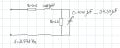
  • Impedance scale: 1 Ω = 5 cm
  • Admittance scale (optional): 200 mS = 1 cm


photo_2025-07-20 19.00.11.jpeg
 

Papabravo

Joined Feb 24, 2006
22,058
Can you elaborate on what kind of help you might need? Isn't it just a matter of computing a table of values, plotting the resulting points, and fitting a curve to the collection of points?

Why not start with the two endpoints? If you can correctly get those two values, the rest should be trivial.
 
Last edited:

WBahn

Joined Mar 31, 2012
32,704
So... what's your question? Or are you just expecting someone here to do your work for you and feed you the solutions so that you and turn it in and get credit for someone else's work?

You need to show YOUR best attempt to work your homework as far as you can and try to describe what is giving you trouble and preventing you from proceeding further. We can then look at what you've done and provide guidance to help you identify where you've gone wrong or what you might be missing to get you over your current hurdle.
 

Papabravo

Joined Feb 24, 2006
22,058
Can you confirm that the frequency of interest is:

\( 2,778\text{ MHz.} \;=\;2.778\times10^9\text{ Hz.} \)

Your symbol for the letter 'M' looks like a capital 'U' which is many orders of magnitude away from what I initially assumed.
 

MrAl

Joined Jun 17, 2014
13,667
So, can the TS confirm that the frequency of interest is in fact 2778 Hz?
It must be 2778Hz. It would make no sense to be 2778kHz and even less sense to be 2778MHz.
Not only that, 2778 plus an unknown character plus "z" means there are only two characters after the "2778" as written.
 

MrAl

Joined Jun 17, 2014
13,667
Hello,

The TS used a strange way to write the H in the given drawing.

Bertus
Hi there,

Yes, and I believe we can prove that from the circuit itself. If the frequency was too high it would result in an almost straight line for the response :)
If it was close to 3000Hz, it would be near a critical frequency.
Thus, I vote for 2778Hz :)

Unless of course it is a Russian "N" for nanohertz (ha ha).

What else is a little interesting is that the upper case Greek "Eta" looks like "H" which has either evolved from the backwards "N" or the backwards "N" evolved from it. So maybe it was just a confusion or something. This could also be just a weird coincidence too though.
 
Last edited:

Papabravo

Joined Feb 24, 2006
22,058
Hi there,

Yes, and I believe we can prove that from the circuit itself. If the frequency was too high it would result in an almost straight line for the response :)
If it was close to 3000Hz, it would be near a critical frequency.
Thus, I vote for 2778Hz :)

Unless of course it is a Russian "N" for nanohertz (ha ha).

What else is a little interesting is that the upper case Greek "Eta" looks like "H" which has either evolved from the backwards "N" or the backwards "N" evolved from it. So maybe it was just a confusion or something. This could also be just a weird coincidence too though.
In Russian, the backwards N is actually a "double e".

As in, Извините, pronounced as "eez-veen-eet-ye". It means "Excuse me".
 

MrAl

Joined Jun 17, 2014
13,667
In Russian, the backwards N is actually a "double e".

As in, Извините, pronounced as "eez-veen-eet-ye". It means "Excuse me".
Hi,

That's great, but I did read about other translations also that's why I mentioned that.
I did not try to type it either but I see you managed to do that.
 

Papabravo

Joined Feb 24, 2006
22,058
Hi,

That's great, but I did read about other translations also that's why I mentioned that.
I did not try to type it either but I see you managed to do that.
It is easy if you use online translation to get the word you want, then copy & paste with Ctrl-C & Ctrl-V
 
Top